
增强综合征性颅缝早闭中骨骼生长和颅面形态的预测工具:以颅底变量为重点
Enhancing Predictive Tools for Skeletal Growth and Craniofacial Morphology in Syndromic Craniosynostosis: A Focus on Cranial Base Variables.
作者信息
Zheng Lantian, Abdullah Norli Anida, Ramli Norlisah Mohd, Mohamed Nur Anisah, Hisam Mohamad Norikmal Fazli, Hariri Firdaus
机构信息
Department of Oral and Maxillofacial Clinical Sciences, Faculty of Dentistry, Universiti Malaya, Kuala Lumpur 50603, Malaysia.
Mathematics Division, Centre for Foundation Studies in Science, Universiti Malaya, Kuala Lumpur 50603, Malaysia.
出版信息
Diagnostics (Basel). 2025 Jun 27;15(13):1640. doi: 10.3390/diagnostics15131640.
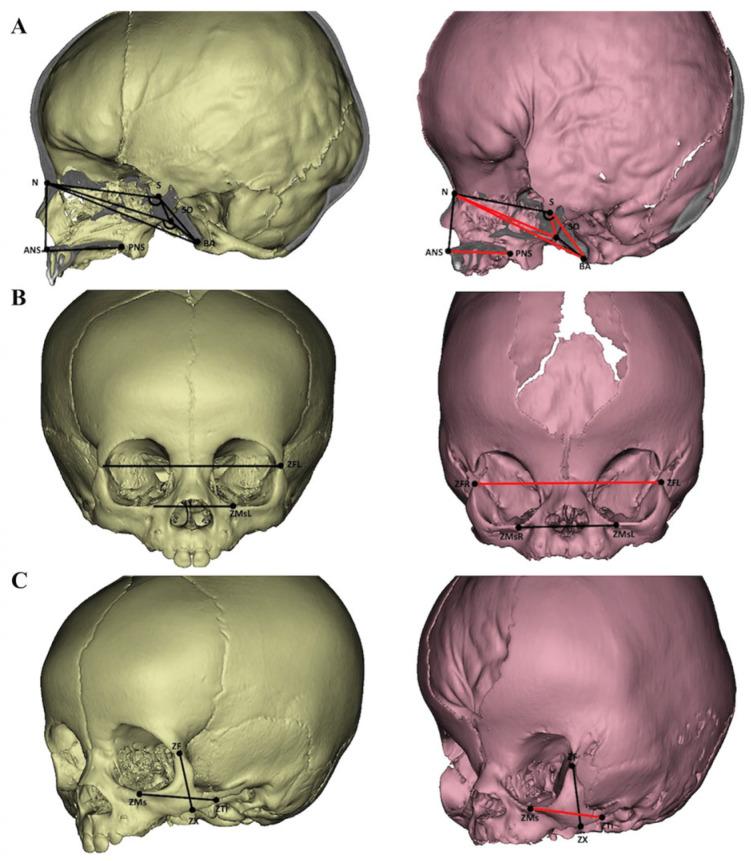
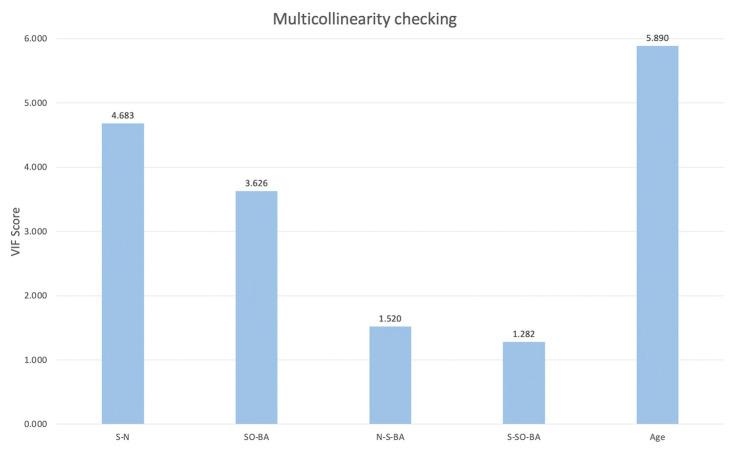
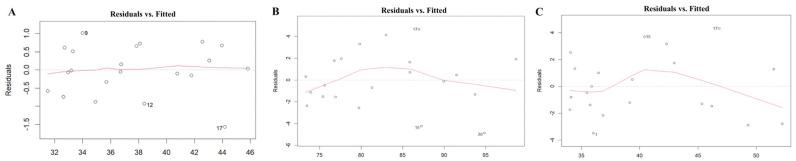
: Patients with syndromic craniosynostosis (SC) pose a significant challenge for post-operational outcomes due to the variability in craniofacial deformities and gain-of-function characteristics. This study aims to develop validated predictive tools using stable cranial base variables to predict changes in the midfacial region and explore the craniofacial morphology among patients with SC. : This study involved 17 SC patients under 12 years old, 17 age-matched controls for morphological analysis, and 21 normal children for developing craniofacial predictive models. A stable cranial base and changeable midfacial variables were analyzed using the Mann-Whitney U test. Pearson correlation identified linear relationships between the midface and cranial base variables. Multicollinearity was checked before fitting the data with multiple linear regression for growth prediction. Model adequacy was confirmed and the 3-fold cross-validation ensured results reliability. : Patients with SC exhibited a shortened cranial base, particularly in the middle cranial fossa (S-SO), and a sharper N-S-SO and N-SO-BA angle, indicating a downward rotation and kyphosis. The midface length (ANS-PNS) and zygomatic length (ZMs-ZTi) were significantly reduced, while the midface width (ZFL-ZFR) was increased. Regression models for the midface length, width, and zygomatic length were given as follows: ANS-PNS = 23.976 + 0.139 S-N + 0.545 SO-BA - 0.120 N-S-BA + 0.078 S-SO-BA + 0.051 age (R = 0.978, RMSE = 1.058); ZFL-ZFR = -15.618 + 0.666 S-N + 0.241 N-S-BA + 0.155 S-SO-BA + 0.121 age (R = 0.903, RMSE = 3.158); and ZMs-ZTi = -14.403 + 0.765 SO-BA + 0.266 N-S-BA + 0.111 age (R = 0.878, RMSE = 3.720), respectively. : The proposed models have potential applications for midfacial growth estimation in children with SC.
综合征性颅缝早闭(SC)患者由于颅面畸形和功能获得特征的变异性,给术后预后带来了重大挑战。本研究旨在开发经过验证的预测工具,利用稳定的颅底变量来预测面中部区域的变化,并探索SC患者的颅面形态。本研究纳入了17名12岁以下的SC患者、17名年龄匹配的对照者进行形态学分析,以及21名正常儿童来建立颅面预测模型。使用Mann-Whitney U检验分析稳定的颅底变量和可变的面中部变量。Pearson相关性分析确定了面中部与颅底变量之间的线性关系。在将数据拟合到多元线性回归以进行生长预测之前,检查了多重共线性。确认了模型的充分性,并通过3折交叉验证确保了结果的可靠性。SC患者表现出颅底缩短,尤其是在中颅窝(S-SO),以及更尖锐的N-S-SO和N-SO-BA角,表明向下旋转和脊柱后凸。面中部长度(ANS-PNS)和颧骨长度(ZMs-ZTi)显著缩短,而面中部宽度(ZFL-ZFR)增加。面中部长度、宽度和颧骨长度 的回归模型如下:ANS-PNS = 23.976 + 0.139 S-N + 0.545 SO-BA - 0.120 N-S-BA + 0.078 S-SO-BA + 0 .051年龄(R = 0.978,RMSE = 1.058);ZFL-ZFR = -15.618 + 0.666 S-N + 0.241 N-S-BA + 0.155 S-SO-BA + 0.121年龄(R = 0.903,RMSE = 3.158);ZMs-ZTi = -l4.403 + 0.765 SO-BA + 0.266 N-S-BA + 0.111年龄(R = 0.878,RMSE = 3.720)。所提出的模型在估计SC儿童的面中部生长方面具有潜在应用价值。


 Zotero 插件