Sonaglioni Andrea, Napoli Federico, Dell'Anna Rebecca, Nicolosi Gian Luigi, Bianchi Stefano, Lombardo Michele, Harari Sergio, Lonati Chiara
Division of Cardiology, IRCCS MultiMedica, 20138 Milan, Italy.
Division of Internal Medicine, IRCCS MultiMedica, 20138 Milan, Italy.
J Clin Med. 2025 Jul 5;14(13):4767. doi: 10.3390/jcm14134767.
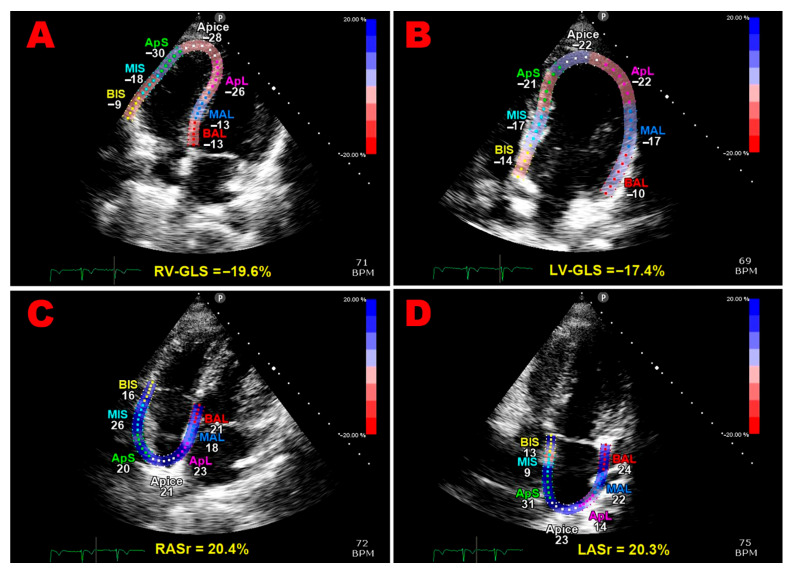
Over the past decade, few echocardiographic investigations have assessed myocardial strain parameters in women with a history of hypertensive disorders of pregnancy (HDP), and their findings have been inconsistent. Moreover, no study has comprehensively evaluated deformation indices of all biventricular and biatrial chambers in women post-HDP. This study aimed to examine the structural and functional myocardial properties of all cardiac chambers in a cohort of women with prior HDP at six years after delivery. We analyzed a consecutive cohort of women with previous HDP and compared them with a control group of normotensive healthy women matched for age and body mass index (BMI). Both groups underwent standard transthoracic echocardiography (TTE) supplemented by a detailed speckle tracking echocardiography (STE) evaluation of biventricular and biatrial myocardial deformation, along with carotid ultrasound, at six years postpartum. The primary endpoint was subclinical myocardial dysfunction, defined by impaired left ventricular global longitudinal strain (LV-GLS < 20%), while the secondary endpoint was early carotid atherosclerosis, defined by common carotid artery intima-media thickness (CCA-IMT) ≥ 0.7 mm. The study included 31 women with previous HDP (mean age 42.3 ± 5.9 years) and 30 matched controls without HDP history (mean age 40.8 ± 5.0 years). The average follow-up duration was 6.1 ± 1.3 years postpartum. Despite preserved and comparable systolic function on conventional TTE, most myocardial strain and strain rate measures in both ventricles and atria were significantly reduced in the HDP group compared to controls. Subclinical myocardial dysfunction was detected in 58.1% of women with prior HDP, and 67.7% exhibited increased CCA-IMT (≥0.7 mm). A history of pre-eclampsia (PE) was independently associated with subclinical myocardial dysfunction (HR 4.01, 95% CI 1.05-15.3, = 0.03). Both third-trimester BMI (HR 1.21, 95% CI 1.07-1.38, = 0.003) and PE (HR 6.38, 95% CI 1.50-27.2, = 0.01) independently predicted early carotid atherosclerosis. Notably, a third-trimester BMI above 27 kg/m showed optimal sensitivity and specificity for identifying the secondary outcome. A history of PE is independently associated with a higher risk of subclinical myocardial dysfunction and early carotid atherosclerosis at six years postpartum.
在过去十年中,很少有超声心动图研究评估有妊娠高血压疾病(HDP)病史女性的心肌应变参数,其研究结果也不一致。此外,尚无研究全面评估HDP后女性所有双心室和双心房腔室的变形指标。本研究旨在检查一组有既往HDP病史的女性在产后六年时所有心腔的心肌结构和功能特性。我们分析了一组连续的有既往HDP病史的女性,并将她们与年龄和体重指数(BMI)相匹配的血压正常的健康女性对照组进行比较。两组在产后六年时均接受了标准经胸超声心动图(TTE)检查,并辅以对双心室和双心房心肌变形的详细斑点追踪超声心动图(STE)评估,以及颈动脉超声检查。主要终点是亚临床心肌功能障碍,定义为左心室整体纵向应变受损(LV-GLS<20%),次要终点是早期颈动脉粥样硬化,定义为颈总动脉内膜中层厚度(CCA-IMT)≥0.7mm。该研究纳入了31名有既往HDP病史的女性(平均年龄42.3±5.9岁)和30名无HDP病史的匹配对照组女性(平均年龄40.8±5.0岁)。平均随访时间为产后6.1±共1.3年。尽管在传统TTE上收缩功能保持且相当,但与对照组相比,HDP组双心室和双心房的大多数心肌应变和应变率测量值均显著降低。在有既往HDP病史的女性中,58.1%检测到亚临床心肌功能障碍,67.7%表现为CCA-IMT增加(≥0.7mm)。子痫前期(PE)病史与亚临床心肌功能障碍独立相关(HR 4.01,95%CI 1.05-共15.3,P=0.03)。孕晚期BMI(HR 1.21,95%CI 1.07-1.38,P=0.003)和PE(HR 6.38,95%CI 1.50-27.2,P=0.01)均独立预测早期颈动脉粥样硬化。值得注意 的是,孕晚期BMI高于27kg/m²对识别次要结局具有最佳的敏感性和特异性。PE病史与产后六年时亚临床心肌功能障碍和早期颈动脉粥样硬化的较高风险独立相关。