Tschöpe Carsten, Elsanhoury Ahmed, Kristen Arnt V
Department of Cardiology, Angiology, and Intensive Medicine (CVK), German Heart Center at Charité (DHZC), Charité-University Medicine Berlin, 13353 Berlin, Germany.
Berlin Institute of Health (BIH), Center for Regenerative Therapies (BCRT), Charité-University Medicine Berlin, 13353 Berlin, Germany.
J Clin Med. 2025 Jul 7;14(13):4785. doi: 10.3390/jcm14134785.
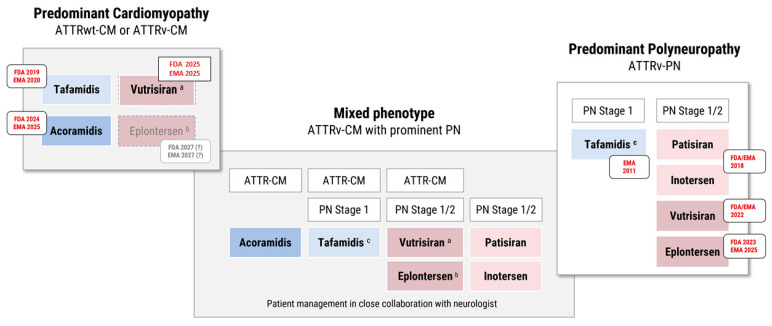
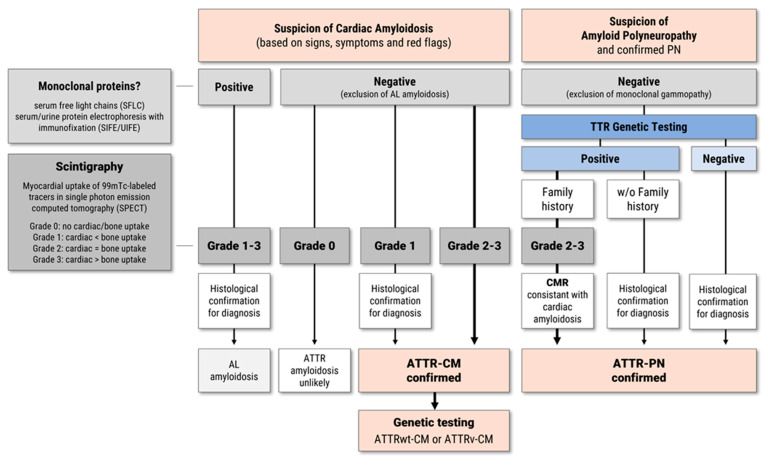
Transthyretin-related (ATTR) amyloidosis is a progressive, multisystem disease caused by the extracellular deposition of misfolded transthyretin (TTR) monomers as insoluble amyloid fibrils. Clinical manifestations vary widely and may include cardiomyopathy (ATTR-CM), polyneuropathy (ATTR-PN), or mixed phenotypes. The condition is increasingly recognized as an underdiagnosed contributor to heart failure, particularly in elderly patients. ATTR amyloidosis exists in two major forms: hereditary (ATTRv), resulting from mutations in the TTR gene, and wild-type (ATTRwt), typically affecting men over 70 years of age. Advances in disease understanding have led to a paradigm shift in management, with the introduction of targeted therapies that slow disease progression and improve prognosis. First-generation therapies such as tafamidis have demonstrated survival benefits in ATTR-CM. More recently, second-generation agents-such as the TTR stabilizer acoramidis and RNA silencers including vutrisiran and eplontersen-have shown promising efficacy in clinical trials. Additional strategies under investigation include gene editing and monoclonal antibodies targeting TTR amyloid deposits. This review outlines current diagnostic strategies and therapeutic options for ATTR amyloidosis, emphasizing the need for early detection and individualized treatment approaches. The expanding therapeutic landscape highlights the importance of accurate phenotyping and timely intervention to optimize clinical outcomes.
转甲状腺素蛋白相关(ATTR)淀粉样变性是一种进行性多系统疾病,由错误折叠的转甲状腺素蛋白(TTR)单体以不溶性淀粉样纤维的形式在细胞外沉积所致。临床表现差异很大,可能包括心肌病(ATTR-CM)、多发性神经病(ATTR-PN)或混合表型。该疾病越来越被认为是心力衰竭的一个诊断不足的原因,尤其是在老年患者中。ATTR淀粉样变性主要有两种形式:遗传性(ATTRv),由TTR基因突变引起;野生型(ATTRwt),通常影响70岁以上的男性。对疾病认识的进展导致了管理模式的转变,引入了能减缓疾病进展并改善预后的靶向治疗。第一代治疗药物如他氟米特已在ATTR-CM中显示出生存获益。最近,第二代药物,如TTR稳定剂阿考米特以及包括伏硫西汀和依洛特森在内的RNA沉默剂,在临床试验中显示出了有前景的疗效。正在研究的其他策略包括基因编辑和靶向TTR淀粉样沉积物的单克隆抗体。本综述概述了ATTR淀粉样变性的当前诊断策略和治疗选择,强调了早期检测和个体化治疗方法的必要性。不断扩大的治疗前景凸显了准确分型和及时干预以优化临床结局的重要性。