Moro Andrea Stefano, Balestrucci Chiara, Cozzi Anna, Santambrogio Paolo, Levi Sonia
Faculty of Medicine, Vita-Salute San Raffaele University, 20132 Milan, Italy.
Division of Neuroscience, IRCCS San Raffaele Scientific Institute, 20132 Milan, Italy.
Int J Mol Sci. 2025 Jun 27;26(13):6197. doi: 10.3390/ijms26136197.
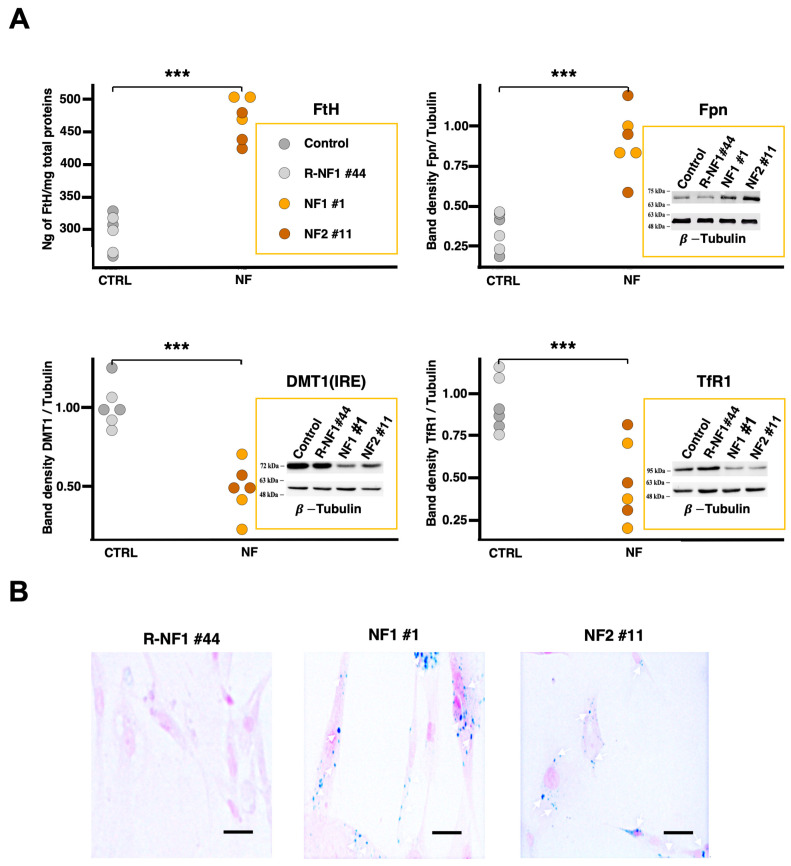
Increased iron levels, common in neurodegenerative diseases, correlate with disease severity, suggesting a role in the pathological process. Recently, efforts have been made to understand the role of iron in cerebral inflammatory processes. Employing astrocyte cell models of genetic neurodegenerative pathologies characterized by iron imbalance, such as the neurodegeneration with brain iron accumulation disorders, can provide valuable insights into astrocytes reactivity, a pivotal process in brain inflammation. Specifically, we employed human-induced pluripotent stem cell-derived astrocytes from Neuroferritinopathy, where iron accumulation is primary. After confirming iron accumulation and the deregulation of proteins involved in iron management, we observed that at 35 days since the beginning of differentiation, the elevated iron levels not only trigger ferroptosis but also place the astrocytes in a reactive state. This is evident in the higher extracellular concentrations of IL-6, IL-1β, and glutamate, along with changes in morphology, genes, and proteins involved in astrocyte reactivity. Interestingly, by day 60, IL-6 and IL-1β levels drop below those of the controls, and we observe a reversal in most of the factors considered. Moreover, at day 60, it is possible to observe not only increased senescence but also ferroptosis. These findings demonstrate that iron plays a primary role in inducing astrocyte reactivity.
铁水平升高在神经退行性疾病中很常见,与疾病严重程度相关,表明其在病理过程中发挥作用。最近,人们致力于了解铁在脑部炎症过程中的作用。利用以铁失衡为特征的遗传性神经退行性病变的星形胶质细胞模型,如脑铁沉积障碍所致神经退行性变,能够为星形胶质细胞反应性提供有价值的见解,而星形胶质细胞反应性是脑部炎症的关键过程。具体而言,我们使用了来自神经铁蛋白病的人诱导多能干细胞衍生的星形胶质细胞,其中铁积累是主要特征。在确认铁积累以及参与铁管理的蛋白质失调后,我们观察到在分化开始后的35天,升高的铁水平不仅引发铁死亡,还使星形胶质细胞处于反应性状态。这在细胞外较高浓度的白细胞介素-6、白细胞介素-1β和谷氨酸中很明显,同时伴随着星形胶质细胞反应性相关的形态、基因和蛋白质变化。有趣的是,到第60天,白细胞介素-6和白细胞介素-1β水平降至对照组以下,并且我们观察到大多数所考虑的因素出现逆转。此外,在第60天,不仅可以观察到衰老增加,还能观察到铁死亡。这些发现表明铁在诱导星形胶质细胞反应性中起主要作用。