Bottaro Adele, Nasso Maria Elisa, Stagno Fabio, Fazio Manlio, Allegra Alessandro
Division of Hematology, Department of Human Pathology in Adulthood and Childhood "Gaetano Barresi", University of Messina, via Consolare Valeria, 98125 Messina, Italy.
Int J Mol Sci. 2025 Jun 27;26(13):6229. doi: 10.3390/ijms26136229.
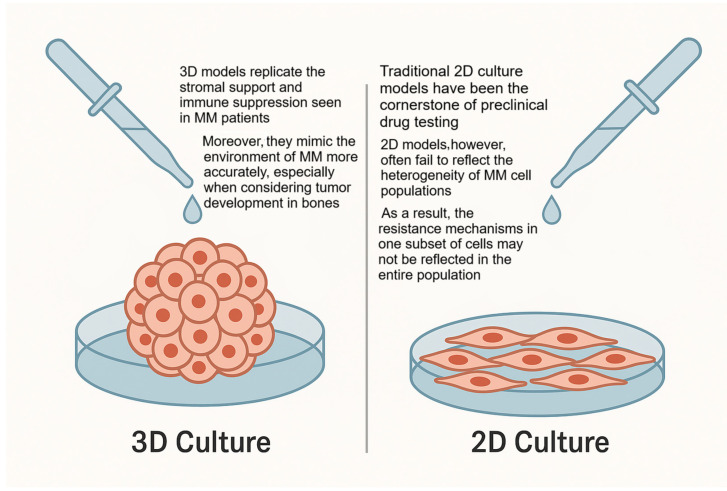
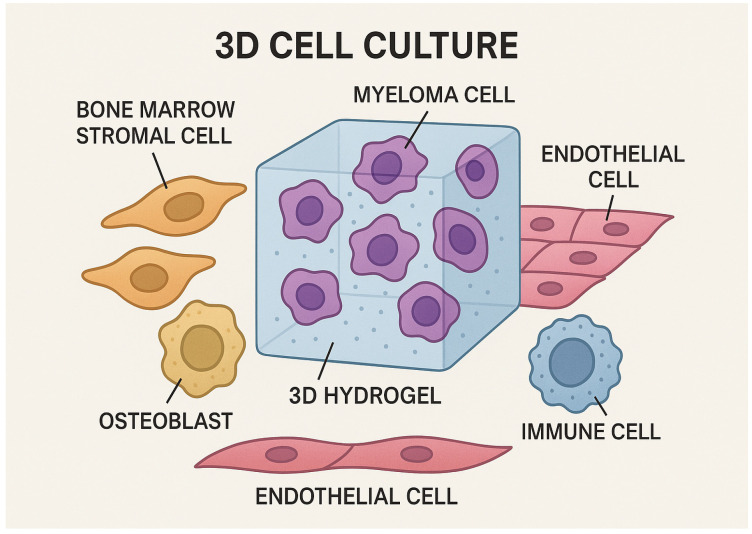
Multiple myeloma is a hematologic malignancy characterized by the clonal proliferation of plasma cells within the bone marrow. The tumor microenvironment plays a crucial role in multiple myeloma pathogenesis, progression, and drug resistance. Traditional two-dimensional cell culture models have been instrumental in multiple myeloma research. However, they fail to recapitulate the complex in vivo bone marrow microenvironment, leading to limited predictive value for clinical outcomes. Three-dimensional cell culture models emerged as more physiologically relevant systems, offering enhanced insights into multiple myeloma biology. Scaffold-based systems (e.g., hydrogels, collagen, and Matrigel), scaffold-free spheroids, and bioprinted models have been developed to simulate the bone marrow microenvironment, incorporating key components like mesenchymal stromal cells, osteoblasts, endothelial cells, and immune cells. These models enable the functional assessment of cell adhesion-mediated drug resistance, cytokine signaling networks, and hypoxia-induced adaptations, which are often lost in 2D cultures. Moreover, 3D platforms demonstrated improved predictive value in preclinical drug screening, facilitating the evaluation of novel agents and combination therapies in a setting that better mimics the in vivo tumor context. Hence, 3D cultures represent a pivotal step toward bridging the gap between basic myeloma research and translational applications, supporting the development of more effective and patient-specific therapies.
多发性骨髓瘤是一种血液系统恶性肿瘤,其特征在于骨髓内浆细胞的克隆性增殖。肿瘤微环境在多发性骨髓瘤的发病机制、进展和耐药性中起着关键作用。传统的二维细胞培养模型在多发性骨髓瘤研究中发挥了重要作用。然而,它们无法重现体内复杂的骨髓微环境,导致对临床结果的预测价值有限。三维细胞培养模型作为更具生理相关性的系统出现,为深入了解多发性骨髓瘤生物学提供了更多见解。基于支架的系统(如水凝胶、胶原蛋白和基质胶)、无支架球体和生物打印模型已被开发出来,以模拟骨髓微环境,纳入间充质基质细胞、成骨细胞、内皮细胞和免疫细胞等关键成分。这些模型能够对细胞黏附介导的耐药性、细胞因子信号网络和缺氧诱导的适应性进行功能评估,而这些在二维培养中往往会丧失。此外,三维平台在临床前药物筛选中显示出更高的预测价值,有助于在更能模拟体内肿瘤环境的条件下评估新型药物和联合疗法。因此,三维培养代表了弥合基础骨髓瘤研究与转化应用之间差距的关键一步,支持开发更有效和针对患者的疗法。