Beau Alice, Natividad Jane, Benoit Berengère, Delerive Philippe, Duboux Stéphane, Feng Yuan, Jammes Marie, Barnel Cecile, Sequino Giuseppina, Pinteur Claudie, Glorieux Griet, Fouque Denis, Vidal Hubert, Koppe Laetitia
CarMeN Laboratory, INSERM, INRAE, Claude Bernard Lyon 1 Université, Pierre-Bénite, France.
Nestle Health Science, Lausanne, Switzerland.
Gut Microbes. 2025 Dec;17(1):2531202. doi: 10.1080/19490976.2025.2531202. Epub 2025 Jul 12.
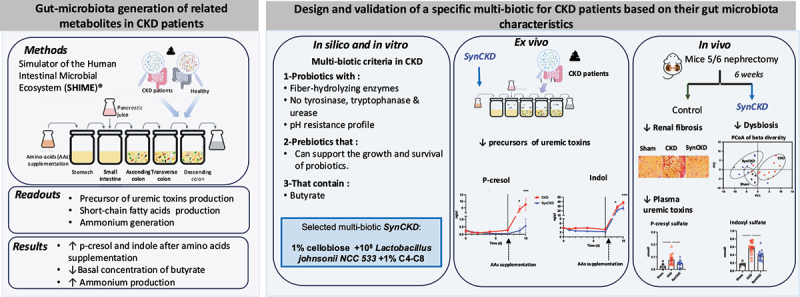
Chronic kidney disease (CKD) is characterized by accumulation of uremic toxins (UTs), such as p-cresyl sulfate and indoxyl sulfate, generated through the transformation of tyrosine and tryptophan by the gut microbiota. Using an Simulator of the Human Intestinal Microbial Ecosystem (SHIME) colonized with fecal samples from eight CKD patients or nine healthy volunteers, a higher bacterial generation of p-cresol and indoles post-amino acid enrichment, as well lower basal butyrate levels, in the feces of CKD patients were found. Through data mining, we selected a probiotic strain lacking the capacity to produce UT, i.e. without genes for tryptophanase, tyrosinase and urease. , we confirmed the potential of cellobiose as a prebiotic supporting the growth of this strain. We further designed a novel specific multi-biotic for CKD (SynCKD) [containing a probiotic , a prebiotic (1% cellobiose), and a postbiotic (1% short and medium chain triglycerides C4-C8, a source of butyrate)]. SynCKD effectively curtailed UT precursor generation . The efficacy of SynCKD (and the synergic effect) was established in two uremic rodent models, demonstrating lower plasma levels of UTs and enhancing kidney function after 6-8 weeks of treatment. These effects were linked to better gut microbial ecology. Metagenomic analysis revealed reduced microbial genes for tryptophan/tyrosine degradation. This study lays the foundation for SynCKD as a potential therapy to mitigate CKD progression.
慢性肾脏病(CKD)的特征是尿毒症毒素(UTs)的积累,如对甲酚硫酸盐和吲哚硫酸盐,这些毒素是由肠道微生物群对酪氨酸和色氨酸进行转化而产生的。使用接种了8名CKD患者或9名健康志愿者粪便样本的人体肠道微生物生态系统模拟器(SHIME),发现CKD患者粪便中氨基酸富集后对甲酚和吲哚的细菌生成量更高,同时基础丁酸盐水平更低。通过数据挖掘,我们选择了一种缺乏产生UT能力的益生菌菌株,即没有色氨酸酶、酪氨酸酶和脲酶基因的菌株。此外,我们证实了纤维二糖作为益生元支持该菌株生长的潜力。我们进一步设计了一种新型的CKD特异性复合益生菌(SynCKD)[包含一种益生菌、一种益生元(1%纤维二糖)和一种后生元(1%短链和中链甘油三酯C4-C8,丁酸盐来源)]。SynCKD有效地减少了UT前体的产生。SynCKD的疗效(以及协同作用)在两种尿毒症啮齿动物模型中得到证实,表明治疗6-8周后血浆UT水平降低,肾功能增强。这些作用与更好的肠道微生物生态有关。宏基因组分析显示,色氨酸/酪氨酸降解的微生物基因减少。本研究为SynCKD作为减轻CKD进展的潜在疗法奠定了基础。