Ma Tianyu, Liao Chunyan, Chen Wenhui, Feng Jia
School of Medicine, Jinan University, Guangzhou, Guangdong, 510630, People's Republic of China.
Department of Anesthesia and Surgery Center, The First Affiliated Hospital of Jinan University, Guangzhou, People's Republic of China.
Nat Sci Sleep. 2025 Jul 8;17:1571-1585. doi: 10.2147/NSS.S511115. eCollection 2025.
Obstructive sleep apnea (OSA) is linked to metabolic dysfunction-associated fatty liver disease (MAFLD), yet their exact causality and underlying mechanisms remain inconclusive. We aimed to investigate their causal associations and shared biomarkers using Mendelian randomization (MR) and bioinformatics approaches.
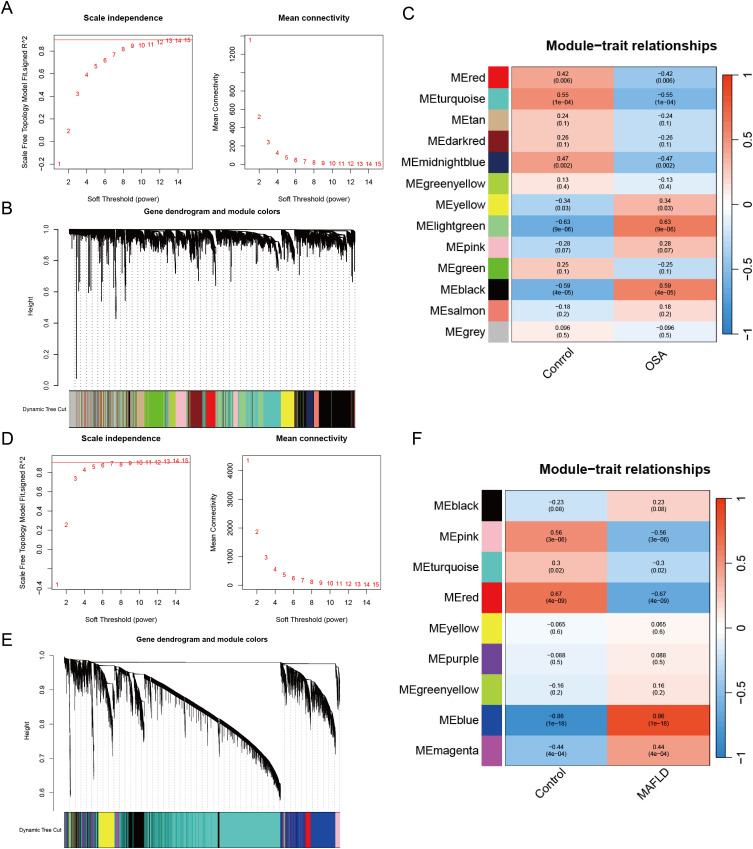
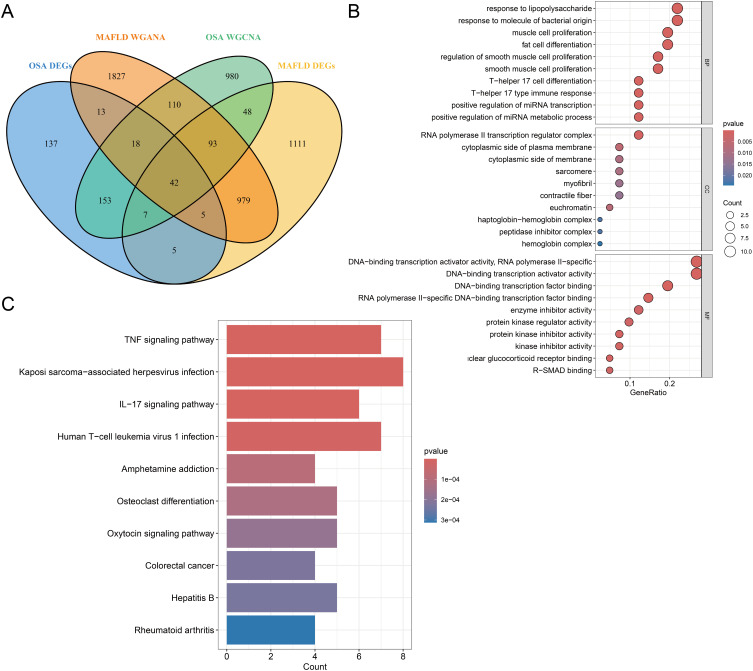
We used OSA-related and MAFLD-related GWAS data to explore their causal relationship and the role of body mass index (BMI) through two-sample and network MR analysis. Gene expression profiles were analyzed to identify intersection genes through differential expression analysis and weighted gene co-expression network analysis (WGCNA). Functional enrichment (GO and KEGG), protein-protein interaction (PPI) networks, and immune cell infiltration analyses (ssGSEA) were performed on the intersecting genes. We then conducted MR analysis to assess the relationship between immune cells and both diseases. Inverse variance weighting (IVW) served as the primary MR method, supplemented by MR-Egger regression, weighted median, and weighted mode.
MR analysis revealed that OSA increased the risk of MAFLD [odds ratio (OR)=1.40, 95% CI 1.14-1.73, p= 0.002], with OSA potentially mediating the effect of BMI on MAFLD, accounting for 62.3% of the mediation. Bioinformatics identified 42 intersection genes. Four hub genes (FOS, EGR1, NR4A1, JUN) were ultimately obtained by PPI network, which were strongly linked to immune cell infiltration. Additionally, three immune cell phenotypes (CD4RA on TD CD4+, HLA DR on CD14+ CD16-monocytes, and HLA DR on CD14+ monocytes) were found to be associated with both OSA and MAFLD.
OSA may causally influence MAFLD and mediate the effect of BMI on MAFLD. Four key genes and three immune cell phenotypes play crucial roles in the shared pathogenesis of both diseases.
阻塞性睡眠呼吸暂停(OSA)与代谢功能障碍相关脂肪性肝病(MAFLD)有关,但其确切因果关系和潜在机制仍无定论。我们旨在使用孟德尔随机化(MR)和生物信息学方法研究它们的因果关联和共享生物标志物。
我们使用与OSA相关和与MAFLD相关的全基因组关联研究(GWAS)数据,通过两样本和网络MR分析来探索它们的因果关系以及体重指数(BMI)的作用。通过差异表达分析和加权基因共表达网络分析(WGCNA)分析基因表达谱以鉴定交集基因。对交集基因进行功能富集(基因本体论和京都基因与基因组百科全书)、蛋白质-蛋白质相互作用(PPI)网络和免疫细胞浸润分析(单样本基因集富集分析)。然后我们进行MR分析以评估免疫细胞与这两种疾病之间的关系。逆方差加权(IVW)作为主要的MR方法,并辅以MR-Egger回归、加权中位数和加权模式。
MR分析显示OSA增加了MAFLD的风险[优势比(OR)=1.40,95%置信区间1.14-1.73,p=0.002],OSA可能介导BMI对MAFLD的影响,占中介作用的62.3%。生物信息学鉴定出42个交集基因。通过PPI网络最终获得了四个枢纽基因(FOS、EGR1、NR4A1、JUN),它们与免疫细胞浸润密切相关。此外,发现三种免疫细胞表型(TD CD4+上的CD4RA、CD14+ CD16-单核细胞上的HLA DR以及CD14+单核细胞上的HLA DR)与OSA和MAFLD均相关。
OSA可能因果性地影响MAFLD并介导BMI对MAFLD的影响。四个关键基因和三种免疫细胞表型在这两种疾病的共同发病机制中起关键作用。