Rubio Prisicilla, Whitaker Shayla Q, Ashby Jonathan, Puljung Michael C
Neuroscience Program, Trinity College Hartford, CT 06107.
Department of Chemistry, Trinity College Hartford, CT 06107.
bioRxiv. 2025 Jun 14:2025.06.10.658839. doi: 10.1101/2025.06.10.658839.
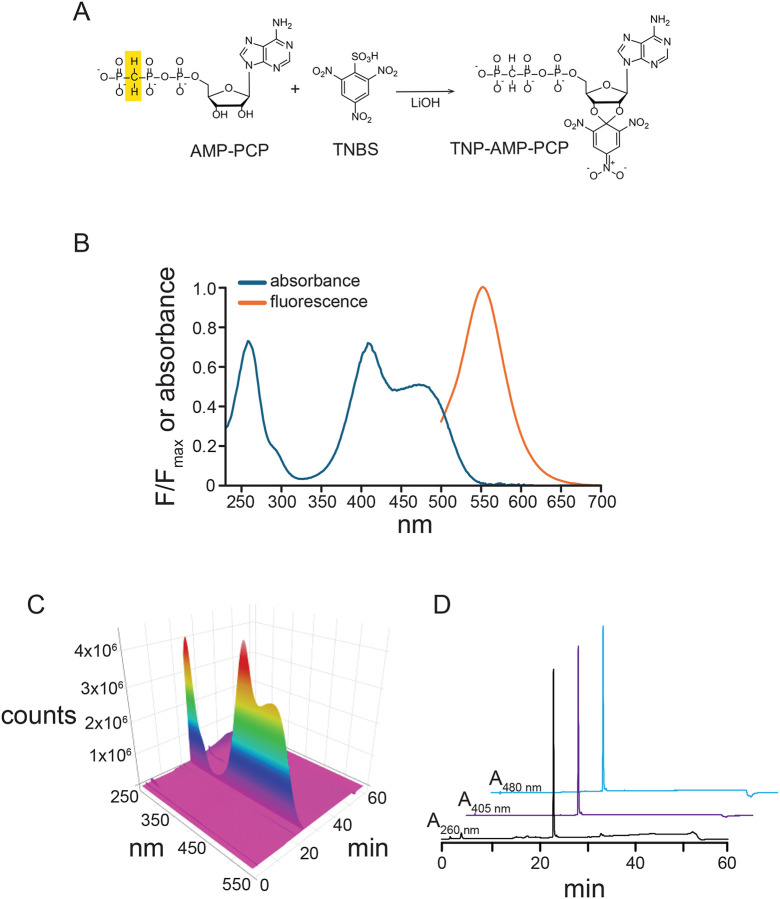
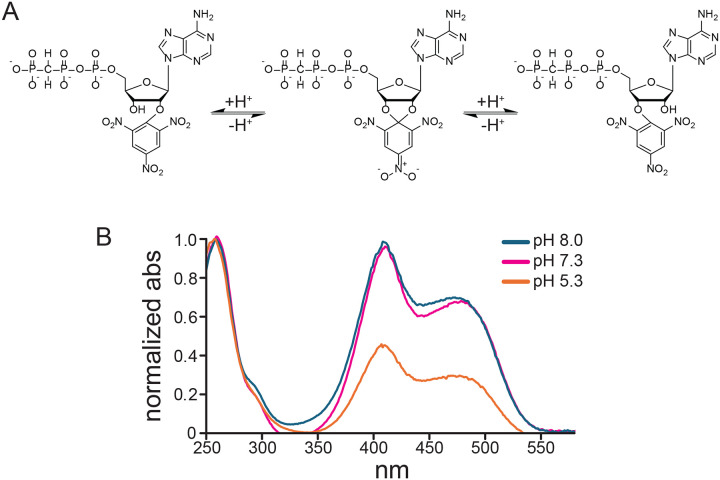
The neuroendocrine ATP-sensitive K (K) channel comprises four pore-forming subunits (Kir6.2), and four modulatory sulfonylurea receptor subunits (SUR1). ATP/ADP binding to Kir6.2 inhibits K, whereas MgATP/MgADP binding to two sites on SUR1 promotes activation. As SUR1 is part of the ABC transporter family, it can hydrolyze MgATP to MgADP. Whether or not enzymatic activity is required for K activation remains controversial. Non-hydrolyzable ATP analogs do not activate K, which may reflect an inability of these compounds to bind to SUR1, their inability to promote a conformational change in SUR1 that leads to channel activation, or a requirement for ATP hydrolysis during channel gating. To explore this, we synthesized a fluorescent trinitrophenyl (TNP) derivative of the non-hydrolyzable ATP analog β,γ-methyleneadenosine 5'-triphosphate (AMP-PCP). Synthesis was verified by UV-visible absorbance, fluorescence, H NMR, and mass spectrometry. Purity was assessed using TLC and reversed-phase HPLC. We can measure real-time binding of fluorescent nucleotide derivatives to intact K channels in cell membranes using FRET between channels labeled with a fluorescent, non-canonical amino acid and TNP-nucleotide derivatives. This technique provides us with sufficient spatial resolution to discriminate between binding to each site on K. Using this approach we measured TNP-ATP binding to nucleotide binding site 1 on SUR1 in fluorescently labeled Kir6.2/SUR1 channels in unroofed membranes of HEK293T cells. TNP-AMP-PCP binds to both nucleotide binding sites on SUR1 in the absence of Mg. AMP-PCP was able to compete with TNP-ATP for binding to NBS2, suggesting that it, too, binds NBS2. We conclude that the failure of non-hydrolyzable ATP analogs to activate K does not stem from an inability of these nucleotides to bind to the channel, leaving open the possibilities that they are unable to induce an activating conformational change in SUR1 or that nucleotide hydrolysis by SUR1 is a prerequisite for channel activation.
神经内分泌ATP敏感性钾(K)通道由四个形成孔道的亚基(Kir6.2)和四个调节性磺脲类受体亚基(SUR1)组成。ATP/ADP与Kir6.2结合会抑制K,而MgATP/MgADP与SUR1上的两个位点结合则会促进激活。由于SUR1是ABC转运蛋白家族的一部分,它可以将MgATP水解为MgADP。K激活是否需要酶活性仍存在争议。不可水解的ATP类似物不会激活K,这可能反映出这些化合物无法与SUR1结合、无法促进SUR1发生导致通道激活的构象变化,或者在通道门控过程中需要ATP水解。为了探究这一点,我们合成了不可水解的ATP类似物β,γ-亚甲基腺苷5'-三磷酸(AMP-PCP)的荧光三硝基苯基(TNP)衍生物。通过紫外可见吸收光谱、荧光光谱、核磁共振氢谱和质谱对合成进行了验证。使用薄层色谱法和反相高效液相色谱法评估纯度。我们可以利用荧光非天然氨基酸标记的通道与TNP-核苷酸衍生物之间的荧光共振能量转移(FRET),测量荧光核苷酸衍生物与细胞膜中完整K通道的实时结合。这项技术为我们提供了足够的空间分辨率,以区分与K上每个位点的结合。使用这种方法,我们在HEK293T细胞去盖膜中荧光标记的Kir6.2/SUR1通道中测量了TNP-ATP与SUR1上核苷酸结合位点1的结合。在没有Mg的情况下,TNP-AMP-PCP与SUR1上的两个核苷酸结合位点都结合。AMP-PCP能够与TNP-ATP竞争结合NBS2,这表明它也能结合NBS2。我们得出结论,不可水解的ATP类似物无法激活K并非源于这些核苷酸无法与通道结合,这使得它们无法在SUR1中诱导激活构象变化或者SUR1的核苷酸水解是通道激活的先决条件这两种可能性仍然存在。