• 文献检索
  • 文档翻译
  • 深度研究
  • 学术资讯
  • Suppr Zotero 插件Zotero 插件
  • 邀请有礼
  • 套餐&价格
  • 历史记录
应用&插件
Suppr Zotero 插件Zotero 插件浏览器插件Mac 客户端Windows 客户端微信小程序
定价
高级版会员购买积分包购买API积分包
服务
文献检索文档翻译深度研究API 文档MCP 服务
关于我们
关于 Suppr公司介绍联系我们用户协议隐私条款
关注我们

Suppr 超能文献

核心技术专利:CN118964589B侵权必究
粤ICP备2023148730 号-1Suppr @ 2026

文献检索

告别复杂PubMed语法,用中文像聊天一样搜索,搜遍4000万医学文献。AI智能推荐,让科研检索更轻松。

立即免费搜索

文件翻译

保留排版,准确专业,支持PDF/Word/PPT等文件格式,支持 12+语言互译。

免费翻译文档

深度研究

AI帮你快速写综述,25分钟生成高质量综述,智能提取关键信息,辅助科研写作。

立即免费体验

孕期使用大麻和大麻二酚的风险认知:一项多方法研究

Perception of Risks of Cannabis and Cannabidiol Use during Pregnancy: A Multi-Methods Study.

作者信息

Goodin Amie, Varma Deepthi S, Dhillon Karamveer, Kaleem Sahar, Dubare Sonila, Jennings Alexis, Goldberger Bruce A, Roussos-Ross Kay

机构信息

Pharmaceutical Outcomes and Policy, Center for Drug Evaluation and Safety, Consortium for Medical Marijuana Clinical Outcomes Research, College of Pharmacy, University of Florida, Gainesville, FL, USA.

Department of Epidemiology, College of Public Health and Health Professions and College of Medicine, University of Florida, Gainesville, FL, USA.

出版信息

Med Cannabis Cannabinoids. 2025 Jun 11;8(1):130-143. doi: 10.1159/000546312. eCollection 2025 Jan-Dec.

DOI:10.1159/000546312
PMID:40661844
原文链接:https://pmc.ncbi.nlm.nih.gov/articles/PMC12258875/
Abstract

INTRODUCTION

The American College of Obstetrics and Gynecology advises against cannabis and cannabidiol (CBD) product use during pregnancy; despite this, recent studies suggest cannabis and CBD use is increasing during pregnancy. The objective of this study is to assess risk perceptions of cannabis and CBD use during pregnancy among pregnant and non-pregnant patients.

METHODS

The study design is multi-method; a cross-sectional survey assessing use behaviors and risk perceptions is supplemented with qualitative focus group discussions (FGDs). Recruitment for surveys was from outpatient obstetrics clinics and recruitment for FGDs was from the same clinics and a substance-use treatment clinic, from October 2022 to February 2023. The survey instrument was developed via combining question items from validated instruments that assess cannabis and CBD use and risk perceptions. Comparisons of response frequency distributions for pregnant versus non-pregnant participants were calculated with chi-square analysis for individual risk perception question items. Data from the FGDs were coded and analyzed via a deductive content analysis approach.

RESULTS

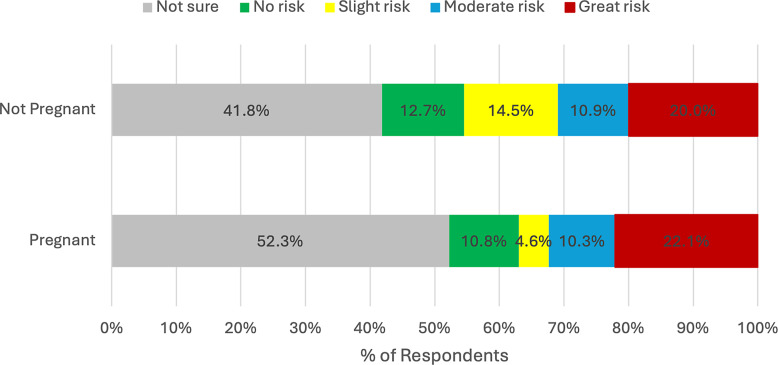
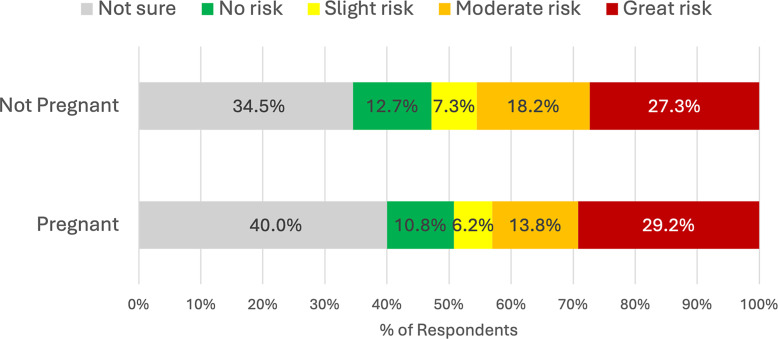
There were 261 survey respondents and 5 FGDs ( = 17). Of the surveys, 198 (75.9%) were currently pregnant, 55 (21.1%) were not pregnant, and 8 (3.1%) did not disclose pregnancy status. Approximately 5.0% ( = 13) reported currently breastfeeding. For the question, "How risky is it to use marijuana [cannabis] once or twice a week during pregnancy?", pregnant versus non-pregnant participants responded most frequently with "great risk" (29.2% vs. 27.3%) and "not sure" (40.0% vs. 34.5%), where = 0.88 (not significant) between pregnant vs. non-pregnant response distribution. For the question, "How risky is it to use CBD once or twice a week during pregnancy?" pregnant vs. non-pregnant participants responded most frequently with: "great risk" (22.1% vs. 20.0%), and "not sure" (52.3% vs. 41.8%), where = 0.12 (not significant). Ever use of cannabis and CBD differed in pregnant versus non-pregnant patients (cannabis 36.0% pregnant vs. 65.5% non-pregnant; CBD 19.9% pregnant vs. 38.2% non-pregnant). Qualitative findings indicated that participants perceived that legalization of marijuana has resulted in reduction of stigma against users, but participants expressed mixed feelings toward the perception of marijuana safety due to legalization, though several participants described perceived benefits of marijuana use more generally.

CONCLUSION

Findings indicate uncertainty of risk related to cannabis and CBD use during pregnancy regardless of current pregnancy or lactation status, despite prevalent ever use of cannabis and CBD in those who were pregnant. This suggests an urgent need for clearer risk communication about cannabis and CBD use in pregnancy.

摘要

引言

美国妇产科学会建议孕期不要使用大麻和大麻二酚(CBD)产品;尽管如此,最近的研究表明孕期使用大麻和CBD的情况正在增加。本研究的目的是评估孕妇和非孕妇对孕期使用大麻和CBD的风险认知。

方法

本研究采用多方法设计;一项评估使用行为和风险认知的横断面调查辅以定性焦点小组讨论(FGD)。调查的招募对象来自门诊产科诊所,FGD的招募对象来自同一诊所和一家物质使用治疗诊所,时间为2022年10月至2023年2月。调查工具是通过结合评估大麻和CBD使用及风险认知的有效工具中的问题项目开发而成。对孕妇和非孕妇参与者的回答频率分布进行比较,采用卡方分析来分析各个风险认知问题项目。FGD的数据通过演绎性内容分析方法进行编码和分析。

结果

共有261名调查对象和5个FGD(n = 17)。在调查对象中,198人(75.9%)目前怀孕,55人(21.1%)未怀孕,8人(3.1%)未透露怀孕状况。约5.0%(n = 13)报告目前正在哺乳。对于“孕期每周使用一两次大麻有多大风险?”这个问题,孕妇和非孕妇参与者最常回答的是“风险很大”(29.2%对27.3%)和“不确定”(40.0%对34.5%),孕妇和非孕妇的回答分布之间的χ² = 0.88(无显著性差异)。对于“孕期每周使用一两次CBD有多大风险?”这个问题,孕妇和非孕妇参与者最常回答的是:“风险很大”(22.1%对20.0%),以及“不确定”(52.3%对41.8%),χ² = 0.12(无显著性差异)。孕妇和非孕妇在大麻和CBD的既往使用情况上存在差异(大麻:孕妇为使用36.0%,非孕妇为65.5%;CBD:孕妇为19.9%,非孕妇为38.2%)。定性研究结果表明,参与者认为大麻合法化导致了对使用者污名化的减少,但参与者对大麻合法化带来的安全性认知表达了复杂的感受,不过有几位参与者更普遍地描述了大麻使用的感知益处。

结论

研究结果表明,无论当前的怀孕或哺乳状况如何,孕期使用大麻和CBD相关的风险存在不确定性,尽管孕期曾使用大麻和CBD的情况很普遍。这表明迫切需要就孕期使用大麻和CBD进行更清晰的风险沟通。
https://cdn.ncbi.nlm.nih.gov/pmc/blobs/caac/12258875/e8195d5e19bc/mca-2025-0008-0001-546312_F02.jpg
https://cdn.ncbi.nlm.nih.gov/pmc/blobs/caac/12258875/92a1df2197c9/mca-2025-0008-0001-546312_F01.jpg
https://cdn.ncbi.nlm.nih.gov/pmc/blobs/caac/12258875/e8195d5e19bc/mca-2025-0008-0001-546312_F02.jpg
https://cdn.ncbi.nlm.nih.gov/pmc/blobs/caac/12258875/92a1df2197c9/mca-2025-0008-0001-546312_F01.jpg
https://cdn.ncbi.nlm.nih.gov/pmc/blobs/caac/12258875/e8195d5e19bc/mca-2025-0008-0001-546312_F02.jpg

相似文献

1
Perception of Risks of Cannabis and Cannabidiol Use during Pregnancy: A Multi-Methods Study.孕期使用大麻和大麻二酚的风险认知:一项多方法研究
Med Cannabis Cannabinoids. 2025 Jun 11;8(1):130-143. doi: 10.1159/000546312. eCollection 2025 Jan-Dec.
2
Sexual Harassment and Prevention Training性骚扰与预防培训
3
Effectiveness and safety of vitamin D in relation to bone health.维生素D对骨骼健康的有效性与安全性。
Evid Rep Technol Assess (Full Rep). 2007 Aug(158):1-235.
4
Preexisting Diabetes and Pregnancy: An Endocrine Society and European Society of Endocrinology Joint Clinical Practice Guideline.孕前糖尿病与妊娠:内分泌学会和欧洲内分泌学会联合临床实践指南
Eur J Endocrinol. 2025 Jun 30;193(1):G1-G48. doi: 10.1093/ejendo/lvaf116.
5
Preexisting Diabetes and Pregnancy: An Endocrine Society and European Society of Endocrinology Joint Clinical Practice Guideline.糖尿病合并妊娠:内分泌学会与欧洲内分泌学会联合临床实践指南
J Clin Endocrinol Metab. 2025 Jul 13. doi: 10.1210/clinem/dgaf288.
6
Psychosocial interventions for cannabis use disorder.针对大麻使用障碍的心理社会干预措施。
Cochrane Database Syst Rev. 2016 May 5;2016(5):CD005336. doi: 10.1002/14651858.CD005336.pub4.
7
Incentives for preventing smoking in children and adolescents.预防儿童和青少年吸烟的激励措施。
Cochrane Database Syst Rev. 2017 Jun 6;6(6):CD008645. doi: 10.1002/14651858.CD008645.pub3.
8
Hypnosis for pain management during labour and childbirth.分娩过程中疼痛管理的催眠疗法。
Cochrane Database Syst Rev. 2016 May 19;2016(5):CD009356. doi: 10.1002/14651858.CD009356.pub3.
9
Cannabinoid content on product labels influences cannabis health perceptions.产品标签上的大麻素含量会影响对大麻健康的认知。
Ann Behav Med. 2025 Jan 4;59(1). doi: 10.1093/abm/kaaf046.
10
Intermittent oral iron supplementation during pregnancy.孕期间歇性口服铁剂补充
Cochrane Database Syst Rev. 2015 Oct 19;2015(10):CD009997. doi: 10.1002/14651858.CD009997.pub2.

本文引用的文献

1
Prevalence of cannabidiol use and correlates in U.S. adults.美国成年人中使用大麻二酚的流行情况及其相关因素。
Drug Alcohol Depend Rep. 2024 Oct 9;13:100289. doi: 10.1016/j.dadr.2024.100289. eCollection 2024 Dec.
2
Association between state-level medical marijuana legalization and marijuana use during pregnancy: A population-based study.州级医用大麻合法化与孕期大麻使用之间的关联:一项基于人群的研究。
Am J Addict. 2025 Jan;34(1):75-84. doi: 10.1111/ajad.13651. Epub 2024 Sep 29.
3
Cannabidiol-Only Product Use in Pregnancy in the United States and Canada: Findings From the International Cannabis Policy Study.
美国和加拿大孕期仅使用大麻二酚产品的情况:国际大麻政策研究的结果
Obstet Gynecol. 2024 Aug 1;144(2):156-159. doi: 10.1097/AOG.0000000000005603. Epub 2024 May 9.
4
Fetal cannabidiol (CBD) exposure alters thermal pain sensitivity, problem-solving, and prefrontal cortex excitability.胎儿接触大麻二酚(CBD)会改变热痛敏感性、解决问题的能力和前额叶皮层的兴奋性。
Mol Psychiatry. 2023 Aug;28(8):3397-3413. doi: 10.1038/s41380-023-02130-y. Epub 2023 Jul 11.
5
Perceptions About Cannabis Following Legalization Among Pregnant Individuals With Prenatal Cannabis Use in California.加利福尼亚州有产前大麻使用史的孕妇对大麻合法化后的看法。
JAMA Netw Open. 2022 Dec 1;5(12):e2246912. doi: 10.1001/jamanetworkopen.2022.46912.
6
Association of Recreational Cannabis Legalization With Cannabis Possession Arrest Rates in the US.美国休闲大麻合法化与大麻持有逮捕率的关联。
JAMA Netw Open. 2022 Dec 1;5(12):e2244922. doi: 10.1001/jamanetworkopen.2022.44922.
7
Trends and Characteristics of Prenatal Cannabis Use in the U.S., 2002-2019.美国 2002-2019 年产前大麻使用的趋势和特征。
Am J Prev Med. 2022 Nov;63(5):846-851. doi: 10.1016/j.amepre.2022.04.027. Epub 2022 Jun 16.
8
Risk Perceptions about Cannabis Use and Receipt of Health-Related Information during Pregnancy.怀孕期间对大麻使用和接受健康相关信息的风险认知。
Am J Health Promot. 2022 Nov;36(8):1316-1325. doi: 10.1177/08901171221099496. Epub 2022 May 5.
9
Attitudes Toward Cannabis Use During Labor in the United States.美国对分娩期间使用大麻的态度。
Womens Health Rep (New Rochelle). 2022 Jan 31;3(1):124-130. doi: 10.1089/whr.2021.0125. eCollection 2022.
10
Facilitators and barriers to pediatric clinical trial recruitment and retention in rural and community settings: A scoping review of the literature.农村和社区环境中儿科临床试验招募和保留的促进因素和障碍:文献综述。
Clin Transl Sci. 2022 Apr;15(4):838-853. doi: 10.1111/cts.13220. Epub 2022 Jan 21.