Lee James, Manon Victor, Chen Jue
Laboratory of Membrane Biophysics and Biology, The Rockefeller University, New York, NY 10065.
Weill Cornell/Rockefeller/Sloan Kettering Tri-Institutional MD-PhD Program, New York, NY 10065.
bioRxiv. 2025 Jun 17:2025.06.12.659373. doi: 10.1101/2025.06.12.659373.
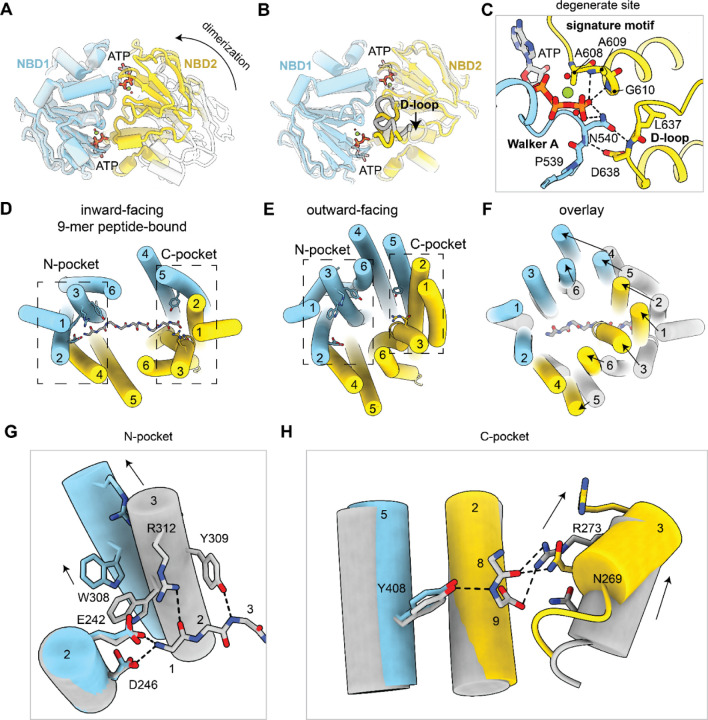
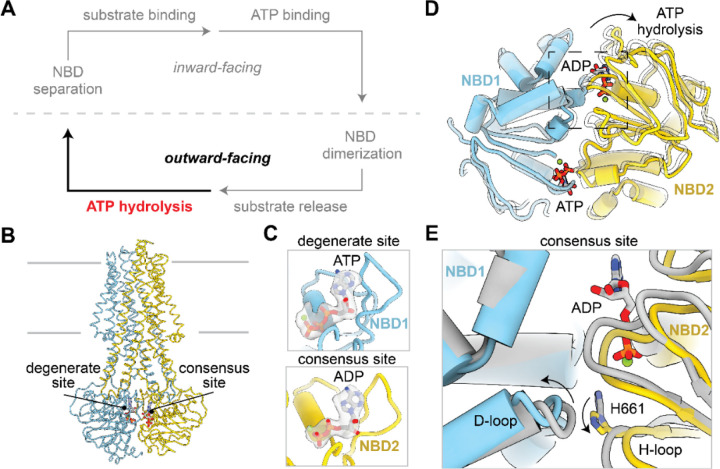
The transporter associated with antigen processing (TAP) is essential for adaptive immunity, delivering peptide antigens from the cytoplasm into the endoplasmic reticulum (ER) for loading onto MHC-I molecules. Previous studies have revealed the mechanism by which TAP selectively binds peptides while allowing for sequence diversity, but how the bound peptides are transported and released into the ER is not yet fully understood. Here, we report cryo-electron microscopy structures of human TAP in multiple functional states along the transport cycle. In the inward-facing conformation, ATP binding strengthens intradomain assembly. The transition to the outward-facing conformation is highly temperature-dependent and leads to a complete reconfiguration of the peptide-binding site, facilitating peptide release. ATP hydrolysis opens the consensus site, and the subsequent separation of the NBDs resets the transport cycle. These findings establish a comprehensive structural framework for understanding the mechanisms of peptide transport, vanadate trapping, and trans-inhibition.
抗原加工相关转运体(TAP)对于适应性免疫至关重要,它将肽抗原从细胞质转运到内质网(ER)中,以便加载到MHC-I分子上。先前的研究揭示了TAP选择性结合肽同时允许序列多样性的机制,但结合的肽如何被转运并释放到内质网中尚未完全了解。在此,我们报告了人类TAP在转运循环中多个功能状态下的冷冻电子显微镜结构。在向内构象中,ATP结合增强了结构域内的组装。向向外构象的转变高度依赖于温度,并导致肽结合位点的完全重新配置,促进肽的释放。ATP水解打开共有位点,随后NBD的分离重置转运循环。这些发现为理解肽转运、钒酸盐捕获和反式抑制的机制建立了一个全面的结构框架。