Lu Yunxi, Zheng Lulu, Mei Huihong
Zhongshan School of Medicine, Sun Yat-sen University, Guangzhou, China.
Department of Nursing Unit, Ward 162, The First Affiliated Hospital of Wenzhou Medical University, Wenzhou, China.
J Gastrointest Oncol. 2025 Jun 30;16(3):1220-1232. doi: 10.21037/jgo-2024-1022. Epub 2025 Jun 27.
The role of postoperative chemotherapy in the survival of combined hepatocellular-cholangiocarcinoma (cHCC-CCA) remains undefined. This study investigated the impact of postoperative chemotherapy on patient survival.
Patients with cHCC-CCA who underwent surgical resection between January 2004 and December 2020 were identified from the Surveillance, Epidemiology, and End Results (SEER) database. Patients were divided into non-chemotherapy (n=138) and postoperative chemotherapy (n=59) groups. Survival analyses were performed using Kaplan-Meier methods, log-rank tests, and Cox proportional hazards models. Propensity score matching (PSM) was used to reduce selection bias.
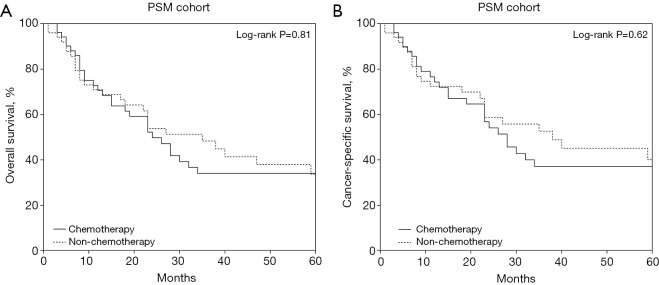
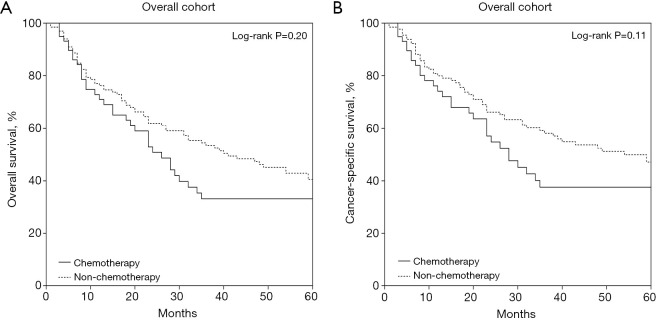
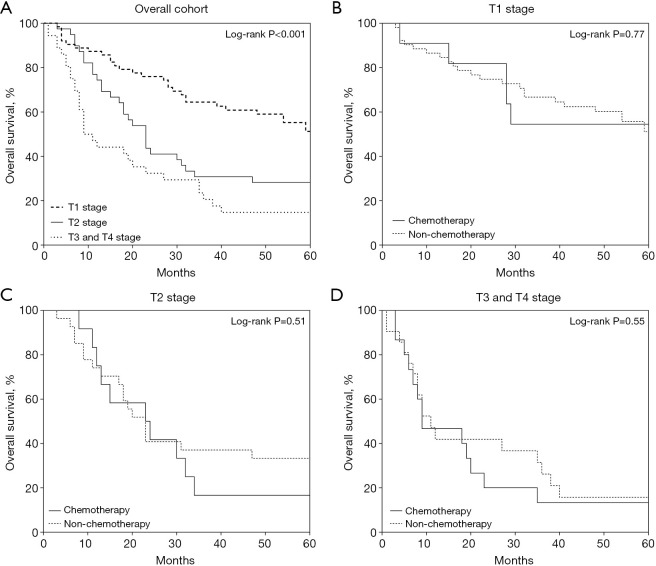
Among 197 patients, median follow-up was 23 months. Median overall survival (OS) was 32 months [95% confidence interval (CI): 22.7-41.3], with 40 months (95% CI: 26.4-53.7) in the non-chemotherapy group versus 26 months (95% CI: 18.6-33.4) in the chemotherapy group; median cancer-specific survival (CSS) was 54 months (95% CI: 32.3-75.7) in the non-chemotherapy group versus 28 months (95% CI: 19.1-36.9) in the chemotherapy group. The 1-, 3-, and 5-year OS were 73.5%, 46.8%, and 37.4%, and CSS were 77.8%, 51.8%, and 43.8%, respectively. Postoperative chemotherapy did not significantly improve OS [hazard ratio (HR) =1.290, 95% CI: 0.850-1.956, P=0.20] or CSS (HR =1.420, 95% CI: 0.892-2.259, P=0.11) compared to no chemotherapy. Older age (51-74 ≤50 years: HR =2.974, 95% CI: 1.243-7.118, P=0.01; ≥75 ≤50 years: HR =4.097, 95% CI: 1.411-11.892, P=0.009) and higher T stage (T2 T1: HR =1.972, 95% CI: 1.179-3.297, P=0.01; T3 T1: HR =3.010, 95% CI: 1.586-5.713, P=0.001, T4 T1: HR =3.628, 95% CI: 1.659-7.934, P=0.001) were associated with worse OS. Chemotherapy did not yield a survival benefit in any age or T stage subgroup (P>0.05), but subgroup analyses were limited by small sample sizes. In the multivariate analysis of 3-year OS, T stage was an independent factor, whereas postoperative chemotherapy showed no significant benefit. After PSM, 52 patients in each group were matched (n=104 total). There was still no significant difference in OS (HR =1.063, 95% CI: 0.646-1.749, P=0.81) or CSS (HR =1.148, 95% CI: 0.663-1.988, P=0.62) between the two groups.
Our study did not find a significant association between postoperative chemotherapy and improved prognosis in cHCC-CCA patients. Older age and higher T stage were associated with worse prognosis. Prospective studies evaluating postoperative chemotherapy and other adjuvant strategies are needed to improve outcomes for this rare tumor.
术后化疗在肝细胞胆管癌(cHCC-CCA)患者生存中的作用尚不明确。本研究探讨术后化疗对患者生存的影响。
从监测、流行病学和最终结果(SEER)数据库中识别出2004年1月至2020年12月期间接受手术切除的cHCC-CCA患者。患者分为非化疗组(n = 138)和术后化疗组(n = 59)。采用Kaplan-Meier方法、对数秩检验和Cox比例风险模型进行生存分析。使用倾向评分匹配(PSM)来减少选择偏倚。
197例患者的中位随访时间为23个月。中位总生存期(OS)为32个月[95%置信区间(CI):22.7 - 41.3],非化疗组为40个月(95% CI:26.4 - 53.7),化疗组为26个月(95% CI:18.6 - 33.4);非化疗组的中位癌症特异性生存期(CSS)为54个月(95% CI:32.3 - 75.7),化疗组为28个月(95% CI:19.1 - 36.9)。1年、3年和5年的OS分别为73.5%、46.8%和37.4%,CSS分别为77.8%、51.8%和43.8%。与未化疗相比,术后化疗并未显著改善OS[风险比(HR)= 1.290,95% CI:0.850 - 1.956,P = 0.20]或CSS(HR = 1.420,95% CI:0.892 - 2.259,P = 0.11)。年龄较大(51 - 74岁≤50岁:HR = 2.974,95% CI:1.243 - 7.118,P = 0.01;≥75岁≤50岁:HR = 4.097,95% CI:1.411 - 11.892,P = 0.009)和较高的T分期(T2对T1:HR = 1.972,95% CI:1.179 - 3.297,P = 0.01;T3对T1:HR = 3.010,95% CI:1.586 - 5.713,P = 0.001,T4对T1:HR = 3.628,95% CI:1.659 - 7.934,P = 0.001)与较差的OS相关。化疗在任何年龄或T分期亚组中均未产生生存获益(P>0.05),但亚组分析因样本量小而受到限制。在3年OS的多因素分析中,T分期是一个独立因素,而术后化疗未显示出显著益处。PSM后,每组匹配52例患者(共104例)。两组之间的OS(HR = 1.063,95% CI:0.646 - 1.749)或CSS(HR = 1.148,95% CI:0.663 - 1.988)仍无显著差异。
我们的研究未发现术后化疗与cHCC-CCA患者预后改善之间存在显著关联。年龄较大和T分期较高与较差的预后相关。需要进行前瞻性研究来评估术后化疗和其他辅助策略,以改善这种罕见肿瘤的治疗效果。