Ghezzi Beatrice, Fiorilla Irene, Carreira Ágata, Recco Francesco, Sorci Leonardo, Avalle Lidia, Ponzano Alessia, Mazzola Francesca, Todesco Alberto Maria, Tommasi Nicoletta, Gasparrini Massimiliano, D'Agostino Vito Giuseppe, Mignone Flavio, Provenzani Alessandro, Audrito Valentina
Department of Science and Technological Innovation, University of Eastern Piedmont, Alessandria, Italy, Viale Teresa Michel 11, 15121.
Department of Cellular, Computational and Integrative Biology (CIBIO), University of Trento, Trento, Italy.
Cell Commun Signal. 2025 Jul 21;23(1):348. doi: 10.1186/s12964-025-02361-2.
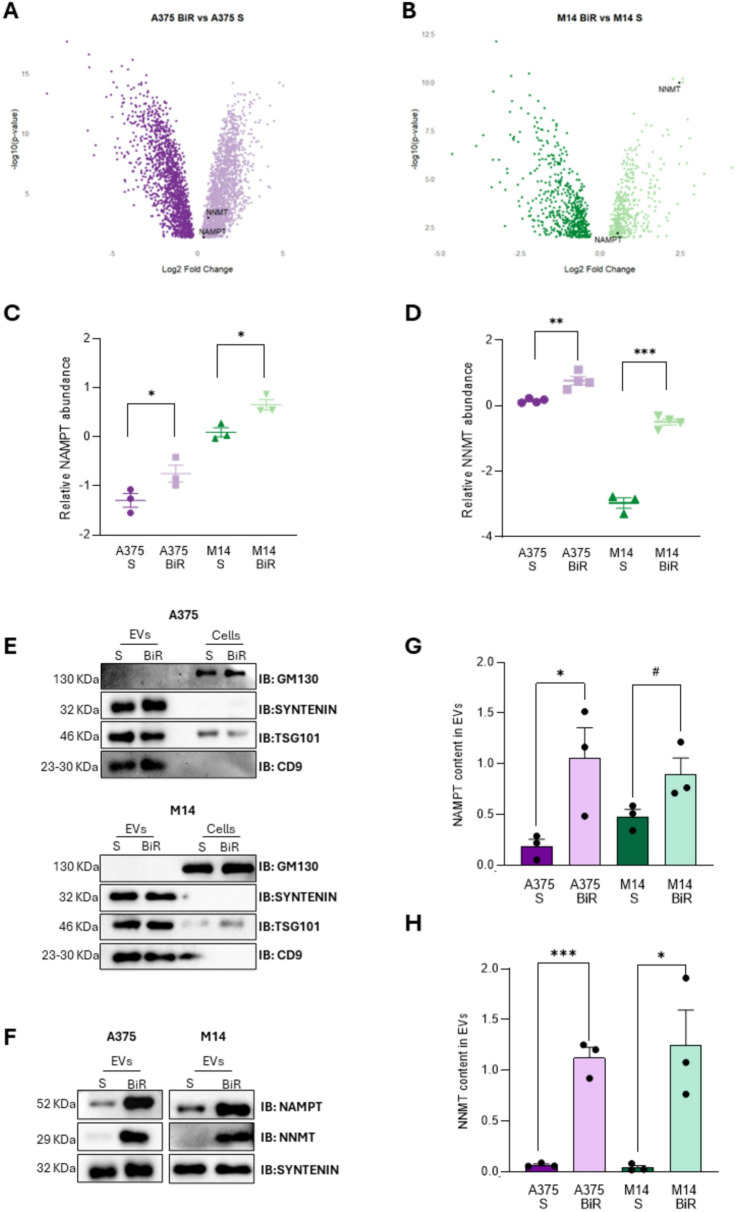
Drugs targeting mutant BRAF and MEK oncogenes are effective in melanoma, even though resistance rapidly develops. This complex picture includes acquired intrinsic tumor and tumor microenvironmental-mediated mechanisms. Here we show that melanoma cells resistant to BRAF inhibitors (BRAFi) overexpress the rate-limiting enzymes involved in nicotinamide (NAM) metabolism nicotinamide phosphoribosyltransferase (NAMPT) and nicotinamide N-methyltransferase (NNMT). Remarkably, these cells release NAMPT and NNMT both in the free-form or loaded into extracellular vesicles (EVs). NAMPT is emerging as a key mediator of resistance to BRAFi in melanoma, primarily due to its established role in NAD biosynthesis. Although previously identified as a soluble extracellular factor in this tumor, its presence within EVs released by melanoma cells has not been reported until now, highlighting a previously unrecognized mechanism through which NAMPT may influence the tumor microenvironment (TME). NNMT was revealed to increase in melanoma lesions compared to benign nevi. Here, we report for the first time its overexpression in resistant melanoma cell lines at intracellular and extracellular levels (secreted both as a soluble factor and into EVs). NNMT expression is increased in BRAF-mutated melanoma patients, suggesting a link between its upregulation and the BRAF oncogenic signaling. Moreover, NNMT levels positively correlate with gene signatures associated with pro-inflammatory signaling, immune cell migration, and chemokine-mediated pathways. NNMT pharmacological inhibition and genetic silencing significantly reduce resistant melanoma cell growth. In addition, we found that BRAFi-resistant cells are more sensitive to NNMT inhibition, highlighting a trait of vulnerability of BRAFi-resistant melanomas. Lastly, we proposed for the first time a tetrameric NNMT:TLR4 binding model offering a plausible structural and mechanistic basis for their association. Our functional results indicated that exogenous NNMT treatment is able to trigger NF-κB pathway, one of the main TLR4-dependent signaling, sharing this cytokine-like properties with NAMPT, and opening a future deeper exploration of its functional role in the extracellular space. Overall, the identification of NAMPT and, surprisingly also NNMT, included in EVs and abundantly released from resistant melanoma cells supports the impact of these moonlighting proteins involved in nicotinamide metabolism as mediators of BRAF/MEK inhibitors resistance with tumor intrinsic and potentially tumor microenvironment-mediated mechanisms. Interfering with nicotinamide metabolism could be a valid strategy to counteract drug resistance acting on the multifactorial tumor-host interactions.
The online version contains supplementary material available at 10.1186/s12964-025-02361-2.
靶向突变型BRAF和MEK癌基因的药物在黑色素瘤中有效,尽管耐药性会迅速产生。这种复杂的情况包括获得性内在肿瘤和肿瘤微环境介导的机制。在这里,我们表明,对BRAF抑制剂(BRAFi)耐药的黑色素瘤细胞过表达参与烟酰胺(NAM)代谢的限速酶烟酰胺磷酸核糖转移酶(NAMPT)和烟酰胺N-甲基转移酶(NNMT)。值得注意的是,这些细胞以游离形式或装载到细胞外囊泡(EVs)中释放NAMPT和NNMT。NAMPT正在成为黑色素瘤对BRAFi耐药的关键介质,主要是由于其在NAD生物合成中已确定的作用。尽管以前在这种肿瘤中被鉴定为可溶性细胞外因子,但直到现在才报道其在黑色素瘤细胞释放的EVs中的存在,这突出了NAMPT可能影响肿瘤微环境(TME)的一种以前未被认识的机制。与良性痣相比,NNMT在黑色素瘤病变中增加。在这里,我们首次报道其在耐药黑色素瘤细胞系的细胞内和细胞外水平(作为可溶性因子分泌并进入EVs)均过表达。BRAF突变的黑色素瘤患者中NNMT表达增加,表明其上调与BRAF致癌信号之间存在联系。此外,NNMT水平与促炎信号、免疫细胞迁移和趋化因子介导的途径相关的基因特征呈正相关。NNMT的药理学抑制和基因沉默显著降低耐药黑色素瘤细胞的生长。此外,我们发现BRAFi耐药细胞对NNMT抑制更敏感,突出了BRAFi耐药黑色素瘤的一种脆弱性特征。最后,我们首次提出了一种四聚体NNMT:TLR4结合模型,为它们的关联提供了合理的结构和机制基础。我们的功能结果表明,外源性NNMT处理能够触发NF-κB途径,这是主要的TLR4依赖性信号之一,与NAMPT具有这种细胞因子样特性,并为未来更深入探索其在细胞外空间的功能作用开辟了道路。总体而言,在EVs中发现并从耐药黑色素瘤细胞大量释放的NAMPT以及令人惊讶的还有NNMT,支持了这些参与烟酰胺代谢的兼职蛋白作为BRAF/MEK抑制剂耐药的介质,通过肿瘤内在和潜在的肿瘤微环境介导机制产生的影响。干扰烟酰胺代谢可能是一种有效的策略,以对抗作用于多因素肿瘤-宿主相互作用的耐药性。
在线版本包含可在10.1186/s12964-025-02361-2获取的补充材料。