Charmode Sundip, Kushwaha Sudhir Shyam, Mishra Abhishek Kumar, Mehra Simmi
Anatomy, All India Institute of Medical Sciences Rajkot, Rajkot, IND.
Orthopedics, All India Institute of Medical Sciences Gorakhpur, Gorakhpur, IND.
Cureus. 2025 Jun 20;17(6):e86461. doi: 10.7759/cureus.86461. eCollection 2025 Jun.
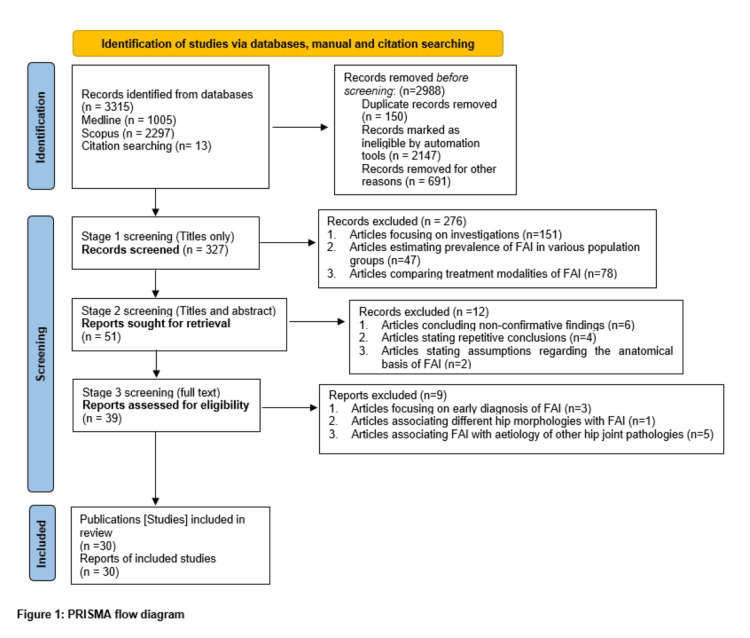
Femoroacetabular impingement (FAI) causes hip pain because of unusual bone shapes at the area where the femur connects to the hip (cam-type) or at the hip socket (pincer-type). Due to the rarity of hip osteoarthritis, people in India often overlook FAI. Significant knowledge gaps exist in the underlying pathophysiology of FAI, impacting its progression. This study aims to look at the shape changes in the femoral head-neck junction in FAI and how these changes relate to the development of hip joint osteoarthritis. We chose original reviews, book chapters, and controlled trials written in English about the causes, symptoms, and progression of FAI that were published between January 2015 and December 2024 from the PubMed/Medline and Scopus databases. Case reports, series, editorials, commentaries, abstracts, and preprints were excluded. The risk of bias in systematic reviews (ROBIS) tool was used to assess the risk of bias in selected studies, and a standardized data extraction checklist was used to obtain pertinent data for synthesis. This research protocol was prospectively registered in the International Prospective Register of Systematic Reviews (PROSPERO) under registration ID CRD42025638992. A PubMed and Medline search using the MeSH term "femoro-acetabular impingement" yielded 3315 publications. We recorded 327 articles after filtering for English, humans only, no preprints, and all ages. Based on the title and abstract, 39 articles were shortlisted after a thorough review by two investigators, who finally selected 30 articles (four systematic reviews, 18 original studies, six review articles, one clinical trial, and one book chapter) for analysis. FAI appears to be primarily mechanical rather than inflammatory, with radiographic findings often not correlating with clinical severity. As the skeleton matures, the angle of the acetabulum increases, and early closing of the triradiate cartilage leads to pincer-type FAI.
股骨髋臼撞击症(FAI)会导致髋关节疼痛,这是由于股骨与髋关节相连处(凸轮型)或髋关节窝(钳夹型)的骨骼形状异常所致。由于髋关节骨关节炎较为罕见,印度人常常忽视FAI。FAI的潜在病理生理学存在重大知识空白,影响其进展。本研究旨在观察FAI中股骨头-颈交界处的形状变化,以及这些变化与髋关节骨关节炎发展的关系。我们从PubMed/Medline和Scopus数据库中选取了2015年1月至2024年12月期间发表的关于FAI病因、症状和进展的英文原创综述、书籍章节和对照试验。排除病例报告、系列研究、社论、评论、摘要和预印本。使用系统评价中的偏倚风险(ROBIS)工具评估所选研究的偏倚风险,并使用标准化数据提取清单获取相关数据进行综合分析。本研究方案已在国际前瞻性系统评价注册库(PROSPERO)中进行前瞻性注册,注册号为CRD42025638992。使用MeSH术语“股骨髋臼撞击症”在PubMed和Medline上进行检索,共得到3315篇出版物。经过筛选英文、仅限人类、无预印本且涵盖所有年龄段后,我们记录了327篇文章。基于标题和摘要,两名研究者经过全面审查后筛选出39篇文章,最终选择30篇文章(四篇系统评价、18篇原创研究、六篇综述文章、一篇临床试验和一篇书籍章节)进行分析。FAI似乎主要是机械性的而非炎症性的,影像学表现往往与临床严重程度不相关。随着骨骼成熟,髋臼角度增加,而三辐射软骨过早闭合会导致钳夹型FAI。