Höchsmann Christoph, Heselton Hyeon Jung, Beckford Safiya E, French Jeffrey A, Stevens Jeffrey R, Dorling James L, Boron Julie B, Koehler Karsten
Department of Health and Sport Sciences, TUM School of Medicine and Health, Technical University of Munich, Munich, Germany.
Department of Gerontology, University of Nebraska at Omaha, Omaha, NE, United States.
Curr Dev Nutr. 2025 Jun 23;9(7):107491. doi: 10.1016/j.cdnut.2025.107491. eCollection 2025 Jul.
Acute exercise alters appetite-regulating hormones like peptide tyrosine tyrosine (PYY), glucagon-like peptide-1 (GLP-1), and ghrelin, suppressing appetite and reducing food intake. The effect of exercise on hunger and satiety has been shown to vary by body composition, sex, and habitual physical activity, but the influence of aging is less understood.
We aimed to examine age-related differences in the effect of acute exercise on appetite-regulating hormones.
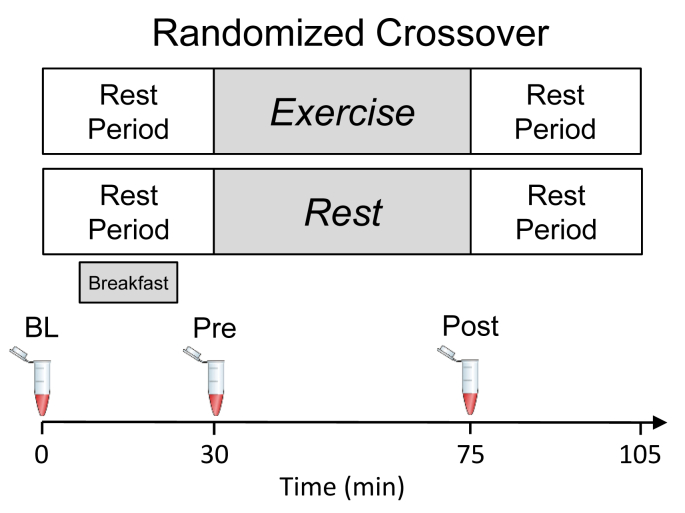
Participants from 2 age cohorts (younger adults, 19-29 y, = 39; older adults, 65-75 y, = 29) completed 2 45-min study conditions on separate days in randomized order: ) an exercise bout (60% O) on a bicycle ergometer (), and ) a seated rest period (). Plasma concentrations of PYY 3-36 (PYY3-36), GLP-1, and acylated ghrelin, as well as subjective perceptions of hunger, fullness, thirst, and nausea (via visual analog scales), were measured before a standardized snack (fasted) and before and after a subsequent exercise/rest condition.
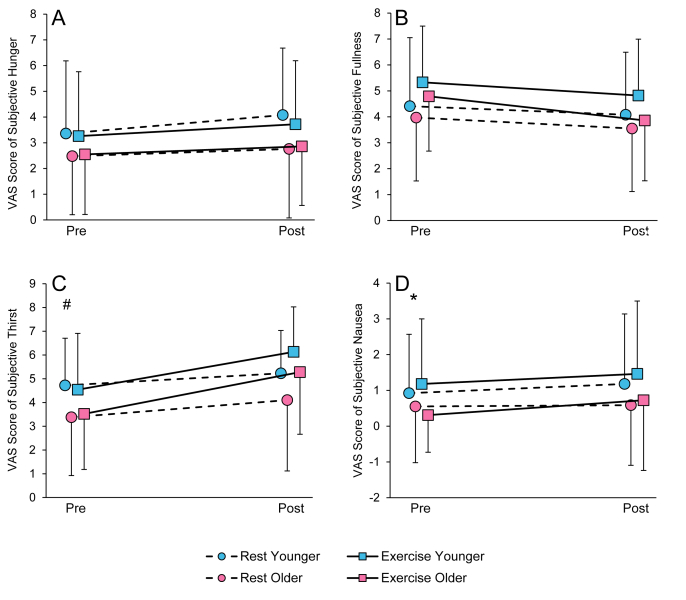
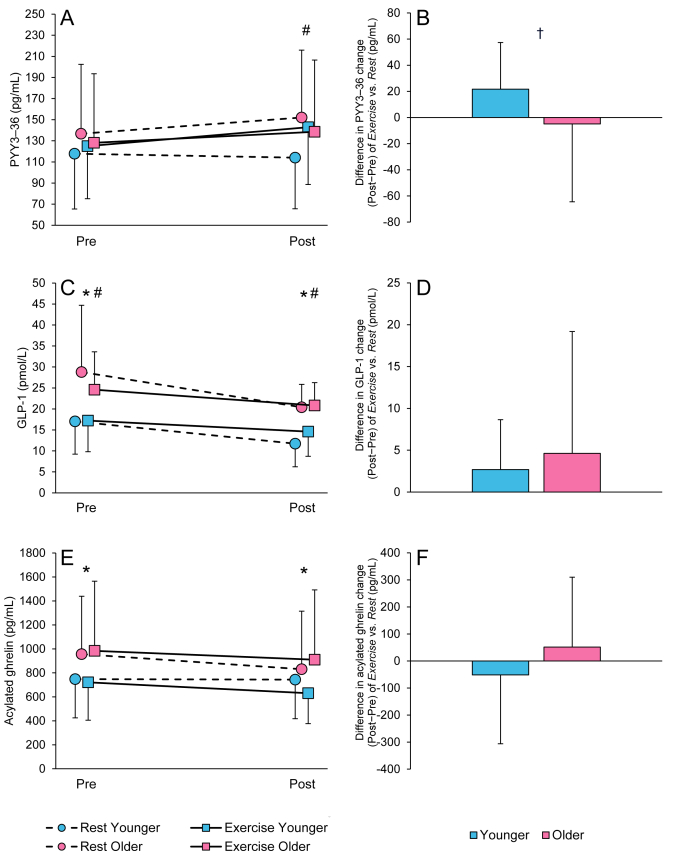
induced a greater increase in PYY3-36 relative to in younger adults compared to older adults (difference: 26.6 pg/mL; 95% confidence interval (CI): 3.4, 49.8 pg/mL; = 0.025). GLP-1 concentrations were consistently greater in older adults independent of the study condition ( all < 0.001), but the GLP-1 response to exercise did not differ by age group ( = 0.456). Similarly, exercise responses in acylated ghrelin ( = 0.114) and subjective appetite perceptions (all ≥ 0.288) did not differ between younger adults and older adults.
The present study showed age-related differences in the appetite-regulating hormone response to 45 min of nonfasted, moderate-intensity exercise in PYY3-36 but not GLP-1 or acylated ghrelin. The age-related variations did not translate into differences in subjective hunger or fullness.
急性运动可改变食欲调节激素,如酪酪肽(PYY)、胰高血糖素样肽-1(GLP-1)和胃饥饿素,从而抑制食欲并减少食物摄入量。运动对饥饿和饱腹感的影响已被证明因身体成分、性别和习惯性身体活动而异,但衰老的影响尚不太清楚。
我们旨在研究急性运动对食欲调节激素的影响中与年龄相关的差异。
来自2个年龄组的参与者(年轻成年人,19 - 29岁,n = 39;老年人,65 - 75岁,n = 29)在不同日期以随机顺序完成2种45分钟的研究条件:1)在自行车测力计上进行一次运动 bout(60% VO₂),2)一段坐姿休息时间。在标准化零食前(空腹)以及随后的运动/休息条件前后,测量血浆中PYY 3 - 36(PYY3 - 36)、GLP - 1和酰化胃饥饿素的浓度,以及饥饿、饱腹感、口渴和恶心的主观感受(通过视觉模拟量表)。
与老年人相比,年轻人运动后PYY3 - 36的增加幅度相对于休息时更大(差异:26.6 pg/mL;95%置信区间(CI):3.4,49.8 pg/mL;P = 0.025)。无论研究条件如何,老年人的GLP - 1浓度始终更高(所有P < 0.001),但GLP - 1对运动的反应在不同年龄组之间没有差异(P = 0.456)。同样,年轻人和老年人在酰化胃饥饿素的运动反应(P = 0.11)和主观食欲感受(所有P ≥ 0.288)方面没有差异。
本研究表明,在非空腹、中等强度运动45分钟后,食欲调节激素PYY3 - 36的反应存在与年龄相关的差异,但GLP - 1或酰化胃饥饿素不存在这种差异。与年龄相关的变化并未转化为主观饥饿或饱腹感的差异。