Wei Na, Dai Shiyu, Li Wei, Zhou Jun, Chen Ye
Department of Anesthesiology, The Affiliated Hospital, Southwest Medical University, Luzhou, Sichuan, China.
Anesthesiology and Critical Care Medicine Key Laboratory of Luzhou, The Affiliated Hospital, Southwest Medical University, Luzhou, Sichuan, China.
Front Neurosci. 2025 Jul 8;19:1596467. doi: 10.3389/fnins.2025.1596467. eCollection 2025.
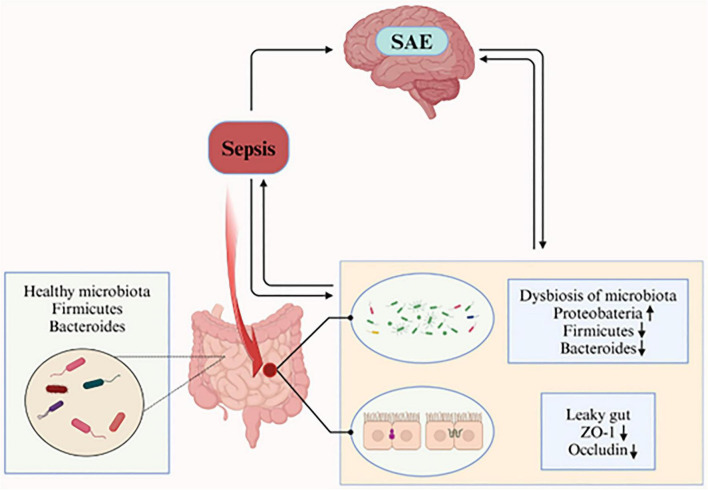
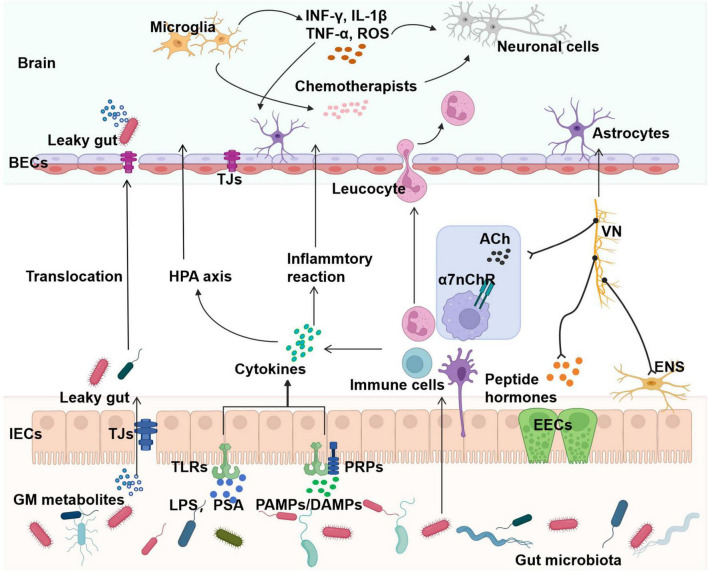
Sepsis is defined as a condition of immune dysregulation in response to an infection, and sepsis-associated encephalopathy (SAE) is often the initial symptom that manifests in patients with sepsis. This condition is characterized by its high mortality rates and the potential to cause significant disability among survivors. Despite its severity, the underlying pathophysiologic mechanisms that contribute to the development of SAE are not yet fully understood. Additionally, there are no established strict diagnostic criteria or potent treatment options available for this condition. However, an increasing body of evidence suggests that an imbalance in the gut microbiota is associated with SAE, potentially through the gut-brain axis (GBA). The GBA axis refers to the bidirectional communication between the gut microbiota and the central nervous system. In this review, we discuss the changes in the gut microbiota in SAE and the mechanisms of the GBA axis, involving neural, immune, endocrine, and neurotransmitter pathways. Finally, we conclude by evaluating the preclinical and clinical evidence for fecal microbiota transplantation and probiotics in SAE. Targeting the GBA axis will be an actionable target to ameliorate the development and progression of SAE.
脓毒症被定义为机体对感染产生免疫失调的一种状态,而脓毒症相关脑病(SAE)通常是脓毒症患者出现的首发症状。这种病症的特点是死亡率高,且幸存者有导致严重残疾的可能性。尽管其病情严重,但导致SAE发生的潜在病理生理机制尚未完全明确。此外,针对这种病症,目前尚无既定的严格诊断标准或有效的治疗方法。然而,越来越多的证据表明,肠道微生物群失衡可能通过肠-脑轴(GBA)与SAE相关。GBA轴是指肠道微生物群与中枢神经系统之间的双向通信。在本综述中,我们讨论了SAE中肠道微生物群的变化以及GBA轴的机制,涉及神经、免疫、内分泌和神经递质途径。最后,我们通过评估粪便微生物群移植和益生菌在SAE中的临床前和临床证据得出结论。针对GBA轴将是改善SAE发生和进展的一个可行靶点。