Huang Rui-Feng, Yick Kit-Lun, Shi Qiu-Qiong, Liu Lin, Li Chu-Hao
School of Fashion and Textiles, The Hong Kong Polytechnic University, Hong Kong, China.
Engineering Research Center of Sports Health Intelligent Equipment of Hubei Province, Wuhan Sports University, Wuhan 430000, China.
J Funct Morphol Kinesiol. 2025 Jul 7;10(3):257. doi: 10.3390/jfmk10030257.
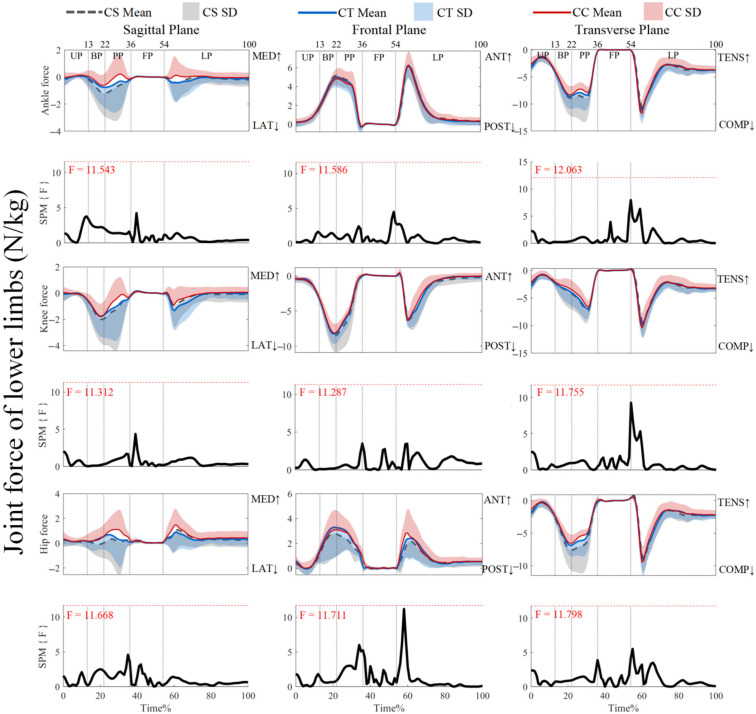
: Compression garments (CG) may influence countermovement jump (CMJ) performance by altering hip and knee biomechanics, but existing evidence remains controversial. This study aimed to compare the effects of compression tights (CTs), compression shorts (CSs), and control shorts (CCs) on CMJ performance and lower-limb biomechanics. : Nine physically active men from a university were recruited to perform CMJ while wearing CTs, CSs, and CCs in a randomized sequence for a within-subjects repeated-measures design. A Vicon 3D motion capture system and an AMTI 3D force plate were used to collect biomechanical data. Visual3D software was used to calculate the joint angle, moment, and force of the lower limbs. : Statistical parametric mapping analysis with repeated measures analysis of variance (ANOVA) revealed that during the propulsion phase of the CMJ, wearing CSs significantly reduced the hip flexion angle compared to wearing CCs (25-36%); meanwhile, wearing CTs significantly reduced the knee extension and flexion moment (34-35%) and decreased the hip extension moment during the propulsion phase (36-37%). In addition, CTs significantly reduced the hip abduction angle during the flight phase (37-39%), and CSs significantly reduced the hip anterior force during the landing phase (59-60%). : Compression legwear significantly affected the hip and knee biomechanics in propulsion, but these differences were not sufficient to improve the CMJ height. Due to the improvement in hip biomechanics in the flight and landing phases, there may be potential benefits for movement transitions and landing performance in CMJ.
压力服装(CG)可能通过改变髋部和膝部生物力学来影响纵跳(CMJ)表现,但现有证据仍存在争议。本研究旨在比较紧身压力裤(CTs)、压力短裤(CSs)和对照短裤(CCs)对CMJ表现和下肢生物力学的影响。
九名来自某大学的身体活跃男性被招募,按照随机顺序穿着CTs、CSs和CCs进行CMJ测试,采用受试者内重复测量设计。使用Vicon 3D动作捕捉系统和AMTI 3D测力台收集生物力学数据。使用Visual3D软件计算下肢的关节角度、力矩和力。
重复测量方差分析(ANOVA)的统计参数映射分析表明,在CMJ的推进阶段,与穿着CCs相比,穿着CSs显著减小了髋部屈曲角度(25%-36%);同时,穿着CTs显著减小了膝关节伸展和屈曲力矩(34%-35%),并在推进阶段减小了髋部伸展力矩(36%-37%)。此外,CTs在腾空阶段显著减小了髋部外展角度(37%-39%),CSs在着陆阶段显著减小了髋部向前力(59%-60%)。
压力腿部服装在推进过程中显著影响了髋部和膝部生物力学,但这些差异不足以提高CMJ高度。由于在腾空和着陆阶段髋部生物力学有所改善,在CMJ的动作转换和着陆表现方面可能存在潜在益处。