Miyauchi Yuu, Koba Haruna, Sawai Madoka, Kansui Hisao, Takechi Shinji, Hishinuma Eiji, Matsukawa Naomi, Hiratsuka Masahiro, Mackenzie Peter I, Ishii Yuji
Laboratory of Hygienic Chemistry, Faculty of Pharmaceutical Sciences, Sojo University, Kumamoto, Japan.
Laboratory of Hygienic Chemistry, Faculty of Pharmaceutical Sciences, Sojo University, Kumamoto, Japan.
J Biol Chem. 2025 Jul 21;301(9):110502. doi: 10.1016/j.jbc.2025.110502.
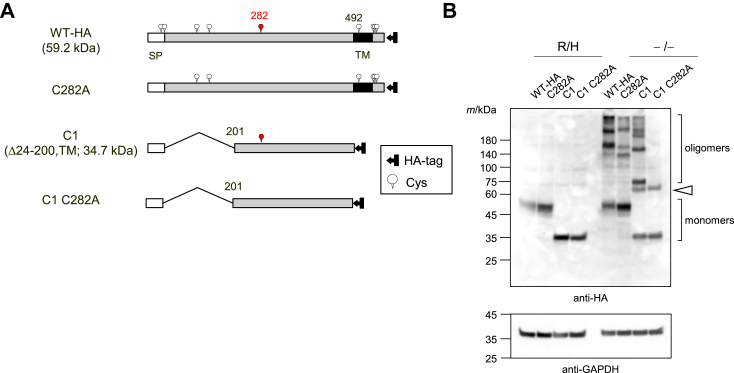
UDP-glucuronosyltransferase (UGT) is an important drug-metabolizing enzyme involved in the detoxification of hydrophobic chemicals by conjugating them with hydrophilic glucuronic acid. Previous studies have revealed that UGTs form oligomers between or among the same or other isoforms, but the molecular mechanism underlying this formation remains unclear. In this study, we used optimized electrophoretic techniques to analyze UGT2B7 homo-oligomer formation. UGT2B7 was expressed in COS-1 cells, and lysates were analyzed by sodium dodecyl sulfate-polyacrylamide gel electrophoresis (SDS-PAGE). By omitting the heating and reducing steps during SDS-PAGE sample preparation, bands corresponding to dimer, tetramer, and higher-order oligomers were detected in addition to monomeric bands. Since these SDS-stable UGT2B7 oligomer bands disappeared with the addition of reducing agents, we hypothesized that intermolecular disulfide bonds are involved in the formation of UGT oligomers. The cysteine residues important for this oligomer formation were investigated. Analyses using alanine substitution and deletion mutants suggested that three cysteine residues of UGT2B7, Cys127, Cys156, and Cys282, are important not only for oligomer formation but also for glucuronidation ability. We further investigated the oligomerization of UGT2B7 in intact living cells using two membrane-permeable cross-linkers, disuccinimidyl suberate and dithiobis(succinimidyl propionate). UGT2B7-expressing cells were treated with these reagents and analyzed by western blot. This cross-linker treatment markedly reduced the UGT2B7 monomer band and increased the formation of higher-molecular-mass species. These results indicated that the majority of UGT2B7 is present within cells as oligomers, maintaining its enzymatic function, rather than as a monomer.
尿苷二磷酸葡萄糖醛酸转移酶(UGT)是一种重要的药物代谢酶,通过将疏水性化学物质与亲水性葡萄糖醛酸结合来参与其解毒过程。先前的研究表明,UGT在相同或其他同工型之间或之中形成寡聚体,但其形成的分子机制仍不清楚。在本研究中,我们使用优化的电泳技术分析UGT2B7同源寡聚体的形成。UGT2B7在COS-1细胞中表达,裂解物通过十二烷基硫酸钠-聚丙烯酰胺凝胶电泳(SDS-PAGE)进行分析。通过在SDS-PAGE样品制备过程中省略加热和还原步骤,除了单体条带外,还检测到了对应于二聚体、四聚体和高阶寡聚体的条带。由于这些SDS稳定的UGT2B7寡聚体条带在加入还原剂后消失,我们推测分子间二硫键参与了UGT寡聚体的形成。研究了对这种寡聚体形成重要的半胱氨酸残基。使用丙氨酸替代和缺失突变体的分析表明,UGT2B7的三个半胱氨酸残基Cys127、Cys156和Cys282不仅对寡聚体形成很重要,而且对葡萄糖醛酸化能力也很重要。我们使用两种膜渗透性交联剂辛二酸双琥珀酰亚胺酯和二硫代双(琥珀酰亚胺丙酸酯)进一步研究了完整活细胞中UGT2B7的寡聚化。用这些试剂处理表达UGT2B7的细胞,并通过蛋白质印迹法进行分析。这种交联剂处理显著减少了UGT2B7单体条带,并增加了高分子量物种的形成。这些结果表明,大多数UGT2B7在细胞内以寡聚体形式存在,维持其酶功能,而不是以单体形式存在。