Joseph Jayanthi J, Leestemaker-Palmer Amy, Bermudez Luiz E
Department of Biomedical Sciences, Carlson College of Veterinary Medicine, Corvallis, USA.
Department of Microbiology, College of Science, Oregon State University, Corvallis, OR, USA.
Arch Microbiol. 2025 Jul 25;207(9):202. doi: 10.1007/s00203-025-04396-y.
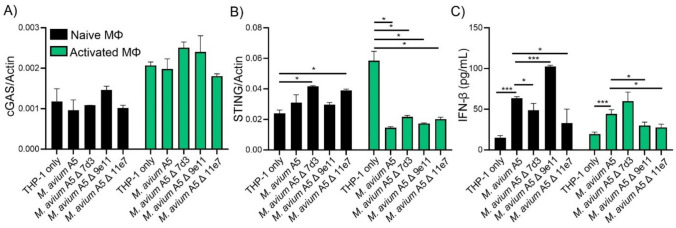
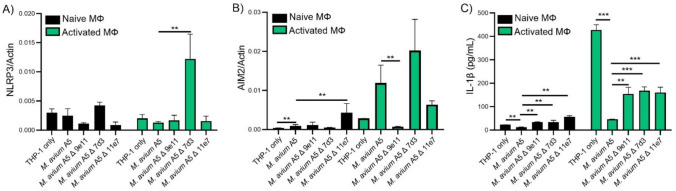
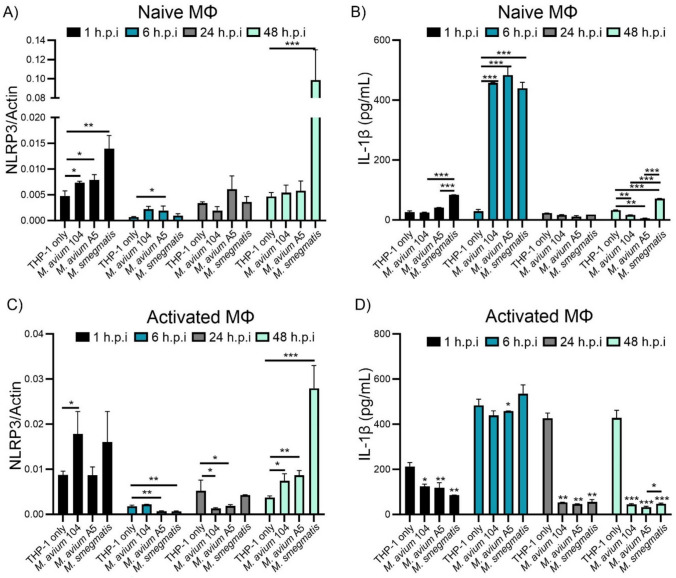
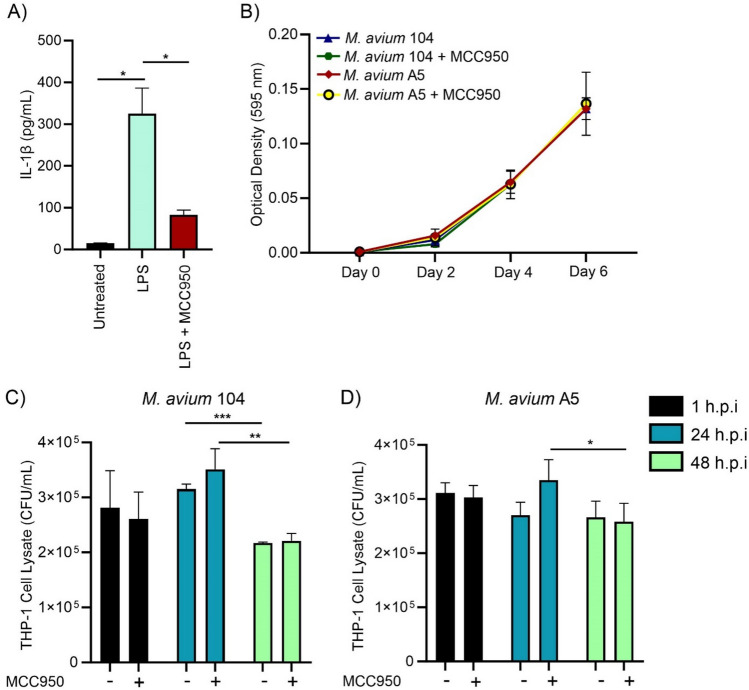
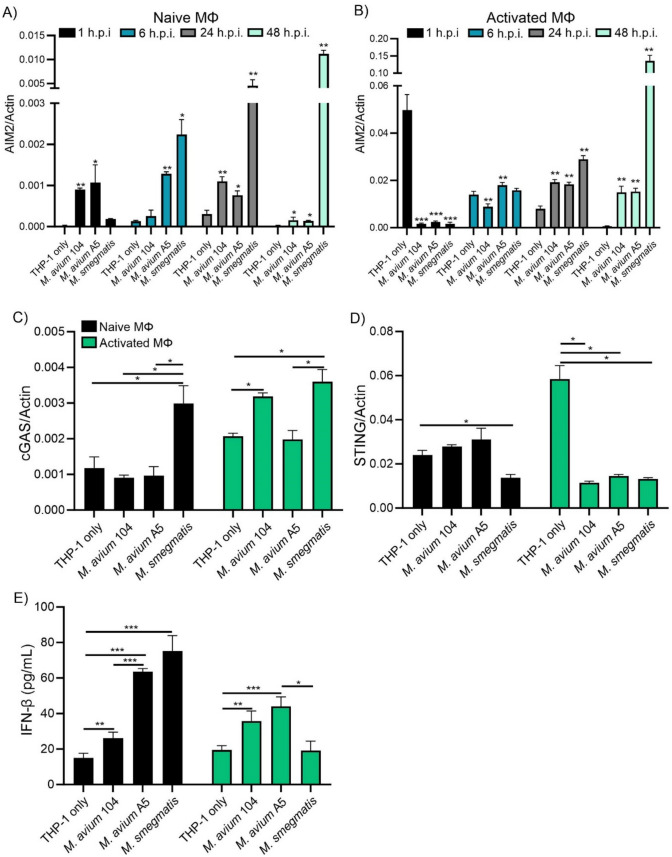
Mycobacterium avium subsp. hominissuis (M. avium) is a pathogen that causes pulmonary and systemic infection in humans. Mycobacterial infection activates both pro-inflammatory and anti-inflammatory pathways modulating these routes to escape killing. eDNA has a role for environmental survival and biofilm formation of M. avium. We hypothesized that M. avium eDNA might play a role in macrophages survival. To investigate the macrophage response to M. avium eDNA, we utilized two virulent strains of M. avium, eDNA-deficient mutants, and nonvirulent Mycobacterium smegmatis. eDNA-deficient mutants were attenuated at macrophage survival and yielded significantly higher IL-1β than wildtype bacterium, while M. avium, but not M. smegmatis, suppresses IL-1β production and NLRP3 expression by host macrophages. We also observed that M. avium triggered IFN-β production in a DNA-dependent manner but did not have an effect on cGAS expression. These data indicate that M. avium strains modulate macrophage responses in an eDNA dependent manner.
鸟分枝杆菌人亚种(鸟分枝杆菌)是一种可导致人类肺部和全身感染的病原体。分枝杆菌感染会激活促炎和抗炎途径,调节这些途径以逃避被杀死。胞外DNA(eDNA)在鸟分枝杆菌的环境生存和生物膜形成中发挥作用。我们推测鸟分枝杆菌的eDNA可能在巨噬细胞存活中起作用。为了研究巨噬细胞对鸟分枝杆菌eDNA的反应,我们使用了两种鸟分枝杆菌强毒株、eDNA缺陷突变体和无毒耻垢分枝杆菌。eDNA缺陷突变体在巨噬细胞存活方面减弱,并且产生的白细胞介素-1β(IL-1β)比野生型细菌显著更高,而鸟分枝杆菌而非耻垢分枝杆菌会抑制宿主巨噬细胞的IL-1β产生和NLRP3表达。我们还观察到鸟分枝杆菌以DNA依赖的方式触发干扰素-β(IFN-β)的产生,但对环鸟苷酸合成酶(cGAS)表达没有影响。这些数据表明鸟分枝杆菌菌株以eDNA依赖的方式调节巨噬细胞反应。