Murphy Kristin, Getman Michael, Lv Xiurui, Murphy Zachary, Abid Deanna, Rahman Nabil, Bulger Michael, Steiner Laurie
Department of Pediatrics, University of Rochester Medical Center, 601 Elmwood Ave, Box 703, Rochester, NY, 14642, USA.
Center for RNA Biology, University of Rochester Medical Center, 601 Elmwood Ave, Box 703, Rochester, NY, 14642, USA.
Epigenetics Chromatin. 2025 Jul 26;18(1):48. doi: 10.1186/s13072-025-00609-2.
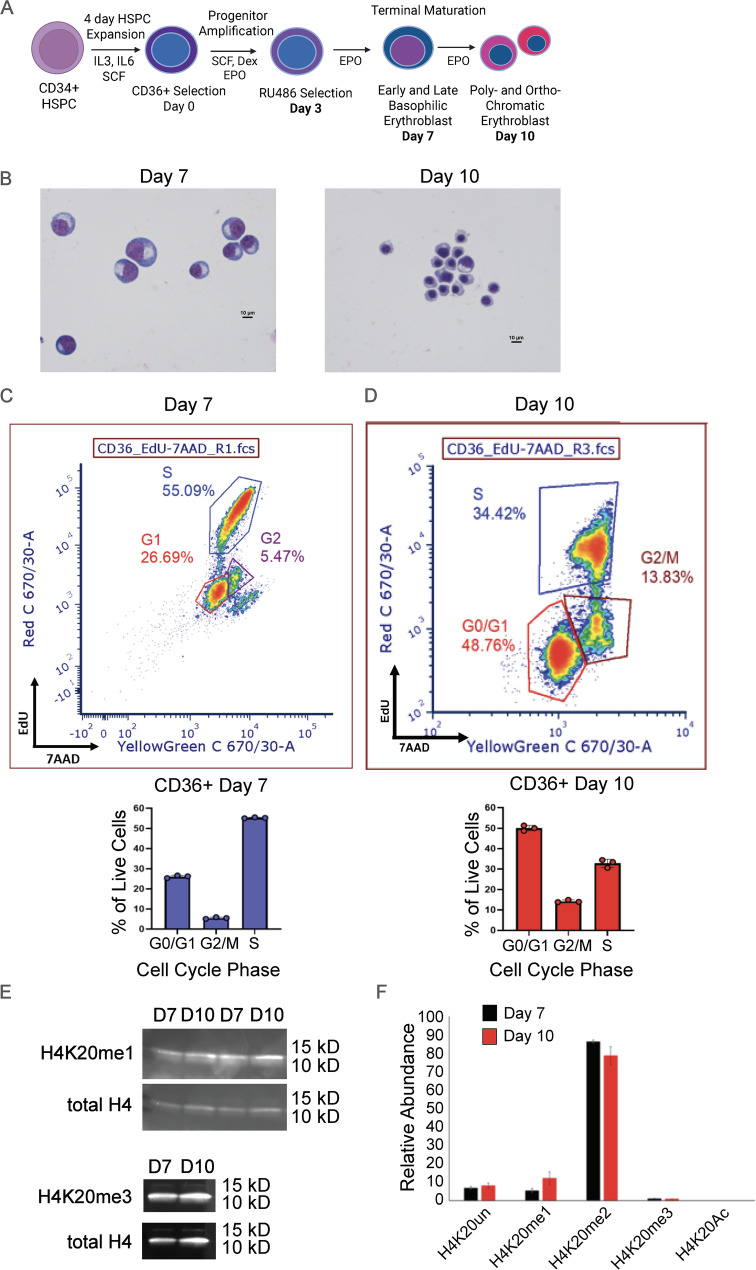
Methylation of H4K20 has been implicated in the regulation of gene expression but also plays essential roles in numerous cellular functions, making studies of its effects on transcription challenging. To gain insights into the role of H4K20 methylation in regulating gene expression, we studied H4K20me1 and H4K20me3 in the context of the well-characterized erythroid differentiation of human hematopoietic stem and progenitor cells.
H4K20me1 enrichment over the gene body was strongly correlated with expression changes. During erythroid differentiation, there was a dramatic decline in the level of RNA Polymerase II (Pol II); H4K20me1 was lost where Pol II was lost, and gained at genes where Pol II occupancy was maintained and transcripts were upregulated. We did identify a small subset of highly expressed genes, including beta-globin, that had a dramatic loss of H4K20me1 during erythroid differentiation, despite a substantial gain of Pol II. The histone demethylase PHF8 was present at these genes, as well as at the transcription start site of many active genes. In contrast to H4K20me1 over gene bodies correlating with transcription, enrichment at the transcription start site occurred at genes with low levels of Pol II occupancy and RNA expression throughout erythroid differentiation. The majority of H4K20me3 was present over intergenic regions, consistent with its well-established role as a repressor of repetitive elements. Intriguingly, H4K20me3 was also present at the transcription start site of genes with H4K20me1 over the gene body. At these genes, H4K20me3 levels were highly correlated with chromatin accessibility at the transcription start site, and an elevated Pol II pausing index. There was a dramatic loss of H4K20me3 occupancy in genic, but not intergenic, regions during erythroid differentiation.
There are dynamic changes in H4K20 methylation during cellular differentiation that correlate strongly with Pol II occupancy and activity. These changes occurred in genic regions, with H4K20me3 at the transcription start site correlated with Pol II pausing, and H4K20me1 gene body levels tightly linked with transcriptional changes. Together, these data provide important insights into the role of H4K20 methylation in the regulation of gene expression during cellular differentiation.
H4K20的甲基化不仅与基因表达的调控有关,还在众多细胞功能中发挥着重要作用,这使得研究其对转录的影响具有挑战性。为了深入了解H4K20甲基化在调控基因表达中的作用,我们在人类造血干细胞和祖细胞特征明确的红系分化过程中研究了H4K20me1和H4K20me3。
基因体上H4K20me1的富集与表达变化密切相关。在红系分化过程中,RNA聚合酶II(Pol II)水平急剧下降;在Pol II缺失的地方H4K20me1丢失,而在Pol II占据并转录本上调的基因处H4K20me1增加。我们确实鉴定出一小部分高表达基因,包括β-珠蛋白,它们在红系分化过程中H4K20me1急剧丢失,尽管Pol II大量增加。组蛋白去甲基化酶PHF8存在于这些基因以及许多活跃基因的转录起始位点。与基因体上与转录相关的H4K20me1不同,转录起始位点的富集发生在整个红系分化过程中Pol II占据水平和RNA表达水平较低的基因上。大多数H4K20me3存在于基因间区域,这与其作为重复元件抑制因子的既定作用一致。有趣的是,在基因体上有H4K20me1的基因的转录起始位点也存在H4K20me3。在这些基因处,H4K20me3水平与转录起始位点的染色质可及性以及升高的Pol II暂停指数高度相关。在红系分化过程中,基因区域而非基因间区域的H4K20me3占据显著丢失。
细胞分化过程中H4K20甲基化存在动态变化,与Pol II的占据和活性密切相关。这些变化发生在基因区域,转录起始位点的H4K20me3与Pol II暂停相关,而H4K20me1基因体水平与转录变化紧密相连。总之,这些数据为H4K20甲基化在细胞分化过程中调控基因表达的作用提供了重要见解。