Bernhardt Alexander M, Roeber Sigrun, Ruf Viktoria, Wlasich Elisabeth, Weidinger Endy, Longen Sebastian, Trossbach Svenja V, Gnörich Johannes, Brendel Matthias, Herms Jochen, Giese Armin, Höglinger Günter U, Levin Johannes
Department of Neurology, Ludwig-Maximilians-Universität München, München, Germany.
German Center for Neurodegenerative Diseases (DZNE), site Munich, Germany.
Acta Neuropathol Commun. 2025 Jul 25;13(1):163. doi: 10.1186/s40478-025-02081-1.
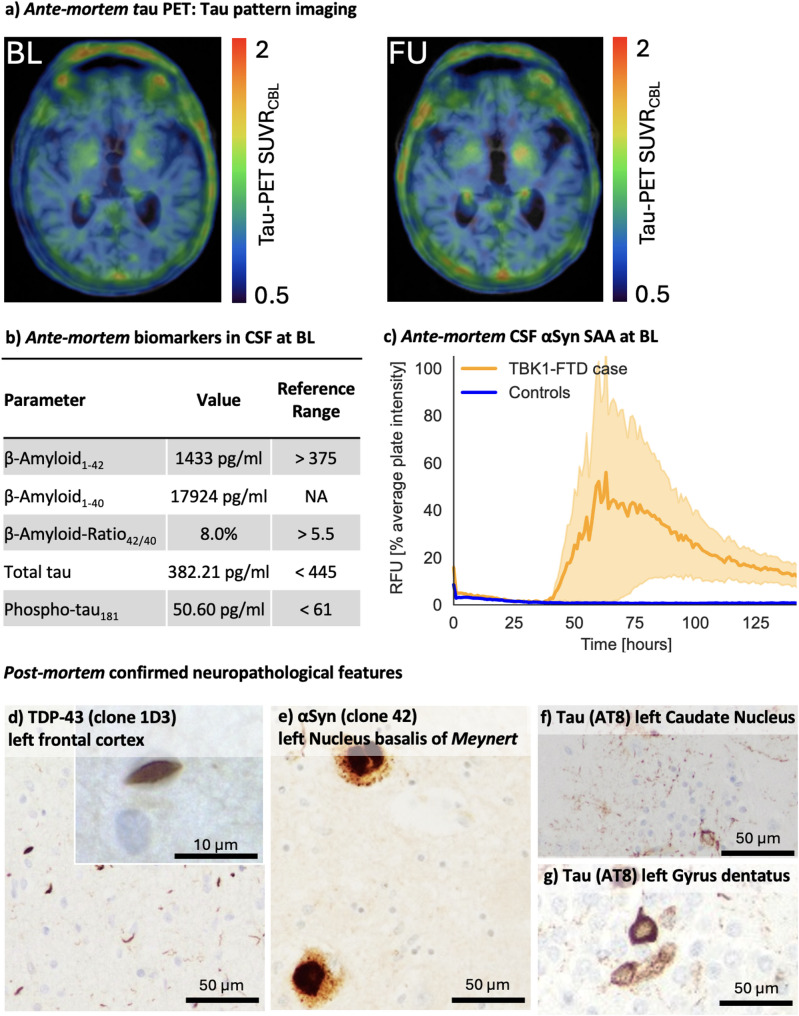
We present the case of a 74-year-old woman with behavioral variant frontotemporal dementia (bvFTD) linked to a pathogenic TANK-binding kinase 1 (TBK1) mutation (c.1349_1352del; p.Ile450Lysfs*15). During clinical workup, the patient underwent comprehensive biomarker analysis, including tau positron emission tomography (PET) and cerebrospinal fluid (CSF) seed amplification assay (SAA) for α-synuclein (αSyn). While CSF biomarkers for Alzheimer's disease were normal, the αSyn SAA was clearly positive, indicating misfolded αSyn aggregates. Tau PET revealed increased [F]PI-2620 uptake in the basal ganglia. Genetic testing confirmed autosomal dominant TBK1-associated FTD. The patient's condition deteriorated over the following year, with rapid cognitive decline and the emergence of cortical signs. Post-mortem neuropathological analysis confirmed multiple proteinopathies: FTLD-TDP43 (subtype A), Lewy body disease (limbic type, Braak stage 5), argyrophilic grain disease (AGD), aging-related tau astrogliopathy (ARTAG), and primary age-related tauopathy (PART). This is the first reported TBK1-FTD case with in vivo detection of αSyn pathology via SAA and in vivo monitoring of tau pathology. The case expands the clinical and neuropathological spectrum of TBK1-associated FTD. Our findings support a broader interpretation of TBK1-associated neurodegeneration and highlight the importance of multimodal diagnostic approaches that integrate molecular, genetic, imaging, and neuropathological tools. This case also underscores the utility of αSyn SAA and tau PET in detecting co-pathologies that may otherwise remain clinically silent and illustrates the need for further studies exploring the molecular cross-talk between TBK1, tau, and αSyn pathologies.
我们报告了一例74岁女性,患有与致病性TANK结合激酶1(TBK1)突变(c.1349_1352del;p.Ile450Lysfs*15)相关的行为变异型额颞叶痴呆(bvFTD)。在临床检查期间,患者接受了全面的生物标志物分析,包括用于α-突触核蛋白(αSyn)的tau正电子发射断层扫描(PET)和脑脊液(CSF)种子扩增分析(SAA)。虽然阿尔茨海默病的脑脊液生物标志物正常,但αSyn SAA明显呈阳性,表明存在错误折叠的αSyn聚集体。Tau PET显示基底神经节中[F]PI-2620摄取增加。基因检测证实为常染色体显性TBK1相关的额颞叶痴呆。在接下来的一年里,患者病情恶化,认知迅速下降并出现皮质体征。死后神经病理学分析证实存在多种蛋白病:FTLD-TDP43(A型)、路易体病(边缘型,Braak分期5期)、嗜银颗粒病(AGD)、衰老相关tau星形胶质细胞病(ARTAG)和原发性年龄相关tau病(PART)。这是首例通过SAA在体内检测到αSyn病理且通过体内监测tau病理的TBK1-额颞叶痴呆病例。该病例扩展了TBK1相关额颞叶痴呆的临床和神经病理学谱。我们的发现支持对TBK1相关神经退行性变进行更广泛的解释,并强调整合分子、基因、成像和神经病理学工具的多模式诊断方法的重要性。该病例还强调了αSyn SAA和tau PET在检测可能在临床上保持沉默的合并病理方面的效用,并说明了需要进一步研究探索TBK1、tau和αSyn病理之间的分子相互作用。