Dagan Misha, Nanayakkara Shane, Chan William, McGiffin David C, Kaye David M
Department of Cardiology, Alfred Hospital, Melbourne, Australia; Monash University, Faculty of Medicine, Nursing and Health Sciences, Clayton, Melbourne, Australia.
Department of Cardiology, Alfred Hospital, Melbourne, Australia; Monash University, Faculty of Medicine, Nursing and Health Sciences, Clayton, Melbourne, Australia; Monash-Alfred-Baker Centre for Cardiovascular Research, Monash University, Melbourne, Australia.
EBioMedicine. 2025 Jul 25;118:105867. doi: 10.1016/j.ebiom.2025.105867.
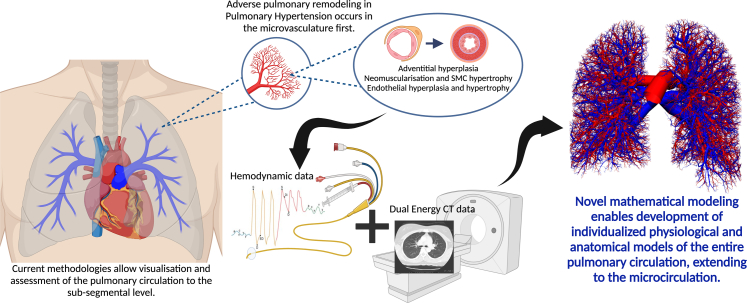
Pulmonary microvascular dysfunction is central to the pathophysiology of pulmonary hypertension (PH), yet remains challenging to evaluate in clinical practice. This review outlines current and emerging methodologies for assessing the pulmonary microcirculation, including advanced imaging, computational modelling, and invasive haemodynamic techniques. Exercise right heart catheterisation, waveform analysis, and vasoreactivity testing provide indirect insights into microvascular health, while novel invasive approaches, such as pulmonary flow reserve and pulmonary microvascular resistance indices, offer the potential for more precise functional characterisation. Computational models incorporating CT-derived anatomical data and patient-specific haemodynamics may enhance early detection and phenotyping of PH. Although many of these tools remain in the research domain, their refinement and integration into clinical workflows could enable earlier diagnosis, personalised risk stratification, and monitoring of therapeutic response. Ultimately, translating these innovations into practice may allow for targeted interventions that address microvascular dysfunction at an earlier stage of disease progression.
肺微血管功能障碍是肺动脉高压(PH)病理生理学的核心,但在临床实践中评估仍具有挑战性。本综述概述了评估肺微循环的现有和新兴方法,包括先进成像、计算建模和有创血流动力学技术。运动右心导管检查、波形分析和血管反应性测试可间接洞察微血管健康状况,而诸如肺血流储备和肺微血管阻力指数等新型有创方法则有可能实现更精确的功能特征描述。结合CT衍生解剖数据和患者特异性血流动力学的计算模型可能会提高PH的早期检测和表型分析能力。尽管这些工具中的许多仍处于研究阶段,但对其进行改进并整合到临床工作流程中可以实现早期诊断、个性化风险分层以及监测治疗反应。最终,将这些创新转化为实践可能会实现有针对性的干预措施,在疾病进展的早期阶段解决微血管功能障碍问题。