Disdier Clémence, Lhotellier Clara, Wagner Stéphanie, Andriambeloson Emile, Théodoro Frédéric, Pruvost Alain, Joudinaud Thomas, Bénech Henri, Mabondzo Aloïse
CERES BRAIN Therapeutics, ICM, Hôpital Pitié-Salpêtrière, Paris, France.
Neurofit SAS, Illkirch, France.
Front Aging Neurosci. 2025 Jul 11;17:1597263. doi: 10.3389/fnagi.2025.1597263. eCollection 2025.
Creatine has been recognized not only as an energy buffer but also for its antioxidant, antiapoptotic, and anti-excitotoxic properties, making it of interest as a neuroprotective agent. Oral creatine monohydrate supplementation is ineffective due to poor brain and neuronal distribution and optimized forms of creatine deserve to be studied. Thus, dodecyl creatine ester (DCE), named CBT101, is a prodrug of creatine created for this purpose. When administered nasally it can follow the nose-to-brain pathway to deliver creatine to neuronal cells after passive diffusion across membranes. In this study, the therapeutic efficacy of intranasal DCE treatment was demonstrated in a 6-OHDA-intoxicated rat model, which is relevant to neurodegenerative diseases such as Parkinson's disease.
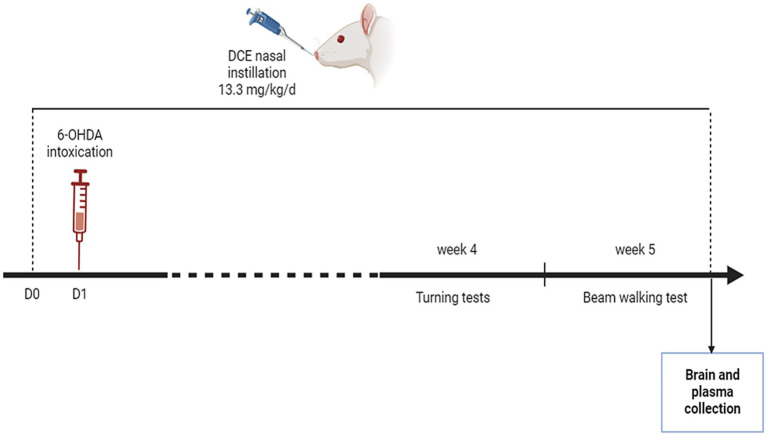
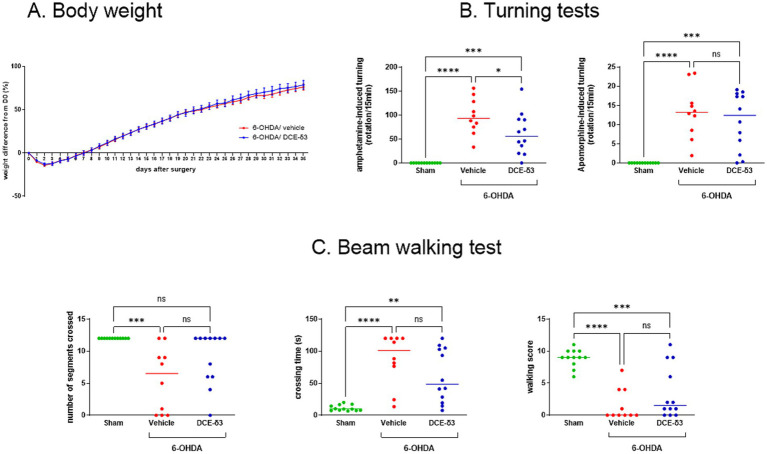
6-OHDA-intoxicated rats received DCE (13.3 mg/kg/day) or a vehicle intranasally for 5 weeks and were compared to a sham group. Imbalance in dopamine between the two hemispheres was assessed using the amphetamine-induced turning test after 3 weeks and sensorimotor performance using the beam walking test after 4 weeks, with ongoing treatment.
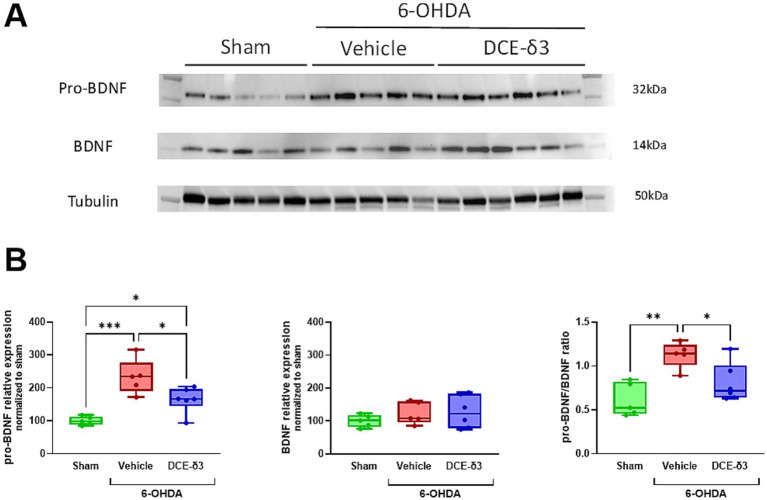
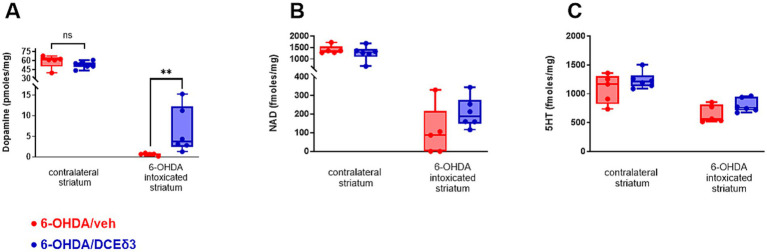
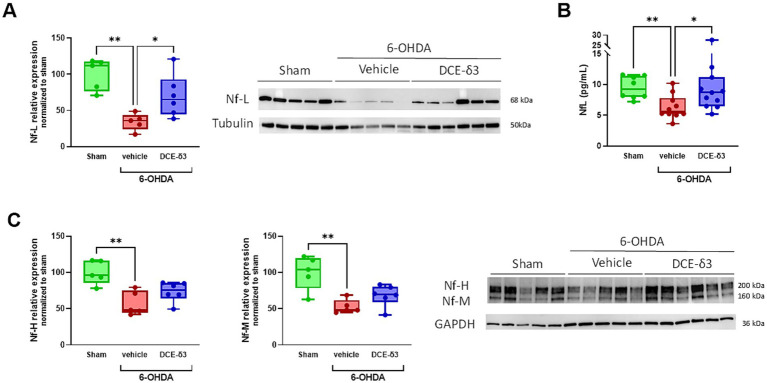
Five weeks after 6-OHDA intoxication, daily intranasal DCE treatment improved sensorimotor performance, striatal dopamine concentration, and modulated striatal pro-BDNF/BDNF balance and neurofilament expression both in plasma and in the striatum. These observations highlight DCE's potential as a therapeutic strategy for neurodegenerative diseases characterized by energy deficiency and major mitochondrial dysfunction.
肌酸不仅被认为是一种能量缓冲剂,还因其抗氧化、抗凋亡和抗兴奋毒性特性而备受关注,使其有望成为一种神经保护剂。口服一水肌酸补充剂效果不佳,因为其在大脑和神经元中的分布较差,因此值得研究优化形式的肌酸。因此,十二烷基肌酸酯(DCE),即CBT101,就是为此目的而研发的肌酸前药。经鼻腔给药时,它可通过鼻脑途径,在被动跨膜扩散后将肌酸传递给神经元细胞。在本研究中,在与帕金森病等神经退行性疾病相关的6-羟基多巴胺中毒大鼠模型中证明了鼻内给予DCE治疗的疗效。
6-羟基多巴胺中毒大鼠经鼻腔接受DCE(13.3mg/kg/天)或赋形剂治疗5周,并与假手术组进行比较。3周后使用苯丙胺诱导的旋转试验评估双侧半球多巴胺失衡情况,4周后在持续治疗的情况下使用横梁行走试验评估感觉运动性能。
6-羟基多巴胺中毒5周后,每日鼻内给予DCE治疗可改善感觉运动性能、纹状体多巴胺浓度,并调节血浆和纹状体中前脑源性神经营养因子/脑源性神经营养因子平衡以及神经丝表达。这些观察结果突出了DCE作为一种治疗策略在以能量缺乏和严重线粒体功能障碍为特征的神经退行性疾病中的潜力。