Collineau Bérénice, Gonçalves Anthony, Domon Marie, Bruyat Damien, Bertucci François, de Nonneville Alexandre
Institut Paoli-Calmettes, Department of Medical Oncology, 13009 Marseille, France.
Institut Paoli-Calmettes, CRCM (Centre de Recherche en Cancérologie de Marseille), Aix-Marseille University, 13009 Marseille, France.
Cancers (Basel). 2025 Jul 11;17(14):2307. doi: 10.3390/cancers17142307.
The treatment options for HER2-negative metastatic breast cancer include targeted therapies, cytotoxic chemotherapies, and immunotherapy. However, limited specificity and inevitable resistance highlight the need for novel agents. Antibody-drug conjugates (ADCs), such as trastuzumab deruxtecan (T-DXd) and sacituzumab govitecan (SG), represent a breakthrough by selectively delivering cytotoxic agents to tumor cells, potentially improving the therapeutic index. Despite demonstrated efficacy, ADCs present toxicity profiles similar to conventional chemotherapy, alongside unique adverse events. In clinical practice, oncologists may face scenarios where both T-DXd and SG are treatment options in HER2-negative mBC. To enable shared decision-making, it is crucial to present a comprehensive overview that includes both efficacy data and detailed toxicity profiles. Our objective was to provide a pooled and informative synthesis of toxicities from pivotal studies, including graphical representations, to support informed, patient-centered medical decisions.
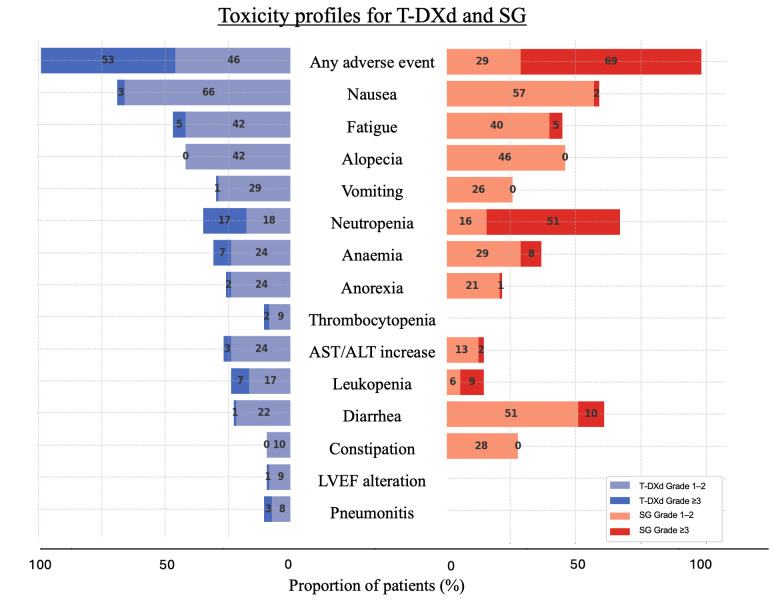
We reviewed safety data from phase 3 clinical trials in HER2-negative mBC: DESTINY-Breast04/DESTINY-Breast06 for T-DXd and ASCENT/TROPICS-02 for SG. Adverse event (AE) profiles, including frequency and severity, were extracted, and weighted means were calculated. Emerging ADCs such as datopotamab deruxtecan and patritumab deruxtecan were considered to contextualize future therapeutic decisions.
Tables, bar plots and radar plots were generated. T-DXd demonstrated high rates of nausea (69.2%), fatigue (47.2%), and neutropenia (35.6%), with 52.7% experiencing grade ≥ 3 AEs. Notably, pneumonitis occurred in 10.7%, with grade ≥ 3 in 2.6%. SG showed a distinct AE profile, with higher incidences of neutropenia (67.1%), with grade ≥ 3 in 51.3%, and diarrhea (60.8%).
The choice between ADCs in HER2-negative metastatic BC when both T-DXd and SG are treatment options should consider toxicity profiles to optimize patient-centered treatment strategies. Tailoring ADC selection based on individual tolerance and preferences is critical for shared decision-making, and future research should focus on assessing the utility and acceptability of such clinical tools to guide treatment selection.
HER2阴性转移性乳腺癌的治疗选择包括靶向治疗、细胞毒性化疗和免疫治疗。然而,特异性有限和不可避免的耐药性凸显了新型药物的必要性。抗体药物偶联物(ADC),如曲妥珠单抗德曲妥珠单抗(T-DXd)和戈沙妥珠单抗(SG),通过将细胞毒性药物选择性地递送至肿瘤细胞,代表了一项突破,有可能提高治疗指数。尽管已证明疗效显著,但ADC的毒性特征与传统化疗相似,同时还存在独特的不良事件。在临床实践中,肿瘤学家可能会面临T-DXd和SG都是HER2阴性转移性乳腺癌治疗选择的情况。为了实现共同决策,提供一份包括疗效数据和详细毒性特征的全面概述至关重要。我们的目标是提供一项汇总的、信息丰富的关键研究毒性综合分析,包括图表展示,以支持基于知情、以患者为中心的医疗决策。
我们回顾了HER2阴性转移性乳腺癌3期临床试验的安全性数据:T-DXd的DESTINY-Breast04/DESTINY-Breast06试验以及SG的ASCENT/TROPICS-02试验。提取不良事件(AE)特征,包括频率和严重程度,并计算加权平均值。考虑了新兴的ADC,如达泊妥珠单抗德曲妥珠单抗和帕妥珠单抗德曲妥珠单抗,以便为未来的治疗决策提供背景信息。
生成了表格、柱状图和雷达图。T-DXd表现出较高的恶心发生率(69.2%)、疲劳发生率(47.2%)和中性粒细胞减少发生率(35.6%),52.7%的患者经历了≥3级AE。值得注意的是,肺炎发生率为10.7%,≥3级为2.6%。SG表现出不同的AE特征,中性粒细胞减少发生率较高(67.1%),≥3级为51.3%,腹泻发生率为60.8%。
当T-DXd和SG都是治疗选择时,在HER2阴性转移性乳腺癌中选择ADC应考虑毒性特征,以优化以患者为中心的治疗策略。根据个体耐受性和偏好定制ADC选择对于共同决策至关重要,未来的研究应侧重于评估此类临床工具指导治疗选择的实用性和可接受性。