Sharma Sonia, Taft David R
Samuel J. and Joan B. Williamson Institute for Pharmacometrics, Division of Pharmaceutical Sciences, Arnold & Marie Schwartz College of Pharmacy and Health Sciences, Long Island University, Brooklyn, NY 11201, USA.
Life (Basel). 2025 Jul 13;15(7):1099. doi: 10.3390/life15071099.
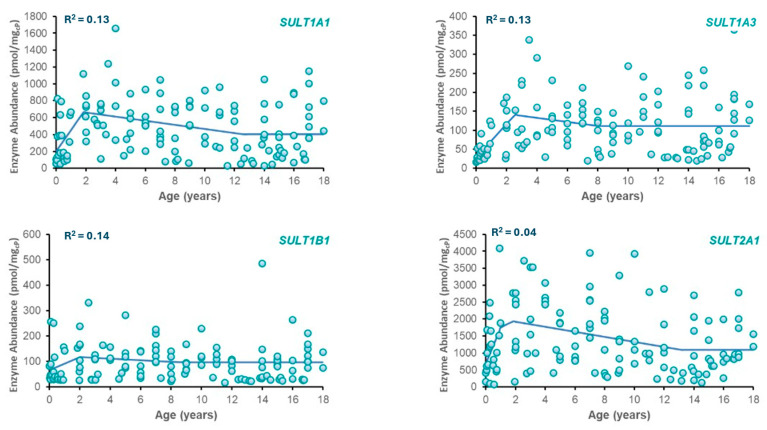
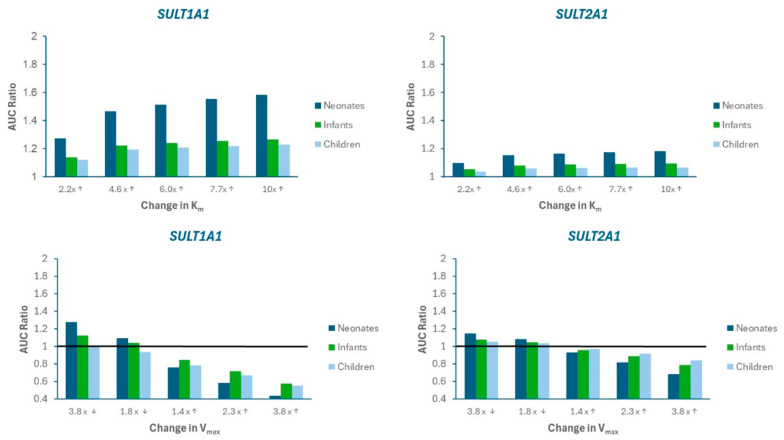
Sulfotransferase (SULT) enzymes contribute significantly to drug metabolism in pediatric patients. The purpose of this study was to develop a PBPK model for acetaminophen (APAP) in pediatric populations that accounts for the ontogeny of SULT isozymes that play a critical role in APAP metabolism. PBPK modeling and simulation were performed using the Simcyp Simulator. The model incorporated the developmental ontogeny of three key hepatic SULT enzymes: SULT1A1, SULT1A3, and SULT2A1 using "best-fit" ontogeny equations for each isozyme as determined by nonlinear regression analysis of enzyme abundance versus age. PBPK model-simulated pharmacokinetic profiles for APAP captured observed clinical data for systemic exposure (Cmax, AUC) in neonates, infants, and children. SULTS accounted for ~60% APAP metabolism in neonates, with decreased contributions to infants and children. Model sensitivity analysis highlighted the potential for APAP metabolic DDIs, primarily through SULT1A1. The study demonstrates that the impact of SULT enzymes on drug metabolism is significant in neonates, which is an important clinical consideration for APAP. A PBPK model that incorporates SULT ontogeny has the potential to help inform dosing decisions in this special patient population.
磺基转移酶(SULT)在儿科患者的药物代谢中起重要作用。本研究的目的是建立一个儿科人群对乙酰氨基酚(APAP)的生理药代动力学(PBPK)模型,该模型考虑了在APAP代谢中起关键作用的SULT同工酶的个体发育情况。使用Simcyp模拟器进行PBPK建模和模拟。该模型纳入了三种关键肝脏SULT酶(SULT1A1、SULT1A3和SULT2A1)的发育个体发育情况,使用通过酶丰度与年龄的非线性回归分析确定的每种同工酶的“最佳拟合”个体发育方程。PBPK模型模拟的APAP药代动力学曲线捕捉了新生儿、婴儿和儿童全身暴露(Cmax、AUC)的观察临床数据。SULT在新生儿中占APAP代谢的约60%,对婴儿和儿童的贡献则降低。模型敏感性分析突出了APAP代谢药物相互作用(DDIs)的可能性,主要通过SULT1A1。该研究表明,SULT酶对药物代谢的影响在新生儿中很显著,这是APAP的一个重要临床考虑因素。纳入SULT个体发育情况的PBPK模型有可能帮助为这一特殊患者群体的给药决策提供依据。