Cummings Matthew J, Lutwama Julius J, Tomoiaga Alin S, Zhao Meng, Owor Nicholas, Lu Xuan, Eliku Peter James, Ross Jesse E, Nsereko Christopher, Nayiga Irene, Kyebambe Stephen, Nsubuga John Bosco, Shinyale Joseph, Asasira Ignatius, Kiyingi Tonny, Ochar Thomas, Kiwubeyi Moses, Nankwanga Rittah, Reynolds Steven J, Nakibuuka Martina Cathy, Kayiwa John, Haumba Mercy, Nakaseegu Joweria, Che Xiaoyu, Nie Kai, Kim-Schulze Seunghee, Ghosh Sankar, Lipkin W Ian, O'Donnell Max R, Bakamutumaho Barnabas
Division of Pulmonary, Allergy, and Critical Care Medicine, Department of Medicine, Vagelos College of Physicians and Surgeons, Columbia University, New York, USA.
Center for Infection and Immunity, Mailman School of Public Health, Columbia University, New York, USA.
Intensive Care Med. 2025 Sep;51(9):1573-1586. doi: 10.1007/s00134-025-08047-0. Epub 2025 Jul 29.
Sub-Saharan Africa carries the highest global burden of critical illness, yet transcriptomic sepsis endotypes have not been defined in the region. Their clinical relevance and alignment with endotypes identified in high-income countries (HICs) remain unknown.
We analyzed data from two prospective observational cohorts of critically ill adults with sepsis in Uganda (discovery cohort [Tororo, rural], N = 243; validation cohort [Entebbe, urban], N = 112). Unsupervised clustering of whole-blood RNAseq data was used to identify endotypes in the discovery cohort. A random forest classifier was used to predict endotype assignment in the validation cohort. Differential gene expression, pathway enrichment, and digital cytometry were used to define endotype pathobiology and determine overlap with HIC-derived endotypes.
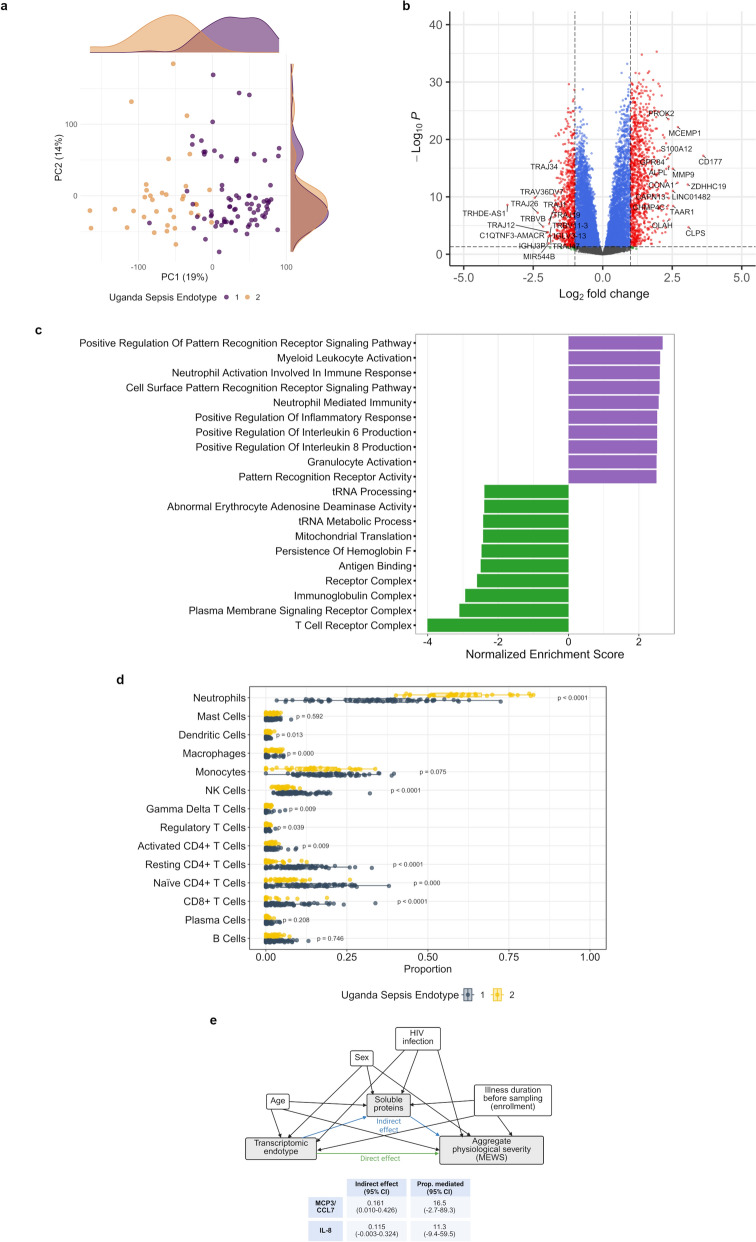
Two endotypes-Uganda Sepsis Endotypes 1 (USE-1) and 2 (USE-2)-were identified in the discovery cohort. USE-2, marked by neutrophil-driven innate immune activation and lymphocyte suppression, was associated with greater physiological severity and higher mortality (41.3% vs. 22.0%; absolute difference 19.3%, 95% CI 7.6-30.9%), irrespective of HIV, tuberculosis, or malaria infection. A 13-gene classifier (misclassification rate 1.43%) replicated two endotypes in the validation cohort with similar biological and clinical profiles. USE-2 showed strong transcriptional overlap with SRS1 and inflammopathic endotypes but only modest concordance in patient-level assignments. Overlap with Mars1 was variable.
We identified two transcriptomic sepsis endotypes in Uganda that reflect inter-individual differences in targetable pathobiology and confer prognostic enrichment across high-burden infections. Divergence from HIC-derived endotypes highlights the need for sepsis classifications that are both globally relevant and locally responsive.
撒哈拉以南非洲地区承担着全球最重的危重病负担,但该地区尚未明确转录组学脓毒症内型。其临床相关性以及与高收入国家(HICs)所确定内型的一致性仍不明确。
我们分析了乌干达两个成年脓毒症危重病患者前瞻性观察队列的数据(发现队列[托罗罗,农村],N = 243;验证队列[恩德培,城市],N = 112)。利用全血RNA测序数据的无监督聚类来识别发现队列中的内型。使用随机森林分类器预测验证队列中的内型分配。采用差异基因表达、通路富集和数字细胞计数来定义内型病理生物学,并确定与源自HICs的内型的重叠情况。
在发现队列中确定了两种内型——乌干达脓毒症内型1(USE - 1)和2(USE - 2)。USE - 2以中性粒细胞驱动的先天性免疫激活和淋巴细胞抑制为特征,与更高的生理严重程度和更高的死亡率相关(41.3%对22.0%;绝对差异19.3%,95%CI 7.6 - 30.9%),无论是否感染艾滋病毒、结核病或疟疾。一个13基因分类器(错误分类率1.43%)在验证队列中复制出了具有相似生物学和临床特征的两种内型。USE - 2与SRS1和炎症型内型显示出强烈的转录重叠,但在患者水平分配上仅有适度的一致性。与Mars1的重叠情况各不相同。
我们在乌干达确定了两种转录组学脓毒症内型,它们反映了可靶向病理生物学方面的个体差异,并在高负担感染中具有预后富集作用。与源自HICs的内型存在差异,这凸显了需要建立既具有全球相关性又能对本地情况做出反应的脓毒症分类方法。