
基于两样本孟德尔随机化研究的肠道微生物群对肺动脉高压的因果效应
The causal effect of gut microbiome on pulmonary artery hypertension based on a two-sample Mendelian randomization study.
作者信息
Jiang Detian, Chang Yuxin, Zhen Xiaowen, Zhao Xin
机构信息
Department of Cardiovascular Surgery, Qilu Hospital of Shandong University (Qingdao), Qingdao, 266035, China.
Department of Emergency, Qingdao Central Hospital, University of Health and Rehabilitation Sciences (Qingdao Central Hospital), Qingdao, 266042, China.
出版信息
Nutr Metab (Lond). 2025 Jul 29;22(1):86. doi: 10.1186/s12986-025-00979-0.
BACKGROUND
Alterations in gut microbiota composition have been linked to the presence of pulmonary artery hypertension (PAH), but it is unclear whether gut microbiota directly causes PAH.
METHODS
A two-sample Mendelian randomization approach was used to investigate the causal association between gut microbiota and PAH. Various MR methods were employed, including inverse variance weighted, MR-Egger, weighted median, weighted model, and simple mode, and instrumental variable heterogeneity was assessed using Cochran’s Q statistics.
RESULTS
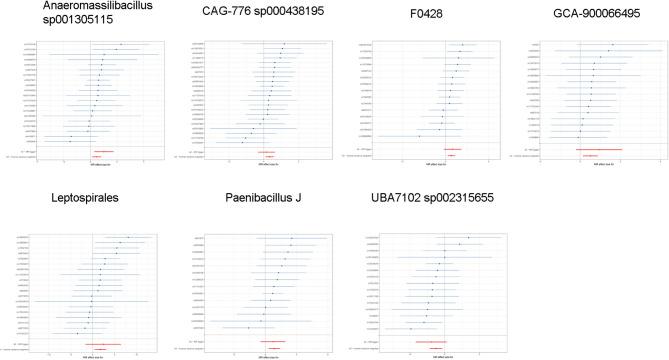
Seven bacterial genera were found to be associated with PAH in at least one MR method. Inverse variance weighted analysis showed that UBA7102 sp002315655 (odds ratio [OR] 0.36, 95% confidence interval [CI] 0.17–0.76, = 0.007) had a protective effect against PAH. Other genera, including Anaeromassilibacillus sp001305115 (OR 1.61, 95% CI: 1.14–2.28, = 0.006), CAG-776 sp000438195 (OR 1.40, 95% CI 1.10–1.7, = 0.005), F0428 (OR 1.96, 95% CI 1.27–3.03, = 0.002), GCA-900,066,495 (OR 1.66, 95% CI: 1.14–2.41, = 0.007), Leptospirales (OR 5.81, 95% CI 1.53–22.0, = 0.009) and Paenibacillus J (OR 3.20, 95% CI: 1.53–6.67, = 0.001), presented a positive association with PAH. No significant instrumental variable heterogeneity was found, and but horizontal pleiotropy was not present in any bacterial taxa.
CONCLUSIONS
This two-sample Mendelian randomization study found that UBA7102 sp002315655, Anaeromassilibacillus sp001305115, CAG-776 sp000438195, F0428, GCA-900,066,495, Leptospirales, and Paenibacillus J may have a causal association with PAH. Further research is needed to determine the underlying mechanisms by which gut microbiota affects PAH.
SUPPLEMENTARY INFORMATION
The online version contains supplementary material available at 10.1186/s12986-025-00979-0.
背景
肠道微生物群组成的改变与肺动脉高压(PAH)的存在有关,但尚不清楚肠道微生物群是否直接导致PAH。
方法
采用两样本孟德尔随机化方法研究肠道微生物群与PAH之间的因果关系。使用了各种孟德尔随机化方法,包括逆方差加权法、MR-Egger法、加权中位数法、加权模型法和简单模式法,并使用Cochran's Q统计量评估工具变量的异质性。
结果
在至少一种孟德尔随机化方法中,发现7个细菌属与PAH相关。逆方差加权分析显示,UBA7102 sp002315655(比值比[OR] 0.36,95%置信区间[CI] 0.17–0.76,P = 0.007)对PAH有保护作用。其他属,包括Anaeromassilibacillus sp001305115(OR 1.61,95% CI:1.14–2.28,P = 0.006)、CAG-776 sp000438195(OR 1.40,95% CI 1.10–1.7,P = 0.005)、F0428(OR 1.96,95% CI 1.27–3.03,P = 0.002)、GCA-900,066,495(OR 1.66,95% CI:1.14–2.41,P = 0.007)、钩端螺旋体目(OR 5.81,95% CI 1.53–22.0,P = 0.009)和芽孢杆菌J(OR 3.20,95% CI:1.53–6.67,P = 0.001)与PAH呈正相关。未发现显著的工具变量异质性,且在任何细菌分类群中均不存在水平多效性。
结论
这项两样本孟德尔随机化研究发现,UBA7102 sp002315655、Anaeromassilibacillus sp001305115、CAG-776 sp000438195、F0428、GCA-900,066,495、钩端螺旋体目和芽孢杆菌J可能与PAH存在因果关系。需要进一步研究以确定肠道微生物群影响PAH的潜在机制。
补充信息
在线版本包含可在10.1186/s12986-025-00979-0获取的补充材料。


 Zotero 插件