Song Junjie, Guan Xueting, Chen Lili, Han Zhouqing, Cui Haojun, Ma Shurong
Key Laboratory of Saline-Alkali Vegetation Ecology Restoration, Ministry of Education, Northeast Forestry University, Harbin 150040, China.
Microorganisms. 2025 Jul 2;13(7):1562. doi: 10.3390/microorganisms13071562.
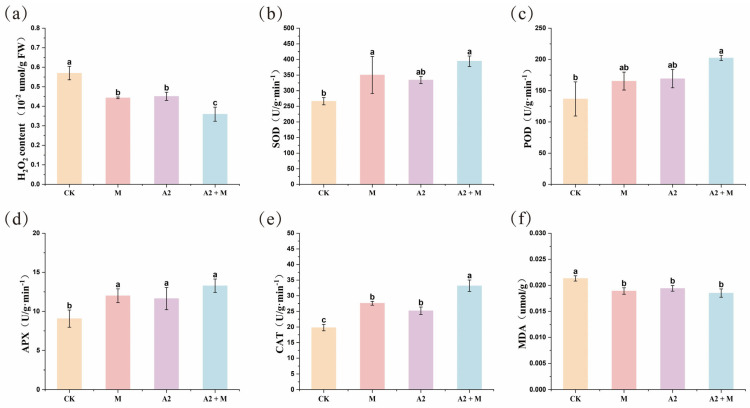
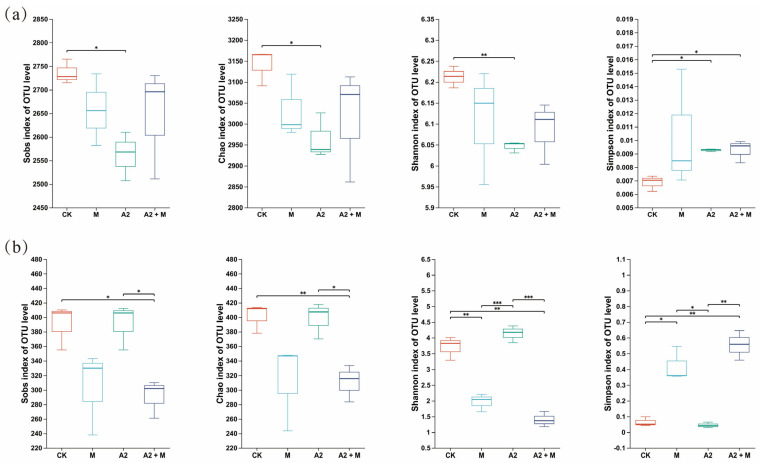
Soil salinization has become a major obstacle to global agricultural sustainability. While microbial inoculants show promise for remediation, the functional coordination between and PGPR in saline alkali rhizospheres requires systematic investigation. Pot studies demonstrated that while individual inoculations of (M) or (A2) moderately improved rice growth and soil properties, their co-inoculation (A2 + M) synergistically enhanced stress tolerance and nutrient availability-increasing available nitrogen (AN +28.02%), phosphorus (AP +11.55%), and potassium (AK +8.26%) more than either strain alone, while more effectively mitigating salinity (EC -5.54%) and alkalinity (pH -0.13 units). High-throughput sequencing further revealed that the A2 + M treatment reshaped the rhizosphere microbiome, uniquely enriching beneficial taxa (e.g., Actinomycetota [+9.68%], Ascomycota [+50.58%], Chytridiomycota [+152.43%]), and plant-growth-promoting genera (e.g., , ), while drastically reducing saline-alkali-adapted Basidiomycota (-87.96%). Further analysis identified soil organic matter (SOM), AN, and AP as key drivers for the enrichment of Chytridiomycota and Actinomycetota, whereas pH and EC showed positive correlations with Mortierellomycota, Aphelidiomycota, unclassified_k__Fungi, and Basidiomycota. Collectively, the co-inoculation of and PGPR strains enhanced soil microbiome structure and mitigated saline alkali stress in rice seedlings. These findings demonstrate the potential of microbial consortia as an effective bio-strategy for saline alkali soil amelioration.
土壤盐渍化已成为全球农业可持续发展的主要障碍。虽然微生物接种剂在修复方面显示出前景,但盐碱根际中微生物与植物根际促生细菌(PGPR)之间的功能协调需要系统研究。盆栽试验表明,虽然单独接种微生物(M)或植物根际促生细菌(A2)能适度改善水稻生长和土壤性质,但它们的共同接种(A2 + M)协同增强了胁迫耐受性和养分有效性,增加的有效氮(AN +28.02%)、磷(AP +11.55%)和钾(AK +8.26%)均超过单独接种任一菌株,同时更有效地减轻了盐分(EC -5.54%)和碱度(pH -0.13个单位)。高通量测序进一步揭示,A2 + M处理重塑了根际微生物群落,独特地富集了有益类群(如放线菌门[+9.68%]、子囊菌门[+50.58%]、壶菌门[+152.43%])和促进植物生长的属(如, ),同时大幅减少了适应盐碱的担子菌门(-87.96%)。进一步分析确定土壤有机质(SOM)、AN和AP是壶菌门和放线菌门富集的关键驱动因素,而pH和EC与被孢霉门、无分类_k__真菌和担子菌门呈正相关。总体而言,微生物与植物根际促生细菌菌株的共同接种增强了土壤微生物群落结构,减轻了水稻幼苗的盐碱胁迫。这些发现证明了微生物群落作为盐碱土壤改良有效生物策略的潜力。