Ruggaber Julian, Pölzleitner Daniel, Brembeck Jonathan
German Aerospace Center (DLR), Institute of Vehicle Concepts, Vehicle System Dynamics and Control, 82234 Weßling, Germany.
Sensors (Basel). 2025 Jul 8;25(14):4253. doi: 10.3390/s25144253.
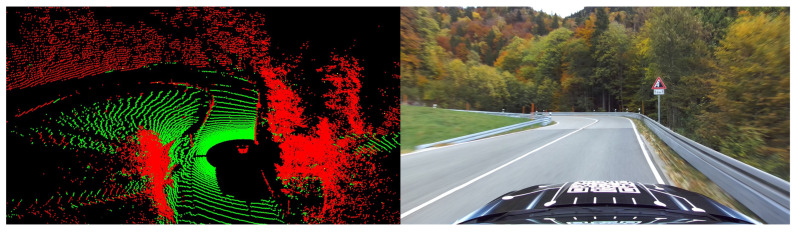
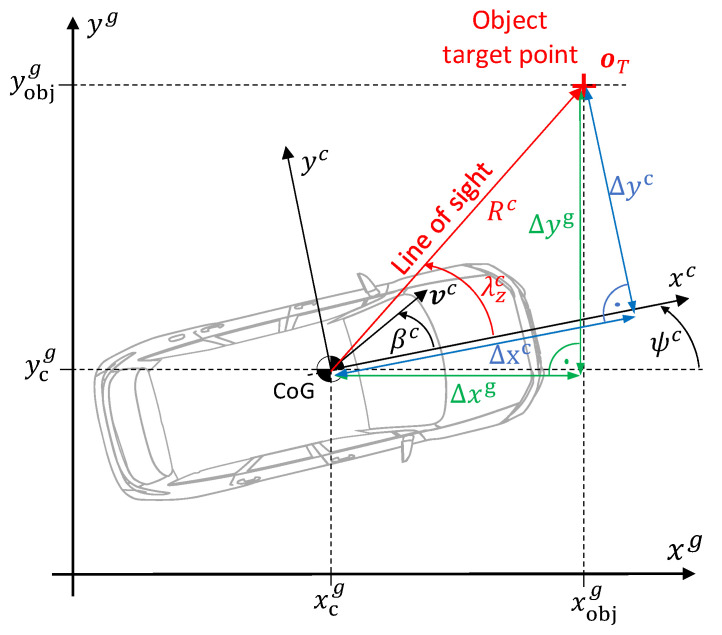
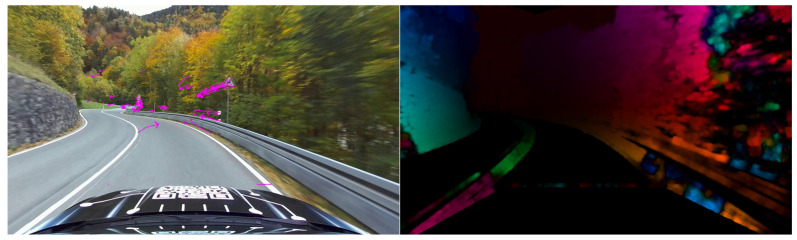
With the rise of vehicle automation, accurate estimation of driving dynamics has become crucial for ensuring safe and efficient operation. Vehicle dynamics control systems rely on these estimates to provide necessary control variables for stabilizing vehicles in various scenarios. Traditional model-based methods use wheel-related measurements, such as steering angle or wheel speed, as inputs. However, under low-traction conditions, e.g., on icy surfaces, these measurements often fail to deliver trustworthy information about the vehicle states. In such critical situations, precise estimation is essential for effective system intervention. This work introduces an AI-based approach that leverages perception sensor data, specifically camera images and lidar point clouds. By using relative kinematic relationships, it bypasses the complexities of vehicle and tire dynamics and enables robust estimation across all scenarios. Optical and scene flow are extracted from the sensor data and processed by a recurrent neural network to infer vehicle states. The proposed method is vehicle-agnostic, allowing trained models to be deployed across different platforms without additional calibration. Experimental results based on real-world data demonstrate that the AI-based estimator presented in this work achieves accurate and robust results under various conditions. Particularly in low-friction scenarios, it significantly outperforms conventional model-based approaches.
随着车辆自动化程度的提高,准确估计行驶动力学对于确保安全高效运行至关重要。车辆动力学控制系统依靠这些估计来提供必要的控制变量,以便在各种情况下稳定车辆。传统的基于模型的方法使用与车轮相关的测量值,如转向角或车轮速度,作为输入。然而,在低牵引力条件下,例如在结冰路面上,这些测量值往往无法提供有关车辆状态的可靠信息。在这种关键情况下,精确估计对于有效的系统干预至关重要。这项工作介绍了一种基于人工智能的方法,该方法利用感知传感器数据,特别是相机图像和激光雷达点云。通过使用相对运动学关系,它避开了车辆和轮胎动力学的复杂性,并能够在所有情况下进行稳健估计。从传感器数据中提取光流和场景流,并由循环神经网络进行处理,以推断车辆状态。所提出的方法与车辆无关,允许在不同平台上部署经过训练的模型,而无需额外校准。基于实际数据的实验结果表明,本文提出的基于人工智能的估计器在各种条件下都能取得准确而稳健的结果。特别是在低摩擦场景中,它明显优于传统的基于模型的方法。