Almeida João G, Teixeira Rafael, Neves Inês, Carrington Mafalda, Fonseca Paulo, Oliveira Marco, Gonçalves Helena, Primo João, Fontes-Carvalho Ricardo, Barra Sérgio, Martínez Juan Pablo, Almeida Rute
Cardiology Department, Unidade Local de Saúde Gaia Espinho, Vila Nova de Gaia, Portugal.
CINTESIS@RISE, Department of Community Medicine, Information and Health Decision Sciences, Faculty of Medicine, University of Porto, Porto, Portugal.
Heart Rhythm O2. 2025 Apr 21;6(7):969-977. doi: 10.1016/j.hroo.2025.04.004. eCollection 2025 Jul.
Atrial fibrillation (AF) remains a challenging condition to manage traditionally in clinical practice, and despite improvements in digital health, its impact on clinical outcomes remains uncertain.
This study aimed to assess the feasibility of a structured digital-blended follow-up for patients undergoing AF ablation, incorporating electronic patient-reported outcome measures (PROMs) while evaluating its impact on the timing of recurrence diagnosis and reintervention.
In this retrospective observational study, we included patients enrolled in a structured 2-year digital program starting in January 2021. This featured a Web platform for physicians to record clinical variables and a patient-centered mobile application to report PROM (Atrial Fibrillation Effect on Quality-of-Life [AFEQT] and Patient-Reported Outcomes Measurement Information System [PROMIS]). Clinical outcomes were compared with those from a retrospective conventionally managed cohort (2017-2020) after propensity score matching (n = 363 per group).
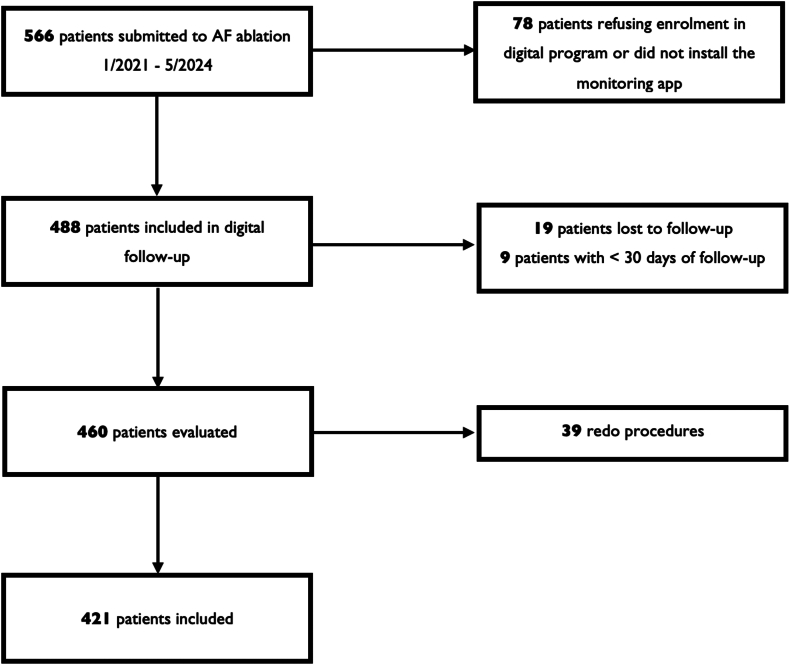
Until May 2024, 421 patients were enrolled (mean age: 60.9 years; 33.0% female). Over a median follow-up of 546 days, 64% of the patients used the application monthly, and completeness rates for AFEQT and PROMIS questionnaires were 80% and 50%, respectively. At 12 months, significant improvements were observed for AFEQT and PROMIS scores (cognitive and physical function, anxiety, and depression). Arrhythmia recurrence significantly influenced the rates of changes for AFEQT, depression, and physical function ( < .05 for interactions). Digital follow-up was associated with a shorter time until atrial tachycardia or AF recurrence (hazard ratio 1.45, = .019) and antiarrhythmic intervention (hazard ratio 1.65, = .022).
Systematic electronic PROM collection after AF ablation is feasible in clinical practice. Structured digital-blended integrated care guarantees continuity of AF management and supports earlier detection and treatment of recurrences.
在临床实践中,心房颤动(AF)的传统管理仍然具有挑战性,尽管数字健康有所改善,但其对临床结局的影响仍不确定。
本研究旨在评估对接受房颤消融术的患者进行结构化数字混合随访的可行性,纳入电子患者报告结局指标(PROMs),同时评估其对复发诊断时间和再次干预的影响。
在这项回顾性观察研究中,我们纳入了从2021年1月开始参加为期2年结构化数字项目的患者。该项目的特点是有一个供医生记录临床变量的网络平台和一个以患者为中心的移动应用程序,用于报告PROM(房颤对生活质量的影响[AFEQT]和患者报告结局测量信息系统[PROMIS])。在倾向得分匹配后(每组n = 363),将临床结局与回顾性传统管理队列(2017 - 2020年)的结局进行比较。
截至2024年5月,共纳入421例患者(平均年龄:60.9岁;33.0%为女性)。在中位随访546天期间,64%的患者每月使用该应用程序,AFEQT和PROMIS问卷的完成率分别为80%和50%。在12个月时,观察到AFEQT和PROMIS评分(认知和身体功能、焦虑和抑郁)有显著改善。心律失常复发显著影响AFEQT、抑郁和身体功能的变化率(交互作用P <.05)。数字随访与心房心动过速或房颤复发的时间缩短相关(风险比1.45,P = 0.019)以及抗心律失常干预相关(风险比1.65,P = 0.022)。
房颤消融术后系统收集电子PROM在临床实践中是可行的。结构化数字混合综合护理可确保房颤管理的连续性,并支持对复发的早期检测和治疗。