Cseprekal Orsolya, Savoye Emilie, Hawajri Nasser Al, Legeai Camille, Stengel Benedicte, Massy Ziad, Jacquelinet Christian
Department of Surgery, Transplantation and Gastroenterology, Semmelweis University, Budapest, Hungary.
INSERM Unit 1018, Team 5, CESP, Hôpital Paul Brousse, Paris-Sud University and Versailles Saint-Quentin-en-Yvelines University (Paris-Ile-de-France-Ouest University, UVSQ), Villejuif, France.
Clin Kidney J. 2025 May 13;18(7):sfaf129. doi: 10.1093/ckj/sfaf129. eCollection 2025 Jul.
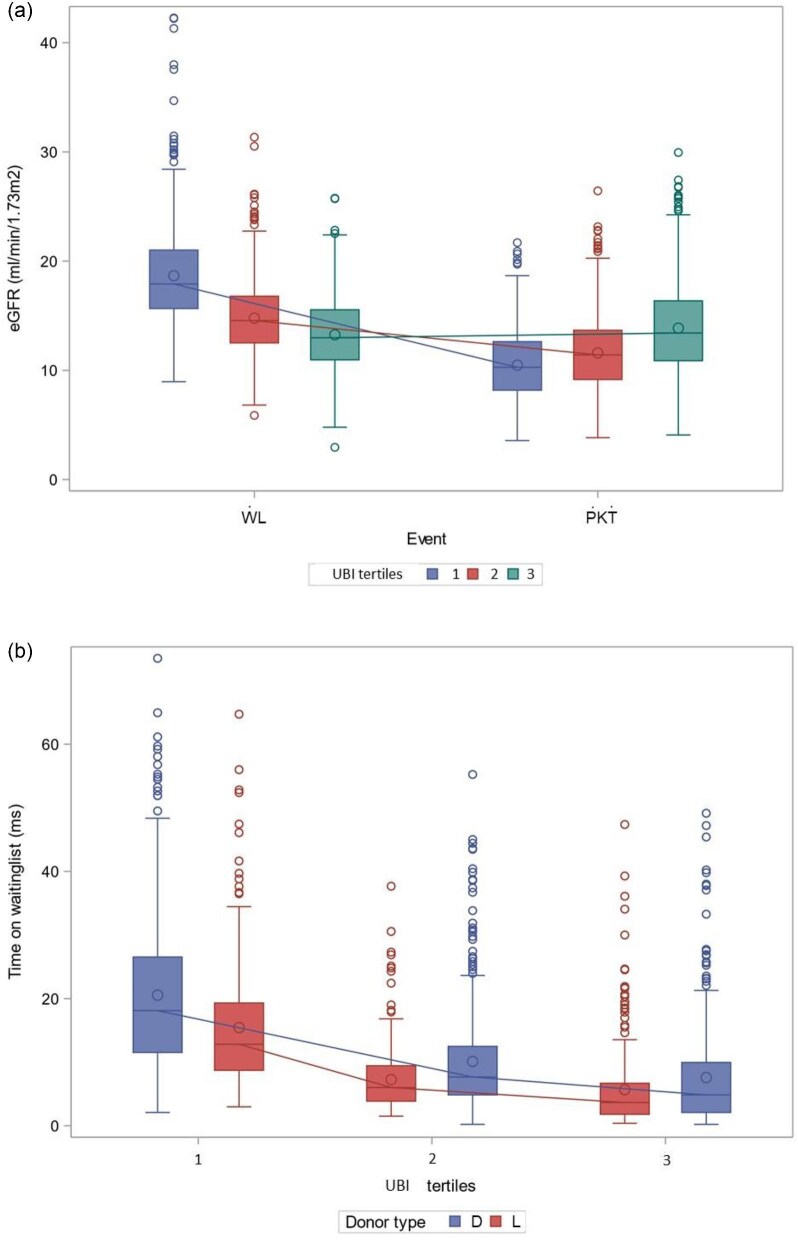
Timing of pre-emptive kidney transplantation (PKT) and the role of estimated glomerular filtration rate (eGFR) change in outcome prediction remains a subject of debate. This study aimed to assess potential factors, with special attention to uraemic burden, which may be associated with 5-year outcomes. In our retrospective observational cohort study, first PKT adults registered in the CRISTAL database between 2013 and 2019 were analysed to elucidate the role of eGFR and other associating factors with death and graft loss. Recipient-, donor- and transplantation-related features were analysed by using multivariable logistic regression analysis. A conditional inference tree was applied for risk stratification. A total of 2327 first PKT [52.8 years (interquartile range 43-64), 38% female) were included. The mean percentage of PKT over time was 14%. Primary kidney disease (congenital anomalies, glomerulonephritis and other causes versus autosomal dominant polycystic kidney disease), donor age and number of DR mismatches associated with combined 5-year outcomes [odds ratio 2.64 (95% confidence interval 1.42-4.93); 1.94 (1.1-4.93); 1.76 (1.06-2.92); 1.03 (1.02-1.05); 1.67 (1.1-2.53); < .05], whereas donor type was not associated with outcomes. By supervised decision-tree analysis, >30% risk of failure in PKT was attributed to high recipient risk, higher donor age, uraemic burden index (UBI)-a novel parameter defined by the product of eGFR change and the logarithmic time on the waiting list-and two DR mismatches. In conclusion, eGFR and donor type were not associated with death or graft failure in PKT. UBI can potentially be a novel parameter of uraemic burden and contribute to predict 5-year risk of failure. Clinical decisions based on objective risk estimations might be crucial to approach the 'PKT in due course' concept.
预先肾移植(PKT)的时机以及估计肾小球滤过率(eGFR)变化在结局预测中的作用仍是一个有争议的话题。本研究旨在评估可能与5年结局相关的潜在因素,特别关注尿毒症负担。在我们的回顾性观察队列研究中,分析了2013年至2019年间在CRISTAL数据库中登记的首次接受PKT的成年患者,以阐明eGFR和其他相关因素在死亡和移植肾丢失中的作用。通过多变量逻辑回归分析对受者、供者和移植相关特征进行分析。应用条件推断树进行风险分层。共纳入2327例首次接受PKT的患者[年龄52.8岁(四分位间距43 - 64岁),38%为女性]。PKT随时间的平均百分比为14%。原发性肾病(先天性异常、肾小球肾炎和其他病因与常染色体显性多囊肾病)、供者年龄和DR错配数量与5年综合结局相关[比值比2.64(95%置信区间1.42 - 4.93);1.94(1.1 - 4.93);1.76(1.06 - 2.92);1.03(1.02 - 1.05);1.67(1.1 - 2.53);P < 0.05],而供者类型与结局无关。通过监督决策树分析,PKT失败风险>30%归因于高受者风险、较高的供者年龄、尿毒症负担指数(UBI)——一个由eGFR变化与等待名单上的对数时间之积定义的新参数——以及两个DR错配。总之,eGFR和供者类型与PKT中的死亡或移植肾失败无关。UBI可能是尿毒症负担的一个新参数,并有助于预测5年失败风险。基于客观风险估计的临床决策对于实现“适时PKT”概念可能至关重要。