Grouthier Virginie, Matamala Marie, Tabarin Antoine, Galioot Amandine, Couffinhal Thierry, Vaglio Martino, Badilini Fabio, Prifti Edi, Salem Joe-Elie
Department of Endocrinology, Diabetes and Nutrition, Centre Hospitalier Universitaire de Bordeaux, Haut-Leveque Hospital, F-33604 Pessac, France.
University of Bordeaux, Inserm U1034, Biology of Cardiovascular Diseases, Pessac, France.
JAMA Netw Open. 2025 Jul 1;8(7):e2524124. doi: 10.1001/jamanetworkopen.2025.24124.
Transgender women (assigned male at birth) usually take antiandrogens associated with estrogens (or are castrated) to induce feminization, whereas transgender men (assigned female at birth) take testosterone to induce masculinization. However, the cardiovascular outcomes of these gender-affirming hormone therapies (GAHTs) remain poorly studied.
To examine the association between GAHT intake and cardiac repolarization alterations on electrocardiography in transgender individuals.
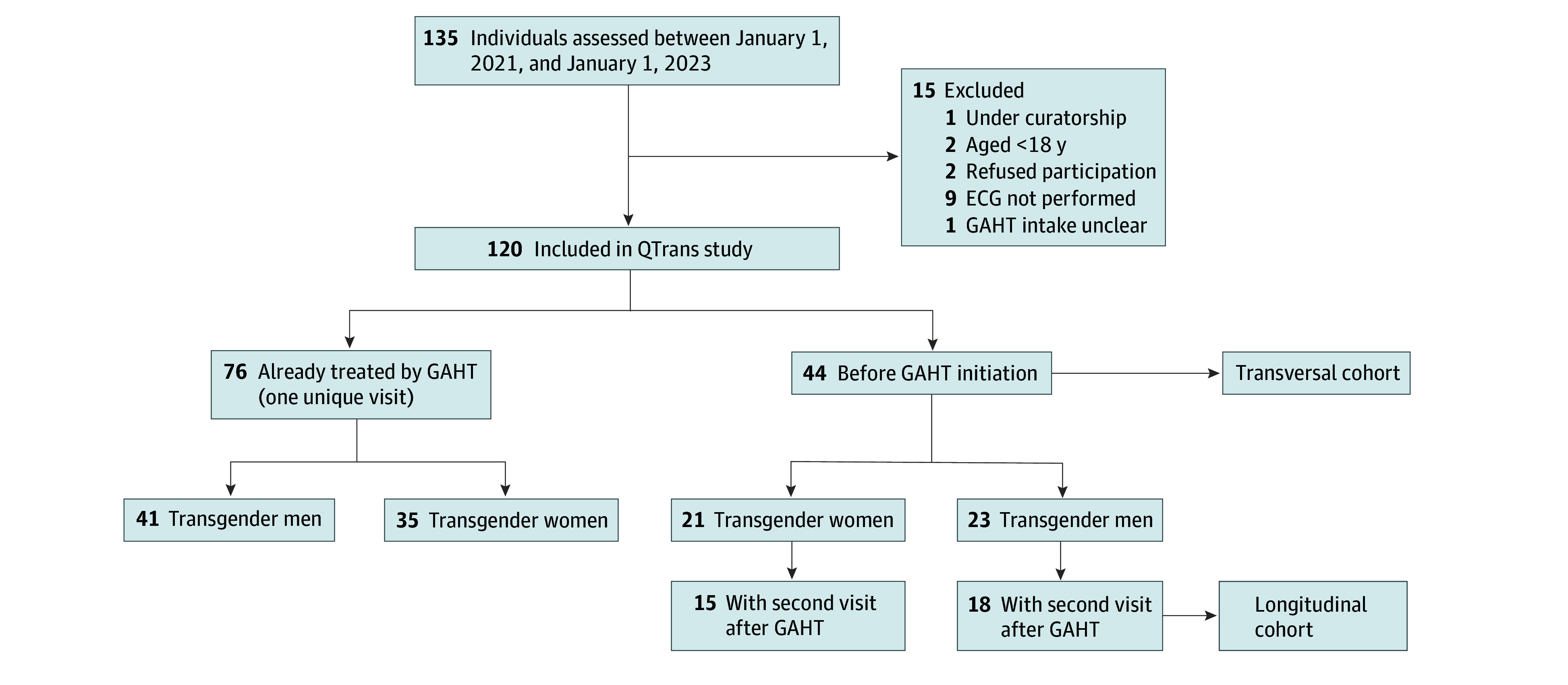
DESIGN, SETTING, AND PARTICIPANTS: In this cohort study, data from a prospective cohort of adult transgender individuals from a single center in France were collected from January 1, 2021, to January 1, 2023. GAHT consisted of injectable testosterone in transgender men and transdermal estradiol with mostly oral cyproterone acetate as antiandrogens in transgender women.
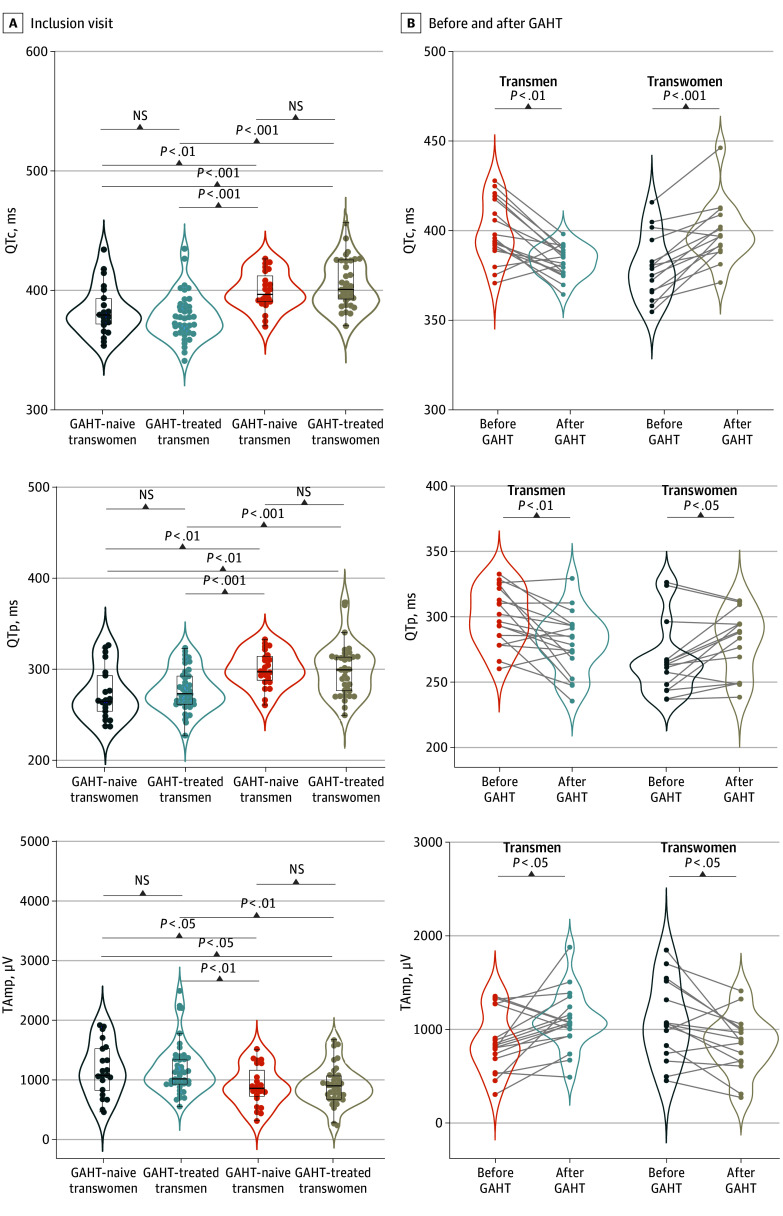
Electrocardiographic features, including QTc, T-wave maximal amplitude (TAmp), and QT peak (QTp; distance between Q onset and T peak), were studied. Circulating sex hormones, including total testosterone, estradiol, progesterone, and gonadotrophins, were assessed concomitantly to electrocardiographic intake.
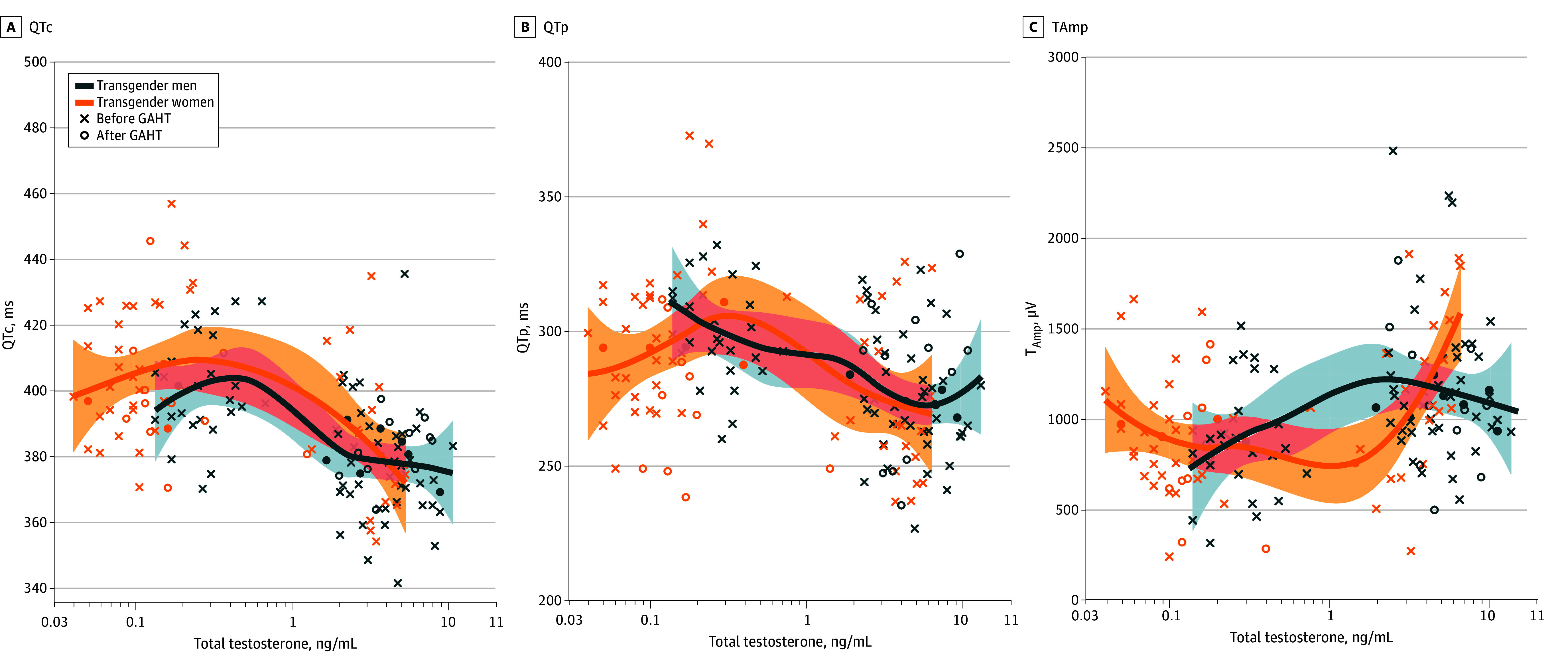
In the overall cohort of 120 transgender individuals (mean [SD] age, 29.7 [11.9] years; 64 transgender men and 56 transgender women), mean (SD) QTc was similar between 35 transgender women receiving GAHT (406 [20] milliseconds) and 23 transgender men before GAHT (400 [16] milliseconds) but prolonged vs 41 transgender men receiving GAHT (378 [19] milliseconds) (P < .001) or 21 transgender women before receiving GAHT (384 [21] milliseconds) (P < .001). The start of GAHT in 15 transgender women was associated with increased QTc (mean [SD], 20 [12] milliseconds vs before receiving GAHT; P < .001) and decreased QTc in 18 transgender men (mean [SD], -17 [16] milliseconds vs before receiving GAHT; P < .001). No participant had a QTc greater than 480 milliseconds or QTc change greater than 60 milliseconds after the start of GAHT in this study. Nonlinear mixed models (eg, integrating age, calcemia, relevant circulating hormones levels, and torsadogenic drug intake) showed that QTc was associated with total testosterone in transgender men (mean [SD] estimate, -1.6 [0.6] ms/ng/mL; P = .007) and prolactin (mean [SD], 0.4 [0.1] ms/ng/mL; P < .001). In transgender women, QTc was associated with total testosterone (mean [SD] estimate, -3.5 [0.8] ms/ng/mL; P < .001). Variation of QTp and TAmp observed after the start of GAHT and associated hormonal alteration were globally associated with those observed with QTc, although in opposite directions for transgender women and transgender men.
In this cohort study, testosterone use in transgender men was associated with QTc and QTp shortening and increased TAmp. Androgen deprivation in transgender women was associated with opposite observations. The magnitude of QTc sexual dimorphism seen in cisgender adults was also observed in the transgender population. This work highlights that potential GAHT effects on cardiac repolarization warrant attention in the exponentially increasing transgender population, which is often exposed to coprescribed drugs prolonging QTc and at risk of TdP.
跨性别女性(出生时被指定为男性)通常服用与雌激素相关的抗雄激素药物(或接受阉割)以诱导女性化,而跨性别男性(出生时被指定为女性)服用睾酮以诱导男性化。然而,这些性别确认激素疗法(GAHTs)对心血管的影响仍研究不足。
研究跨性别个体接受GAHT与心电图上心脏复极改变之间的关联。
设计、地点和参与者:在这项队列研究中,收集了2021年1月1日至2023年1月1日来自法国一个中心的成年跨性别个体前瞻性队列的数据。GAHT在跨性别男性中为注射用睾酮,在跨性别女性中为经皮雌二醇,大多联合口服醋酸环丙孕酮作为抗雄激素药物。
研究心电图特征,包括QTc、T波最大振幅(TAmp)和QT峰(QTp;Q波起始点与T波峰值之间的距离)。在进行心电图检查的同时评估循环性激素水平,包括总睾酮、雌二醇、孕酮和促性腺激素。
在120名跨性别个体的总体队列中(平均[标准差]年龄为29.7[11.9]岁;64名跨性别男性和56名跨性别女性),35名接受GAHT的跨性别女性的平均(标准差)QTc(406[20]毫秒)与23名未接受GAHT的跨性别男性(400[16]毫秒)相似,但与41名接受GAHT的跨性别男性(378[19]毫秒)相比延长(P<.001),与21名未接受GAHT的跨性别女性(384[21]毫秒)相比也延长(P<.001)。15名跨性别女性开始接受GAHT与QTc增加有关(平均[标准差],20[12]毫秒,与接受GAHT前相比;P<.001),18名跨性别男性的QTc降低(平均[标准差],-17[16]毫秒,与接受GAHT前相比;P<.001)。在本研究中,没有参与者在开始GAHT后QTc大于480毫秒或QTc变化大于60毫秒。非线性混合模型(例如,综合年龄、血钙、相关循环激素水平和致尖端扭转型室速药物的使用情况)显示,QTc与跨性别男性的总睾酮(平均[标准差]估计值,-1.6[0.6]毫秒/纳克/毫升;P=.007)和催乳素(平均[标准差],0.4[0.1]毫秒/纳克/毫升;P<.001)有关。在跨性别女性中,QTc与总睾酮有关(平均[标准差]估计值,-3.5[0.8]毫秒/纳克/毫升;P<.001)。开始GAHT后观察到的QTp和TAmp变化以及相关的激素改变总体上与QTc观察到的情况相关,尽管在跨性别女性和跨性别男性中方向相反。
在这项队列研究中,跨性别男性使用睾酮与QTc和QTp缩短以及TAmp增加有关。跨性别女性的雄激素剥夺则出现相反的情况。在顺性别成年人中观察到的QTc性别差异程度在跨性别群体中也有体现。这项研究强调,在数量呈指数增长的跨性别群体中,GAHT对心脏复极的潜在影响值得关注,该群体经常同时服用延长QTc的药物且有发生尖端扭转型室速的风险。