Seidabadi Leila, Vandenbussche Indra, Carter Fink Rowan, Moore MacKenzie, McCorkendale Bailey, Esmailie Fateme
Department of Biomedical Engineering, University of North Texas, Denton, TX 76207, United States.
Interdiscip Cardiovasc Thorac Surg. 2025 Aug 5;40(8). doi: 10.1093/icvts/ivaf184.
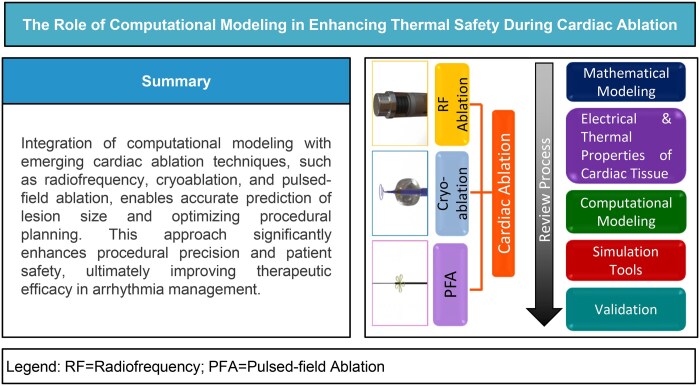
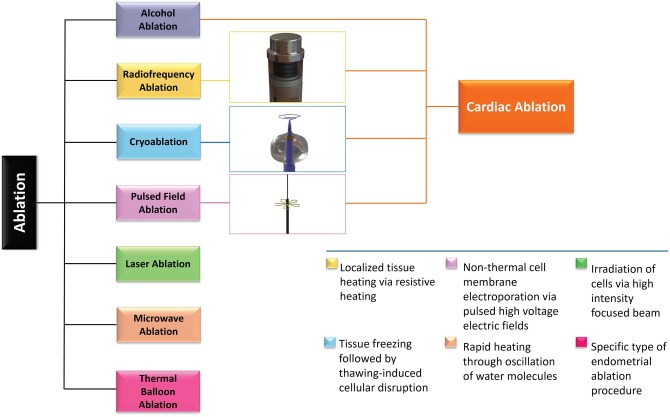
In this narrative review, we aim to provide an analysis of current cardiac ablation techniques, such as radiofrequency ablation, cryoablation, and pulsed-field ablation, with a focus on the role of computational modelling in enhancing the precision, safety, and effectiveness of these treatments. Particular attention is given to thermal management, exploring how computational approaches contribute to understanding and controlling energy delivery, heat distribution, and tissue response during ablation procedures.
We conducted this narrative review based on our expertise and a targeted search using over 50 keywords across major databases. We selected studies for their relevance, impact, and methodological rigor, and included additional references suggested during peer review. While we did not follow a systematic protocol, our approach ensured broad coverage of key developments and emerging trends in the field. We then presented the mechanisms, applications, and limitations of radiofrequency ablation, cryoablation, and pulsed-field ablation. Additionally, we discussed the use of computational approaches, including numerical methods and artificial intelligence based models, for evaluating energy distribution, lesion size, and tissue response during ablation procedures.
Computational methods can be used to predict ablation treatment outcomes and help optimize lesion size, ablation parameters, and procedural safety. However, these models are only reliable when properly validated and verified.
Further research is essential to collect reliable in vivo data for validating computational models and integrating them into clinical practice to improve patient outcomes.
在本叙述性综述中,我们旨在分析当前的心脏消融技术,如射频消融、冷冻消融和脉冲场消融,重点关注计算建模在提高这些治疗的精准度、安全性和有效性方面的作用。特别关注热管理,探讨计算方法如何有助于理解和控制消融过程中的能量传递、热分布和组织反应。
我们基于自身专业知识并使用50多个关键词在主要数据库中进行了有针对性的检索,开展了本叙述性综述。我们根据研究的相关性、影响力和方法的严谨性来选择研究,并纳入同行评审期间建议的其他参考文献。虽然我们没有遵循系统的方案,但我们的方法确保了对该领域关键进展和新兴趋势的广泛覆盖。然后,我们介绍了射频消融、冷冻消融和脉冲场消融的机制、应用和局限性。此外,我们还讨论了计算方法的应用,包括数值方法和基于人工智能的模型,用于评估消融过程中的能量分布、损伤大小和组织反应。
计算方法可用于预测消融治疗结果,并有助于优化损伤大小、消融参数和手术安全性。然而,这些模型只有在经过适当验证和核实后才可靠。
进一步的研究对于收集可靠的体内数据以验证计算模型并将其整合到临床实践中以改善患者预后至关重要。