Chen Shaoyi, Sun Zewen, Li Yun, Yang Fan, Wang Peiyu, Chen Kezhong, Wang Jun, Qiu Mantang
Department of Thoracic Surgery, Peking University People's Hospital, Beijing, 100044, China.
Thoracic Oncology Institute, Peking University People's Hospital, Beijing, 100044, China.
EClinicalMedicine. 2025 Jul 24;86:103369. doi: 10.1016/j.eclinm.2025.103369. eCollection 2025 Aug.
Despite numerous randomized controlled trials (RCTs) on cancer vaccines, systematic evaluations of their efficacy and safety for patients with advanced non-small cell lung cancer (NSCLC) following first-line therapy remain lacking.
In this systematic review and meta-analysis (PROSPERO, CRD42024568178), PubMed, Cochrane Library, and Embase databases were searched from inception up to December 27, 2024. Published phase II or III RCTs reporting survival outcomes in advanced or metastatic NSCLC patients who received vaccine therapy after first-line therapy were included. Data were independently extracted by two reviewers. The primary outcome was overall survival (OS), with progression-free survival (PFS) as secondary outcome. Treatment-related adverse events (TRAEs) was the major safety outcome. Random-effects model was employed in this meta-analysis. Risk of bias was evaluated with RoB 2.
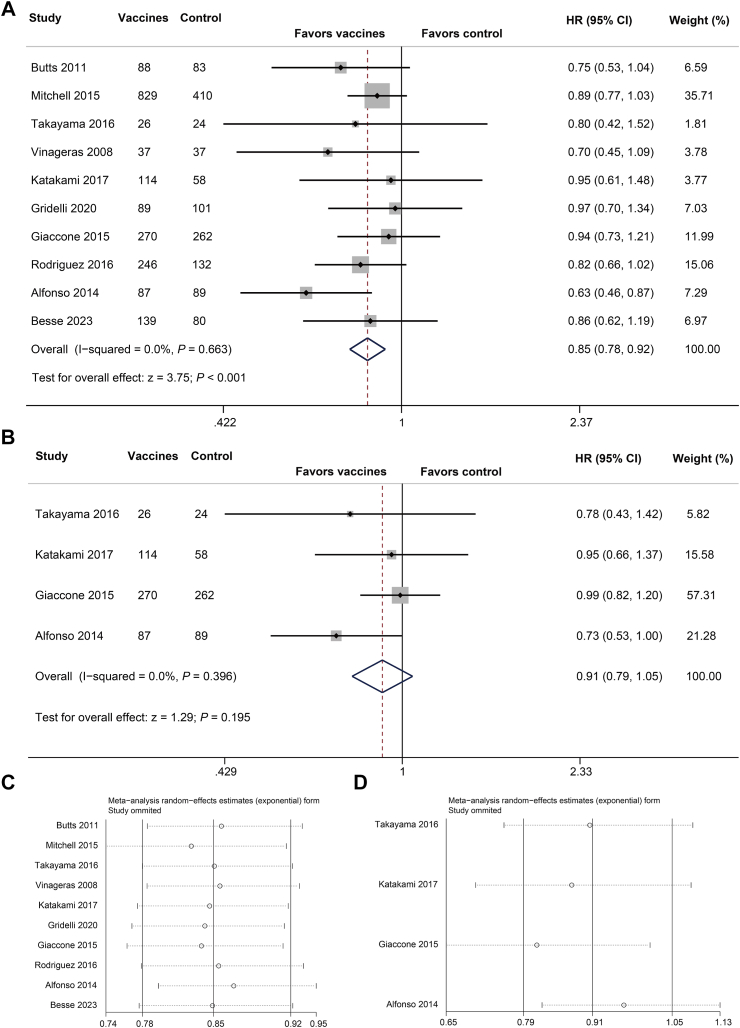
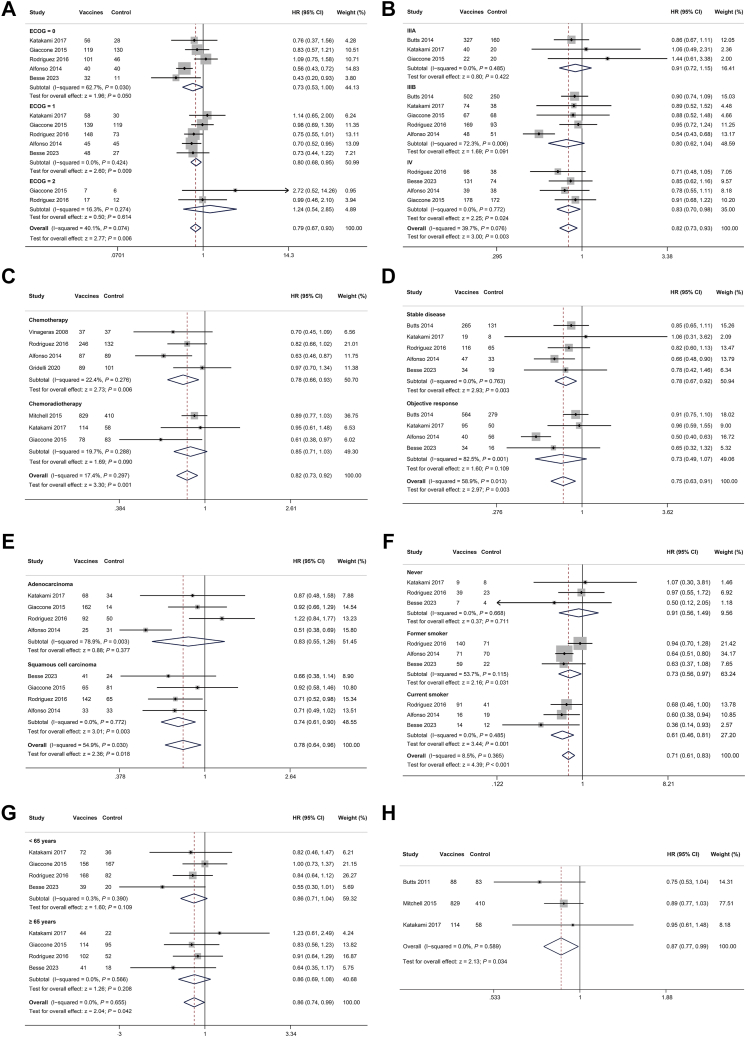
Eleven RCTs comprising 3228 patients (67% male, n = 2162) were included, without high risk of bias. The included studies involved employing cancer vaccines as first-line maintenance therapy, second-line therapy, or third-line therapy. In general, Cancer vaccines associated with improved OS (HR = 0.85, 95% CI, 0.78-0.92, < 0.001) but did not significantly improve PFS (HR = 0.91, 95% CI, 0.79-1.05, = 0.195). Subgroup analyses indicated better OS for patients with ECOG = 1, first-line chemotherapy, squamous cell carcinoma, stable disease after first-line therapy, stage IV, and smoking history. Squamous cell carcinoma (HR = 0.74, 95% CI, 0.61-0.90, = 0.003) responded better to vaccine therapy than adenocarcinoma (HR = 0.83, 95% CI, 0.55-1.26, = 0.377). The pooled OR for TRAEs was 1.5 (95% CI, 0.63-3.61, = 0.361). Exploratory analysis indicated that immune response to cancer vaccines may serve as a predictive biomarker for vaccines effect. Besides, consistent efficacy and safety results were obtained when the meta-analysis was specific to first-line maintenance therapy based on seven trials.
This meta-analysis demonstrated the clinical efficacy and safety of cancer vaccines in advanced NSCLC patients after first-line therapy, especially in those with squamous cell carcinoma. Immune response was identified as a predictive biomarker for vaccines effect. This study provides the state-of-the-art evidence for the clinical application of cancer vaccines in advanced NSCLC patients after first-line therapy.
20240484580, 20230484314, 2023YFF0723500, 2021RU002, 82173386, RZ2022-04.
尽管针对癌症疫苗进行了大量随机对照试验(RCT),但对于一线治疗后的晚期非小细胞肺癌(NSCLC)患者,其疗效和安全性的系统评估仍然缺乏。
在这项系统评价和荟萃分析(PROSPERO,CRD42024568178)中,检索了PubMed、Cochrane图书馆和Embase数据库,检索时间从数据库建立至2024年12月27日。纳入发表的II期或III期RCT,这些研究报告了一线治疗后接受疫苗治疗的晚期或转移性NSCLC患者的生存结果。数据由两名研究者独立提取。主要结局为总生存期(OS),无进展生存期(PFS)作为次要结局。治疗相关不良事件(TRAEs)是主要的安全性结局。本荟萃分析采用随机效应模型。采用RoB 2评估偏倚风险。
纳入11项RCT,共3228例患者(67%为男性,n = 2162),无高偏倚风险。纳入的研究涉及将癌症疫苗用作一线维持治疗、二线治疗或三线治疗。总体而言,癌症疫苗与OS改善相关(HR = 0.85,95%CI,0.78 - 0.92,P < 0.001),但未显著改善PFS(HR = 0.91,95%CI,0.79 - 1.05,P = 0.195)。亚组分析表明,对于东部肿瘤协作组(ECOG)体能状态评分为1、接受一线化疗、鳞状细胞癌、一线治疗后病情稳定、IV期以及有吸烟史的患者,OS更佳。鳞状细胞癌(HR = 0.74,95%CI,0.61 - 0.90,P = 0.003)对疫苗治疗的反应优于腺癌(HR = 0.83,95%CI,0.55 - 1.26,P = 0.377)。TRAEs的合并OR为1.5(95%CI,0.63 - 3.61,P = 0.361)。探索性分析表明,对癌症疫苗的免疫反应可能作为疫苗效果的预测生物标志物。此外,基于七项试验的一线维持治疗特异性荟萃分析获得了一致的疗效和安全性结果。
这项荟萃分析证明了癌症疫苗在一线治疗后的晚期NSCLC患者中的临床疗效和安全性,尤其是在鳞状细胞癌患者中。免疫反应被确定为疫苗效果的预测生物标志物。本研究为癌症疫苗在一线治疗后的晚期NSCLC患者中的临床应用提供了最新证据。
20240484580、20230484314、2023YFF0723500、2021RU002、82173386、RZ2022 - 04。