Schwartz Mathias, Filser Mathilde, Merchadou Kevin, Lemaitre Elisa, Abidallah Khadija, Tenreiro Henrique, Dubois D'enghien Catherine, Rapinat Audrey, Pierre-Noel Elise, Suybeng Voreak, Espenel Marion, Baulande Sylvain, Adams Séverine, Remenieras Audrey, Renaud Crystal, Aucouturier Camille, Delnatte Capucine, Garrec Céline, Renault Victor, Golmard Lisa, Fourme Emmanuelle, Masliah-Planchon Julien, Caputo Sandrine M
Department of Genetics, Institut Curie, Paris, France.
Dynamics of epigenetic plasticity in cancer, UMR3244, Institut Curie, Paris, France.
NPJ Genom Med. 2025 Jul 31;10(1):58. doi: 10.1038/s41525-025-00517-0.
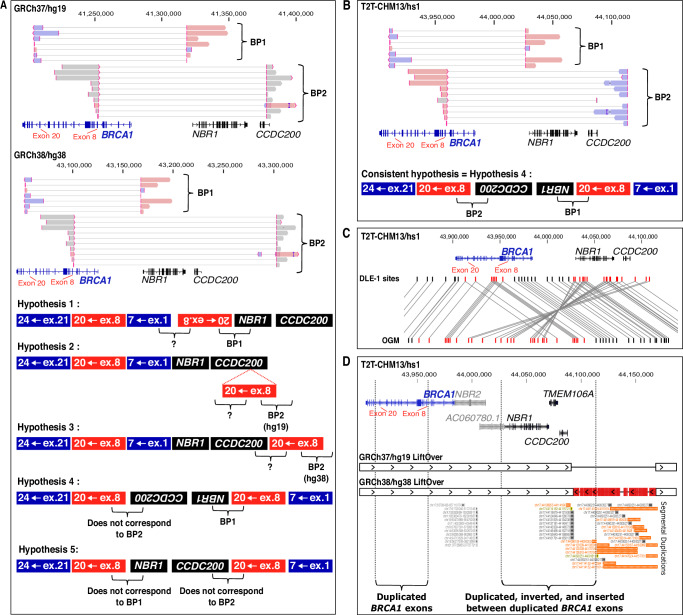
Pathogenicity assessment of genetic variants is the cornerstone of genetic counselling. Copy gains of exons are challenging, as pathogenicity depends on the localization of the additional exons. Eight patients form six families carried copy gains of BRCA1 exons 8-20. For appropriate characterization, long-read sequencing aligned on three distinct reference genome assemblies, optical genomic mapping, short-read and long-read RNA sequencing were performed. All patients shared the same pathogenic structural variant, involving a large segment located downstream in the genome. One breakpoint occurred in a region incorrectly annotated in GRCh37/hg19 and GRCh38/hg38. Alignment to the T2T-CHM13/hs1 assembly was therefore necessary for accurate characterization. This rearrangement caused various BRCA1 transcriptomic abnormalities: back-splicing, forward genomic strand transcription by insertion of an ectopic promoter, fusion transcripts with the "Next to BRCA1" gene 1 (NBR1). Our findings underscore the need to combine advanced technologies with the latest genome references to resolve complex rearrangements with significant medical implications.
基因变异的致病性评估是遗传咨询的基石。外显子的拷贝数增加具有挑战性,因为致病性取决于额外外显子的定位。来自六个家庭的八名患者携带BRCA1外显子8-20的拷贝数增加。为了进行适当的特征描述,对三个不同的参考基因组组装进行了长读长测序比对、光学基因组图谱分析、短读长和长读长RNA测序。所有患者都共享相同的致病性结构变异,涉及基因组下游的一个大片段。一个断点出现在GRCh37/hg19和GRCh38/hg38中注释错误的区域。因此,为了准确表征,有必要与T2T-CHM13/hs1组装进行比对。这种重排导致了各种BRCA1转录组异常:反向剪接、通过插入异位启动子进行正向基因组链转录、与“BRCA1旁边”基因1(NBR1)的融合转录本。我们的研究结果强调了将先进技术与最新的基因组参考相结合以解决具有重大医学意义的复杂重排的必要性。