Busquets Núria, Gardela Jaume, José-Cunilleras Eduard, Solé Alba, Salvador Maria José, Obón Elena, Molina-López Rafael, Aranda Carles, Montalvo Tomás, Corbella Irene, Bou-Monclús Maria Assumpció, Martínez Miguel Julián, Vázquez Ana, Piron Maria, Sauleda Sílvia, Pailler-García Lola, Napp Sebastián
IRTA, Programa de Sanitat Animal, Centre de Recerca en Sanitat Animal (CReSA), Campus de la Universitat Autònoma de Barcelona (UAB), Bellaterra, Catalonia, Spain.
Unitat mixta d'Investigació IRTA-UAB en Sanitat Animal, Centre de Recerca en Sanitat Animal (CReSA), Campus de la Universitat Autònoma de Barcelona (UAB), Bellaterra, Catalonia, Spain.
One Health. 2025 Jul 21;21:101150. doi: 10.1016/j.onehlt.2025.101150. eCollection 2025 Dec.
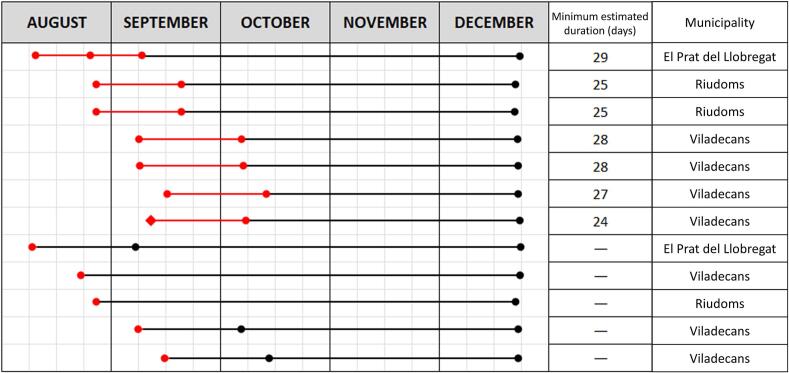
West Nile virus (WNV), mainly transmitted by mosquitoes, poses significant health risks to humans and horses, particularly in endemic regions. The first detection of WNV lineage 2 in Spain was in 2017 in Catalonia (northeastern Spain). In 2023, WNV was confirmed in a young yellow-legged gull and a probable human case was notified within the urban settings. We aimed to define the zone of WNV circulation in the Barcelona Metropolitan Area where these infections occurred and the effectiveness of the One Health approach for early WNV detection. The Catalan WNV surveillance and control programs includes the testing of horses, birds, mosquitoes and humans following molecular and serological methods. Phylogenetic analyses were performed to determine the origin of the circulating virus. IgM-positive data from both active and passive surveillance in horses identified the area of WNV circulation and suggested that WNV circulation happened either before or concurrently with human and bird infections in the agricultural and peri-urban areas. Furthermore, a new WNV introduction was discarded by phylogenetic studies, demonstrating that WNV lineage 2 has been established in Catalonia, albeit at a low level of circulation since the virus was not detected in blood donors. Our findings underscore the importance of integrating active and passive surveillance strategies to early assess WNV circulation and activate public health responses. The study highlights the role of wildlife in the WNV transmission and emphasizes the need for ongoing monitoring in animals and also mosquito control measures to mitigate the risk of animal and human infections.
西尼罗河病毒(WNV)主要通过蚊子传播,对人类和马匹构成重大健康风险,尤其是在流行地区。2017年,西班牙加泰罗尼亚(西班牙东北部)首次检测到西尼罗河病毒2型。2023年,在一只小黄脚鸥身上确诊感染西尼罗河病毒,并通报了一起可能发生在城市环境中的人类病例。我们旨在确定这些感染发生地巴塞罗那大都市区西尼罗河病毒的传播区域,以及“同一健康”方法在早期检测西尼罗河病毒方面的有效性。加泰罗尼亚西尼罗河病毒监测和控制计划包括采用分子和血清学方法对马匹、鸟类、蚊子和人类进行检测。通过系统发育分析来确定传播病毒的来源。对马匹主动监测和被动监测的IgM阳性数据确定了西尼罗河病毒的传播区域,并表明在农业和城郊地区,西尼罗河病毒的传播先于或与人类和鸟类感染同时发生。此外,系统发育研究排除了新的西尼罗河病毒传入的可能性,表明西尼罗河病毒2型已在加泰罗尼亚确立,尽管传播水平较低,因为在献血者中未检测到该病毒。我们的研究结果强调了整合主动监测和被动监测策略以早期评估西尼罗河病毒传播并启动公共卫生应对措施的重要性。该研究突出了野生动物在西尼罗河病毒传播中的作用,并强调需要持续监测动物以及采取蚊虫控制措施以降低动物和人类感染风险。