Keritam Omar, Ascoli Oliver, Harsanyi Andrea, Cetin Hakan, Berger Thomas, Unseld Matthias, Rommer Paulus Stefan
Department of Neurology, Medical University of Vienna, Waehringer Guertel 18-20, 1090, Vienna, Austria.
Comprehensive Center for Clinical Neurosciences and Mental Health, Medical University of Vienna, Vienna, Austria.
J Neurol. 2025 Aug 3;272(8):553. doi: 10.1007/s00415-025-13296-6.
Multiple sclerosis (MS) is a chronic immune-mediated disease that can cause severe physical and cognitive disability. While modern therapies have improved outcomes in relapsing MS, patients with advanced disease remain underserved. In this stage, neurodegeneration dominates, treatment options are limited, and care becomes complex. Yet individuals with advanced MS are largely absent from trials, registries, and structured care pathways, leaving a major evidence gap.
To characterize the clinical, social, and treatment-related profile of patients with advanced MS in institutional care.
We conducted an exploratory, retrospective study of patients with advanced MS (EDSS ≥ 6.5) admitted to a long-term care facility in Vienna. Data on disease history, comorbidities, medications, cognitive and functional status, and social background were extracted from medical records.
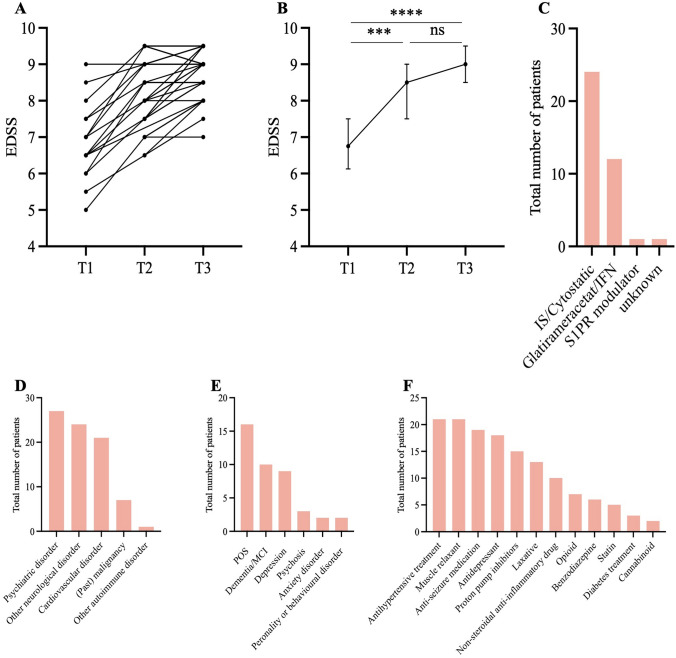
Thirty-four patients were included (73.5% female; median age at admission: 54.1 years). Most had secondary progressive MS (85.3%). Disease-modifying therapy (DMT) exposure was limited; only one patient received DMT during care. Comorbidity and polypharmacy were frequent. EDSS progression occurred in 50%. The Braden Scale was the only score differing significantly between cohorts.
This study highlights care gaps in advanced MS and the need for tailored strategies in institutional care settings.
多发性硬化症(MS)是一种慢性免疫介导性疾病,可导致严重的身体和认知残疾。虽然现代疗法改善了复发型MS的治疗效果,但晚期疾病患者仍未得到充分治疗。在这个阶段,神经退行性变占主导,治疗选择有限,护理变得复杂。然而,晚期MS患者在很大程度上未参与试验、登记和结构化护理途径,留下了重大的证据空白。
描述机构护理中晚期MS患者的临床、社会和治疗相关特征。
我们对入住维也纳一家长期护理机构的晚期MS患者(扩展残疾状态量表[EDSS]≥6.5)进行了一项探索性回顾性研究。从病历中提取疾病史、合并症、用药情况、认知和功能状态以及社会背景的数据。
纳入34例患者(73.5%为女性;入院时中位年龄:54.1岁)。大多数为继发进展型MS(85.3%)。疾病修正治疗(DMT)的暴露有限;护理期间只有1例患者接受了DMT。合并症和多种药物治疗很常见。50%的患者出现EDSS进展。Braden量表是各队列之间唯一有显著差异的评分。
本研究强调了晚期MS的护理差距以及在机构护理环境中制定个性化策略的必要性。