Al-Bitar Ahmad, Senjab Alaa, Alhamwy Zeina, Al Attar Mhd Ruchdi, Al Tawil Muhamad
Faculty of Medicine Damascus University Damascus Syrian Arab Republic.
Urology Department Damascus University Damascus Syrian Arab Republic.
Clin Case Rep. 2025 Aug 1;13(8):e70753. doi: 10.1002/ccr3.70753. eCollection 2025 Aug.
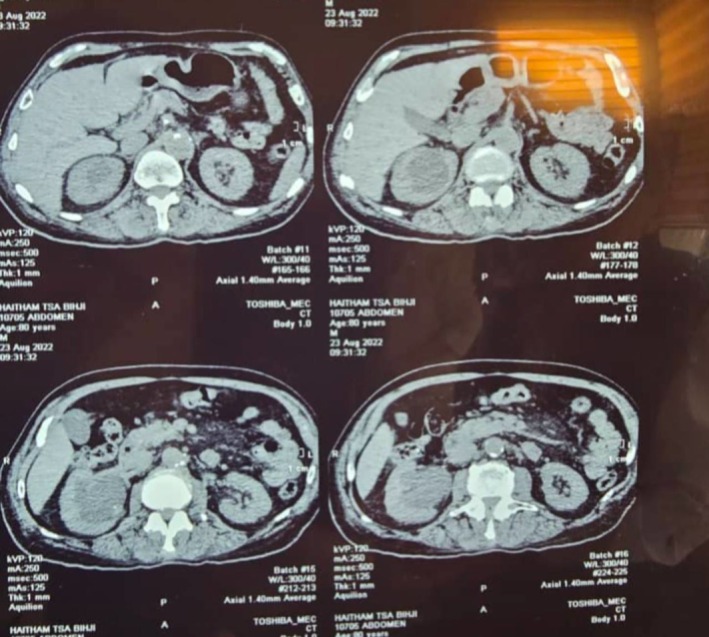
Prostate cancer is the second most common malignancy in males, primarily associated with risk factors such as age, ethnicity, obesity, and family history. While metastases commonly involve lymph nodes, bones, and the liver, ureteral metastasis is exceedingly rare. Ureteral obstruction due to metastatic prostate cancer can lead to hydronephrosis, often requiring ureteroscopy for diagnosis and management. However, persistent symptoms may necessitate exploratory surgery. An 82-year-old Arab male with a history of Gleason 4 + 4 = 8 prostate adenocarcinoma (initially managed with hormonal therapy and surgical castration) presented with right back pain. Imaging revealed stage 4 hydronephrosis, initially attributed to a ureteral stone. Ureteroscopy identified obstructing ureteral tumors instead, with biopsy confirming well-differentiated adenocarcinoma of prostatic origin. Due to persistent obstruction and confirmed malignancy, a right nephroureterectomy was performed. Histopathology demonstrated extensive ureteral involvement (16 cm) with vascular and perineural invasion but no distant metastasis on postoperative PET-CT. This case underscores the diagnostic challenge of ureteral metastasis in prostate cancer, often mimicking benign conditions like ureteral stones. Despite successful local surgical control, the tumor's aggressive features necessitate long-term surveillance and continued hormonal therapy. High clinical suspicion for metastasis is crucial in high-risk prostate cancer patients presenting with obstructive uropathy, even in the absence of significantly elevated PSA. This report highlights the importance of a stepwise diagnostic approach and the need for prompt intervention in such rare presentations.
前列腺癌是男性第二常见的恶性肿瘤,主要与年龄、种族、肥胖和家族史等风险因素相关。虽然转移通常累及淋巴结、骨骼和肝脏,但输尿管转移极为罕见。转移性前列腺癌导致的输尿管梗阻可引起肾积水,通常需要输尿管镜检查来进行诊断和治疗。然而,持续的症状可能需要进行探查性手术。一名82岁的阿拉伯男性,有Gleason 4+4=8前列腺腺癌病史(最初接受激素治疗和手术去势),出现右背痛。影像学检查显示为4期肾积水,最初归因于输尿管结石。输尿管镜检查却发现是梗阻性输尿管肿瘤,活检证实为前列腺来源的高分化腺癌。由于持续梗阻且确诊为恶性肿瘤,遂行右侧肾输尿管切除术。组织病理学显示输尿管广泛受累(16厘米),伴有血管和神经周围侵犯,但术后PET-CT未发现远处转移。该病例强调了前列腺癌输尿管转移的诊断挑战,常表现为类似输尿管结石等良性疾病。尽管局部手术控制成功,但肿瘤的侵袭性特征需要长期监测和持续的激素治疗。对于出现梗阻性尿路病的高危前列腺癌患者,即使前列腺特异性抗原(PSA)没有显著升高,高度怀疑转移也至关重要。本报告强调了逐步诊断方法的重要性以及对此类罕见病例进行及时干预的必要性。