Shrivastava Deepti, Quadri Syed Altafuddin, Alshadidi Abdulkhaliq Ali F, Saini Ravinder, Dewan Meghna, Fernandes Gustavo Vicentis Oliveira, Srivastava Kumar Chandan
Department of Preventive Dentistry, College of Dentistry, Jouf University, Sakaka, Saudi Arabia.
Department of Dental Technology, COAMS, King Khalid University, Abha, Saudi Arabia.
J Maxillofac Oral Surg. 2025 Aug;24(4):1010-1028. doi: 10.1007/s12663-024-02409-9. Epub 2024 Dec 10.
This study analyzed clinical parameters to assess whether dental implant material is a risk factor for peri-implantitis.
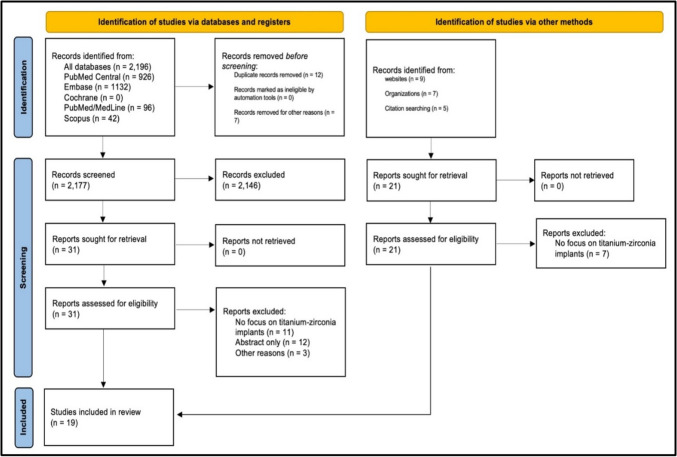
A literature search was performed on PubMed Central, Cochrane, PubMed/MEDLINE, Embase, and Scopus. The PICO strategy involved healthy patient, partially or fully edentulous, receiving at least one dental implant; zirconia or titanium dental implants; comparison involving assessment of whether there were differences in the risk of peri-implantitis among different materials used for dental implants; clinical parameters. Quality assessment was performed using the modified Jadad scale.
Nineteen articles met the inclusion criteria. BoP did not have statistically significant differences comparing zirconia and titanium implants or natural teeth. MBL had diversified results; sometimes, it was higher in zirconia implants than titanium; otherwise, there was no significant difference. Comparing implants with natural teeth, MBL was lower in titanium implants over prolonged observation periods, and greater severity was found in the zirconia group. Notably, natural teeth had minimal bone loss. Zirconia implants demonstrated reduced plaque accumulation and minimal microbial contamination compared to titanium implants and control teeth. The quality assessment was considered poor to low in 9 studies and good to excellent in 10. The development of peri-implantitis was influenced by several patient-specific and clinical factors, underscoring the need to adopt a comprehensive and personalized approach to implant dentistry and peri-implantitis prevention.
It was not possible to draft any solid conclusion for the relationship between implant material and peri-implantitis.
本研究分析临床参数,以评估牙种植体材料是否为种植体周围炎的危险因素。
在PubMed Central、Cochrane、PubMed/MEDLINE、Embase和Scopus上进行文献检索。PICO策略包括健康患者,部分或完全无牙,接受至少一颗牙种植体;氧化锆或钛牙种植体;比较不同种植体材料在种植体周围炎风险方面是否存在差异;临床参数。使用改良的Jadad量表进行质量评估。
19篇文章符合纳入标准。比较氧化锆种植体、钛种植体和天然牙时,探诊出血在统计学上无显著差异。探诊深度结果多样;有时,氧化锆种植体的探诊深度高于钛种植体;否则,无显著差异。与天然牙相比,在较长观察期内钛种植体的探诊深度较低,氧化锆组的严重程度更高。值得注意的是,天然牙的骨丢失极少。与钛种植体和对照牙相比,氧化锆种植体的菌斑堆积减少,微生物污染极少。9项研究的质量评估为差至低,10项为好至优。种植体周围炎的发生受多种患者特异性和临床因素影响,这突出了在种植牙科和种植体周围炎预防中采用全面和个性化方法的必要性。
无法就种植体材料与种植体周围炎之间的关系得出任何确凿结论。