Hassan Rafid, Shamim Abu Ahmed, Ali Masum, Amin Md Ruhul
Institute of Nutrition and Food Science University of Dhaka Dhaka Bangladesh.
Nutrition Research Division, International Centre for Diarrhoeal Disease Research, Bangladesh (icddr,b) Dhaka Bangladesh.
Public Health Chall. 2025 Aug 4;4(3):e70095. doi: 10.1002/puh2.70095. eCollection 2025 Sep.
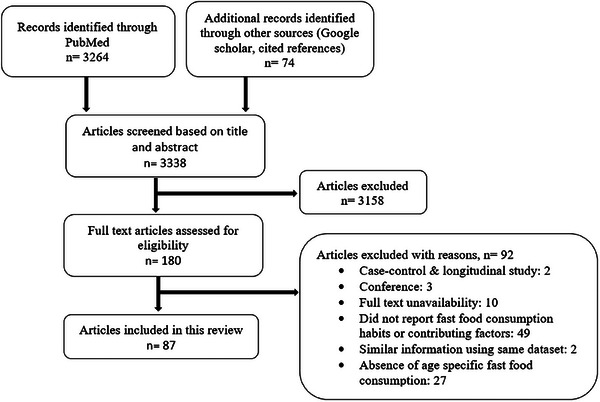
Fast food has become a common dietary choice worldwide, with significant health consequences. In low- and middle-income countries (LMICs), particularly in Asia, the consumption of fast food has risen, yet research providing a comprehensive summary of fast food consumption patterns is limited. Therefore, this review consolidates evidence on the patterns and factors influencing fast food consumption in Asian LMICs. A comprehensive literature search was conducted using PubMed, Google Scholar, and references of relevant studies, covering peer-reviewed articles published in English from January 1, 2011, to June 30, 2023. A total of 87 studies met the inclusion criteria, encompassing data from 178,554 individuals across 26 countries. The findings indicated a higher fast food consumption with a preference for Western fast food, such as pizza, burgers, fried chicken, French fries, and sandwiches, over local options. Key factors driving fast food consumption included taste, affordability, accessibility, mass media advertisement, restaurant environment, service quality, and family/peer influence. Furthermore, socioeconomic status, age, gender, and educational background influenced the consumption. For adults, factors like time constraints, lack of alternatives, employment status, health consciousness, stress, and food quality and hygiene were important. The increasing presence of fast food in the Asian diet highlights the need for comprehensive policies to curb this trend and protect public health.
快餐已成为全球普遍的饮食选择,并带来了重大的健康后果。在低收入和中等收入国家(LMICs),尤其是在亚洲,快餐消费有所上升,但提供快餐消费模式全面总结的研究有限。因此,本综述整合了有关亚洲低收入和中等收入国家快餐消费模式及影响因素的证据。使用PubMed、谷歌学术搜索以及相关研究的参考文献进行了全面的文献检索,涵盖2011年1月1日至2023年6月30日期间以英文发表的同行评审文章。共有87项研究符合纳入标准,涵盖了来自26个国家的178,554人的数据。研究结果表明,快餐消费较高,人们更喜欢西式快餐,如披萨、汉堡、炸鸡、薯条和三明治,而非本地食品。推动快餐消费的关键因素包括口味、可承受性、可及性、大众媒体广告、餐厅环境、服务质量以及家庭/同伴影响。此外,社会经济地位、年龄、性别和教育背景也会影响消费。对于成年人而言,时间限制、缺乏替代选择、就业状况、健康意识、压力以及食品质量和卫生等因素很重要。快餐在亚洲饮食中的日益普及凸显了制定全面政策以遏制这一趋势并保护公众健康的必要性。