Li Gabriel E, Umapathy Mayura P, Shin David S, Abad-Santos Matthew, Monroe Eric J, Chick Jeffrey Forris Beecham, Makary Mina S
Section of Vascular and Interventional Radiology, Department of Radiology, University of Washington, 1959 Northeast Pacific Street, Seattle, WA, 98195, USA.
Division of Vascular and Interventional Radiology, Department of Radiology, The Ohio State University Wexner Medical Center, Columbus, OH, 43210, USA.
CVIR Endovasc. 2025 Aug 5;8(1):62. doi: 10.1186/s42155-025-00577-4.
Endovascular stenting is widely accepted as the standard treatment for central venous obstruction syndromes such as superior vena cava (SVC) syndrome due to its demonstrated clinical efficacy and improved patient outcomes. However, its application in axillosubclavian vein thrombosis (ASVT) has been limited due to concerns about stent compression within the thoracic outlet. This report aims to evaluate the feasibility and safety of the off-label use of dedicated venous stents-engineered with enhanced mechanical features-as an alternative endovascular approach for the treatment of ASVT.
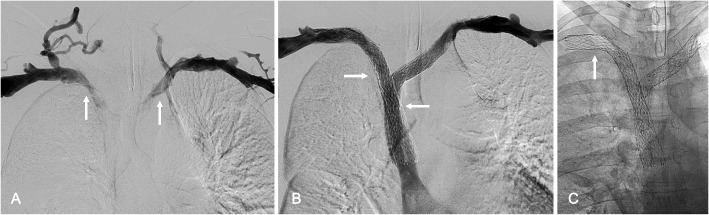
Thirty-eight patients (43 affected limbs) with symptomatic ASVT and no prior treatment or surgical decompression underwent endovascular placement of dedicated venous stents across the thoracic outlet with Abre Venous Stents (Medtronic, Dublin, Ireland), Venovo Venous Stents (BD, Franklin Lakes, NJ, USA), or Vici Venous Stents (Boston Scientific, Marlborough, MA, USA). Stents were extended peripherally to the subclavian or axillary veins and centrally to the brachiocephalic vein or SVC. Technical success was defined as successful stent deployment across the costoclavicular space, and clinical success as symptomatic improvement.
Stent placement was technically successful in all 43 limbs (100%), with clinical improvement observed in 97.4% of patients. The one patient without clinical improvement experienced early thrombosis of the stent, requiring mechanical thrombectomy and additional stenting. Follow-up CT venography at a mean of 301.3 days demonstrated high primary stent patency rates (81.4%), with stent crushing observed in only 7.0% of limbs and no instances of stent fracture. Adverse events were limited, including two access site hematomas and one hypotensive episode, all of which resolved without evidence of long-term complications.
Our findings suggest that stenting across the thoracic outlet for the treatment of ASVT may be a viable option with the use of novel dedicated venous stents, potentially expanding treatment strategies for TCVO.
血管内支架置入术因其已证实的临床疗效和改善的患者预后,被广泛接受为治疗上腔静脉(SVC)综合征等中心静脉阻塞综合征的标准治疗方法。然而,由于担心支架在胸廓出口处受压,其在腋锁骨下静脉血栓形成(ASVT)中的应用受到限制。本报告旨在评估使用具有增强机械特性的专用静脉支架进行非标签使用作为治疗ASVT的另一种血管内方法的可行性和安全性。
38例有症状的ASVT患者(43条患肢),未接受过先前治疗或手术减压,采用Abre静脉支架(美敦力公司,爱尔兰都柏林)、Venovo静脉支架(BD公司,美国新泽西州富兰克林湖)或Vici静脉支架(波士顿科学公司,美国马萨诸塞州马尔伯勒)在胸廓出口处进行专用静脉支架的血管内置入。支架向周围延伸至锁骨下静脉或腋静脉,向中心延伸至头臂静脉或SVC。技术成功定义为支架成功穿过肋锁间隙,临床成功定义为症状改善。
所有43条肢体(100%)的支架置入技术均成功,97.4%的患者临床症状改善。1例无临床改善的患者出现支架早期血栓形成,需要进行机械血栓切除术和额外的支架置入。平均301.3天的随访CT静脉造影显示,支架初始通畅率较高(81.4%),仅7.0%的肢体观察到支架受压,无支架断裂情况。不良事件有限,包括2例穿刺部位血肿和1次低血压发作,所有这些均已缓解,无长期并发症迹象。
我们的研究结果表明,使用新型专用静脉支架在胸廓出口处进行支架置入治疗ASVT可能是一种可行的选择,这可能会扩大上腔静脉阻塞综合征的治疗策略。