Bhatnagar Sumit, Stodtmann Sven, Qian Yuli, Marroum Patrick, Liu Wei, Mohamed Mohamed-Eslam F
Clinical Pharmacology, AbbVie Inc., North Chicago, Illinois, USA.
Clin Transl Sci. 2025 Aug;18(8):e70295. doi: 10.1111/cts.70295.
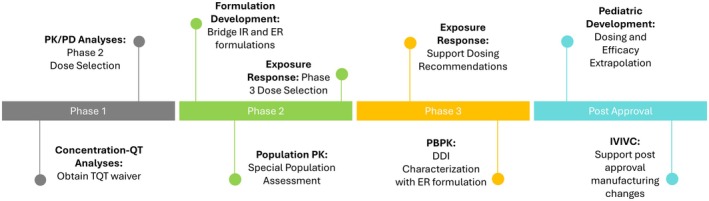
Model-informed drug development (MIDD) entails applying quantitative approaches to assist with decision-making during drug development and has been used for dose optimization, to inform clinical trial design, and to support clinical trial waivers. With increasing cost and competitiveness in drug development, the use of tools that improve efficiency, like MIDD, is increasingly crucial. A unique case for the successful application of MIDD approaches from early Phase 1 through postapproval for the upadacitinib development program is described herein. Upadacitinib is an orally administered selective Janus kinase inhibitor, which is approved for rheumatoid arthritis, psoriatic arthritis, atopic dermatitis, axial spondylarthritis, nonradiographic axial spondyloarthritis, ulcerative colitis, and Crohn's disease for adults, in addition to recent approvals for polyarticular juvenile idiopathic arthritis and pediatric patients with psoriatic arthritis. Applications and impact of modeling and simulation approaches for informing key development decisions are presented to highlight the success of using MIDD for the clinical development of upadacitinib. The lessons learned can provide a framework for the clinical development of other drugs.
模型引导的药物研发(MIDD)需要运用定量方法来辅助药物研发过程中的决策制定,并且已被用于剂量优化、指导临床试验设计以及支持临床试验豁免。随着药物研发成本的增加和竞争的加剧,使用像MIDD这样能够提高效率的工具变得越来越关键。本文描述了MIDD方法在upadacitinib研发项目中从1期早期到获批后成功应用的一个独特案例。Upadacitinib是一种口服的选择性Janus激酶抑制剂,已被批准用于治疗成人类风湿性关节炎、银屑病关节炎、特应性皮炎、强直性脊柱炎、非放射性轴向脊柱关节炎、溃疡性结肠炎和克罗恩病,此外最近还获批用于多关节型幼年特发性关节炎和儿童银屑病关节炎患者。文中介绍了建模与模拟方法在指导关键研发决策方面的应用和影响,以突出使用MIDD进行upadacitinib临床研发的成功之处。所吸取的经验教训可为其他药物的临床研发提供一个框架。