Li Huiqin, Gao Fang, Liu Xuyan, Shen Haoran, Du Mulong, Cheng Lei, Zhang Huihui, Zhang Zhengdong, Lu Meiping, Zheng Rui
Departments of Environmental Genomics and Genetic Toxicology, The Key Laboratory of Modern Toxicology of Ministry of Education, Center for Global Health, Jiangsu Key Laboratory of Cancer Biomarkers, Prevention and Treatment, Collaborative Innovation Center for Cancer Personalized Medicine, School of Public Health, Nanjing Medical University, Nanjing, China.
Institute of Clinical Research, The Affiliated Taizhou People's Hospital of Nanjing Medical University, Taizhou School of Clinical Medicine, Nanjing Medical University, Nanjing, China.
Clin Transl Allergy. 2025 Aug;15(8):e70081. doi: 10.1002/clt2.70081.
Genetic factors contribute essentially to the pathophysiology of house dust mite (HDM)-induced allergic rhinitis. Previous studies mainly focused on the biological pathogenesis, but the heritability remains poorly explained.
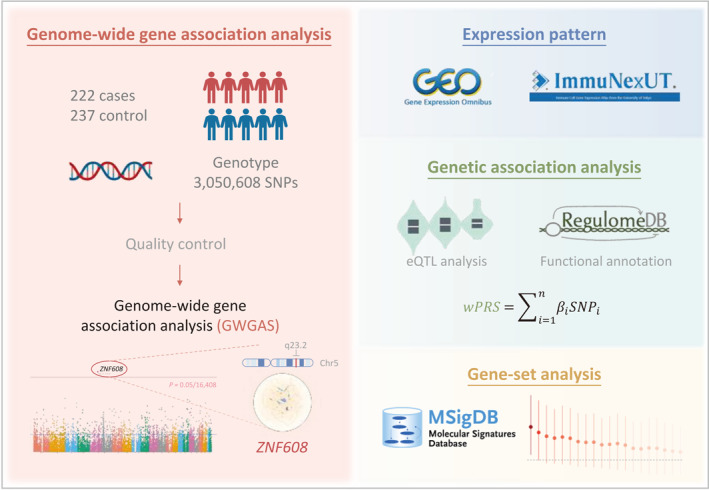
A genome-wide gene association analysis (GWGAS) integrating joint-genetic variant effects at the gene level was initially conducted on allergic rhinitis, validated by differential gene expression analysis. A weighted polygenic risk score (wPRS) was used to proxy the cumulative effect of candidate genetic variants in key genes. Gene-set analysis and eQTL analysis were performed to explore the immunologic pathway and genetic regulation of the key gene.
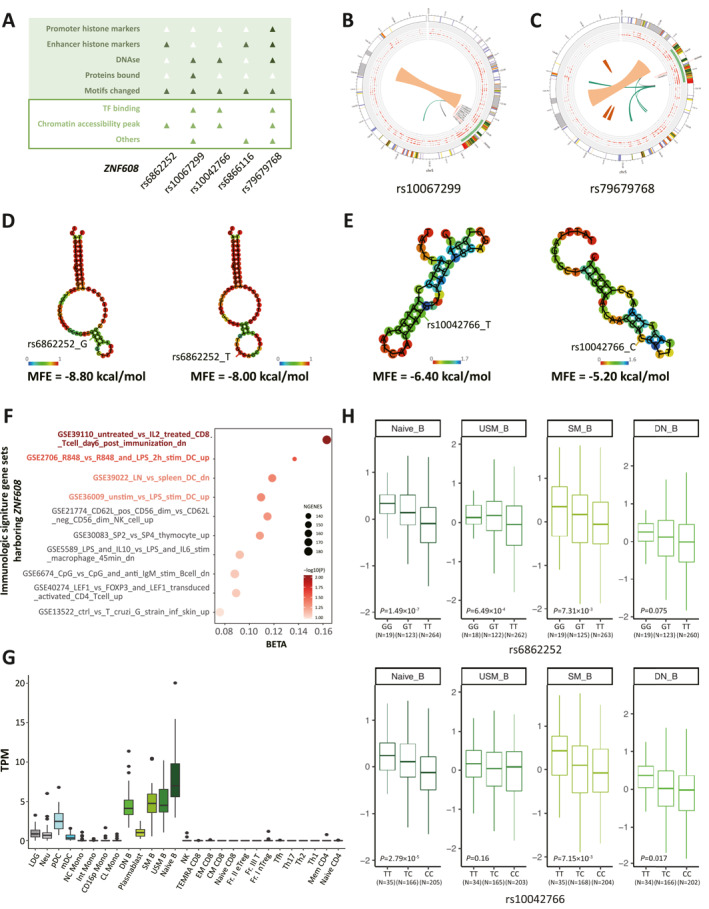
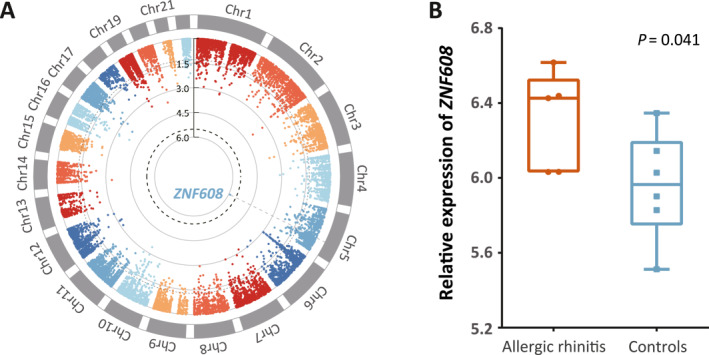
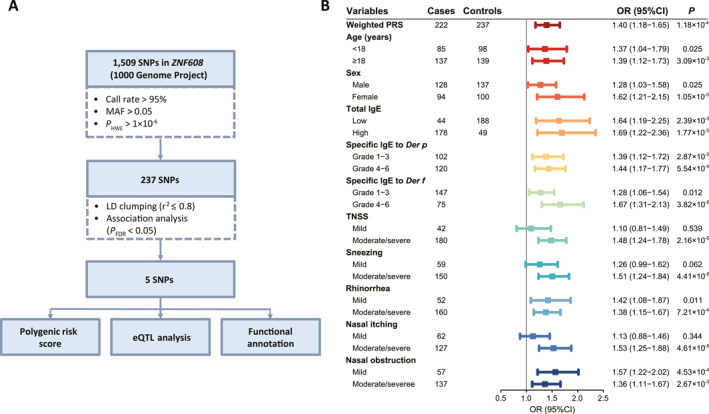
ZNF608 was identified as the key gene involving HDM-induced allergic rhinitis risk (p = 1.23 × 10), which was highly expressed in nasal epithelium cells of allergic rhinitis patients (p = 0.041). Furthermore, a wPRS of five significant variants, rs6862252, rs10067299, rs10042766, rs6866116, and rs79679768 in the ZNF608, showed the cumulative effect was associated with the increased HDM-induced allergic rhinitis risk (odds ratio [OR] = 1.40, 95% confidence interval [CI] = 1.18-1.65, p = 1.18 × 10), with varied effects under diverse conditions of nasal symptoms. Additionally, both rs6862252 G allele and rs10042766 T allele elevated the expression of ZNF608 involving in state and perturbation of immune cells, such as B cell, T cell, and dendritic cell, contributing to HDM-induced allergic rhinitis.
This study highlights the key gene ZNF608 of HDM-induced allergic rhinitis, which may lay the groundwork for risk assessment and early diagnosis of allergic rhinitis.
遗传因素在屋尘螨(HDM)诱发的过敏性鼻炎的病理生理学中起重要作用。以往研究主要集中在生物学发病机制上,但遗传力仍未得到很好的解释。
最初对过敏性鼻炎进行了全基因组基因关联分析(GWGAS),整合了基因水平上的联合遗传变异效应,并通过差异基因表达分析进行验证。使用加权多基因风险评分(wPRS)来代表关键基因中候选遗传变异的累积效应。进行基因集分析和eQTL分析以探索关键基因的免疫途径和遗传调控。
ZNF608被确定为与HDM诱发的过敏性鼻炎风险相关的关键基因(p = 1.23×10),在过敏性鼻炎患者的鼻上皮细胞中高表达(p = 0.041)。此外,ZNF608中五个显著变异rs6862252、rs10067299、rs10042766、rs6866116和rs79679768的wPRS显示,累积效应与HDM诱发的过敏性鼻炎风险增加相关(比值比[OR] = 1.40,95%置信区间[CI] = 1.18 - 1.65,p = 1.18×10),在不同的鼻部症状条件下有不同的影响。此外,rs6862252的G等位基因和rs10042766的T等位基因均提高了ZNF608的表达,该基因参与免疫细胞(如B细胞、T细胞和树突状细胞)的状态和扰动,导致HDM诱发的过敏性鼻炎。
本研究突出了HDM诱发的过敏性鼻炎的关键基因ZNF608,这可能为过敏性鼻炎的风险评估和早期诊断奠定基础。