Zaman Andrew, Jewell Crystal, Izbicki Patricia, Stegemöller Elizabeth L
Department of Kinesiology, Iowa State University, Ames, IA, United States.
Front Hum Neurosci. 2025 Jul 22;19:1613266. doi: 10.3389/fnhum.2025.1613266. eCollection 2025.
Impaired inhibitory gating is a sensory processing symptom of Parkinson's disease (PD) that may be associated with bradykinesia and motor inhibition. Acute stress impairs inhibitory gating in healthy adults; however, it is unclear how stress impacts inhibitory gating in people with PD.
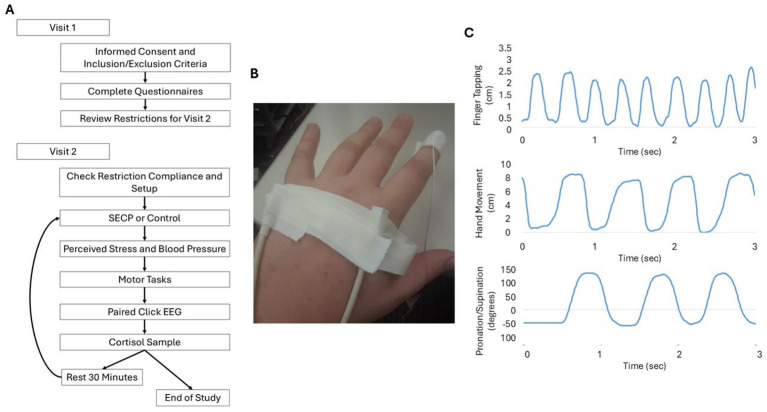
Using a Socially Evaluated Cold Pressor (SECP) to induce acute physical stress, inhibitory gating was assessed through electroencephalography (EEG) in eight individuals diagnosed with PD and 11 age- and gender-matched healthy older adults (HOAs) by measuring the p50 ratio during an auditory paired click paradigm. Kinematic measures of bradykinesia and tremor were also collected.
Results confirmed decreased inhibitory gating [ = 12.813, = 0.002, = 0.430], decreased finger tapping amplitude [ = 7.420, = 0.011, = 0.216], and increased postural tremor amplitude [ = 6.676, = 0.016, = 0.198] in both persons with PD and HOAs following the induction of an acute physical stressor, with larger differences in persons with PD. Moreover, decreases in inhibitory gating were significantly related to changes in finger tapping amplitude and postural tremor amplitude.
These findings provide evidence to suggest that stress impairs both inhibitory gating and some motor impairments in persons with PD, and that these impairments may be related. These results add to the limited literature in understanding the effects of stress on PD symptoms and may inform future potential clinical targets for therapeutics.
抑制性门控受损是帕金森病(PD)的一种感觉处理症状,可能与运动迟缓及运动抑制有关。急性应激会损害健康成年人的抑制性门控;然而,尚不清楚应激如何影响帕金森病患者的抑制性门控。
使用社会评价冷加压试验(SECP)诱导急性身体应激,通过脑电图(EEG)对8名被诊断为帕金森病的个体和11名年龄及性别匹配的健康老年人(HOA)进行抑制性门控评估,在听觉配对点击范式中测量p50比率。还收集了运动迟缓及震颤的运动学指标。
结果证实,在急性身体应激源诱导后,帕金森病患者和健康老年人的抑制性门控均降低[F(1,17)=12.813,p=0.002,ηp²=0.430],手指敲击幅度降低[F(1,17)=7.420,p=0.011,ηp²=0.216],姿势性震颤幅度增加[F(1,17)=6.676,p=0.016,ηp²=0.198],帕金森病患者的差异更大。此外,抑制性门控的降低与手指敲击幅度和姿势性震颤幅度的变化显著相关。
这些发现提供了证据,表明应激会损害帕金森病患者的抑制性门控和一些运动障碍,且这些障碍可能相关。这些结果增加了关于应激对帕金森病症状影响的有限文献,并可能为未来潜在的治疗临床靶点提供信息。