Huang Zhiqian, Chen Chao, Meng Jiaqi, Liu Shuyu, Zhang Keke, Du Yu, Zhu Xiangjia
Eye Institute and Department of Ophthalmology, Eye and ENT Hospital, Fudan University, Shanghai, China.
NHC Key laboratory of Myopia and Related Eye Diseases; Key Laboratory of Myopia and Related Eye Diseases, Chinese Academy of Medical Sciences, Shanghai, China.
Invest Ophthalmol Vis Sci. 2025 Aug 1;66(11):15. doi: 10.1167/iovs.66.11.15.
To investigate the associations among sleep duration, sleep quality, and age-related ocular diseases, accounting for interactions with systemic inflammation.
A total of 380,182 participants in the UK Biobank were included in this prospective population-based cohort study. The investigated exposures were sleep duration, sleep quality (quantified through an established algorithm comprised of five sleep traits), and traits including insomnia, daytime dozing, chronotype, and snoring. Outcomes were incidences of cataract, primary open-angle glaucoma (POAG), diabetic retinopathy (DR), and age-related macular degeneration (AMD). Cox proportional hazards models were used to estimate the hazard ratios (HRs), with mediation analysis of systematic inflammatory indicators further performed to explore potential mechanisms.
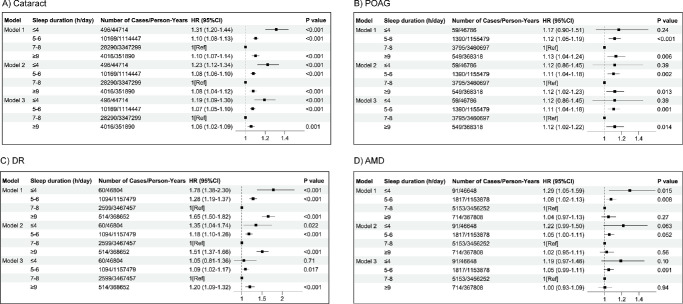
During a median follow-up of 12.6 years, 42,971 cataract cases, 5793 POAG cases, 4267 DR cases, and 7775 AMD cases were documented. Sleep duration displayed U-shaped relationships with cataract, POAG, and DR (all P nonlinear < 0.001), identifying 7 hours per day as optimal. Poor sleep quality also elevated the risks of cataract (HR = 1.17; P < 0.001) and POAG (HR = 1.21; P = 0.019), whereas for DR this effect was not significant but suggestive (HR = 1.15; P = 0.082). Sleep behavior traits including insomnia and daytime dozing were found to predict higher risks of these diseases. Mediation analysis indicated significant contributions of inflammatory indicators to the associations of poor sleep quality with cataract and DR.
Our findings suggest that sleep patterns might be modifiable risk factors for age-related ocular diseases and highlight the potential value of anti-inflammatory therapies to delay the manifestations of ocular aging.
探讨睡眠时间、睡眠质量与年龄相关性眼病之间的关联,并考虑与全身炎症的相互作用。
本前瞻性基于人群的队列研究纳入了英国生物银行的380182名参与者。研究的暴露因素包括睡眠时间、睡眠质量(通过由五个睡眠特征组成的既定算法量化)以及包括失眠、日间嗜睡、昼夜节律类型和打鼾在内的特征。结局指标为白内障、原发性开角型青光眼(POAG)、糖尿病视网膜病变(DR)和年龄相关性黄斑变性(AMD)的发病率。采用Cox比例风险模型估计风险比(HRs),并进一步进行系统性炎症指标的中介分析以探索潜在机制。
在中位随访12.6年期间,记录了42971例白内障病例、5793例POAG病例、4267例DR病例和7775例AMD病例。睡眠时间与白内障、POAG和DR呈U形关系(所有P非线性<0.001),确定每天7小时为最佳睡眠时间。睡眠质量差也会增加白内障(HR = 1.17;P < 0.001)和POAG(HR = 1.21;P = 0.019)的风险,而对于DR,这种影响虽不显著但有提示作用(HR = 1.15;P = 0.082)。发现包括失眠和日间嗜睡在内的睡眠行为特征可预测这些疾病的较高风险。中介分析表明炎症指标对睡眠质量差与白内障和DR之间的关联有显著贡献。
我们的研究结果表明,睡眠模式可能是年龄相关性眼病的可改变风险因素,并突出了抗炎治疗在延缓眼部衰老表现方面的潜在价值。