
评估超级马拉松运动员训练负荷与损伤之间的关系:一种使用广义相加模型的新方法。
Assessing the relationship between training load and injury in ultramarathon runners: a novel approach using Generalised Additive Models.
作者信息
Burgess T L, Durand P, Buchholtz K
机构信息
Division of Physiotherapy, Faculty of Health Sciences, University of Cape Town, Cape Town, South Africa.
Centre for Medical Ethics and Law, Faculty of Medicine and Health Sciences, Stellenbosch University, Cape Town, South Africa.
出版信息
S Afr J Sports Med. 2025 Jul 15;37(1):v37i1a20747. doi: 10.17159/2078-516X/2025/v37i1a20747. eCollection 2025.
BACKGROUND
Ultramarathon running presents significant injury risks, and monitoring training loads may identify risk factors for injury. Injury surveillance studies are required to better assess injury prevalence and its relationship to training loads.
OBJECTIVES
To determine the incidence and nature of running-related injuries and associated training loads in runners 12 weeks before and two weeks after the 2018 Comrades ultramarathon.
METHODS
One hundred and six participants were recruited. Their weekly injury and training load data (distance, duration, frequency and acute-chronic workload ratio) were obtained retrospectively over 14 weeks. The relationship between training load variables and injury risk was modelled using Generalised Additive Models.
RESULTS
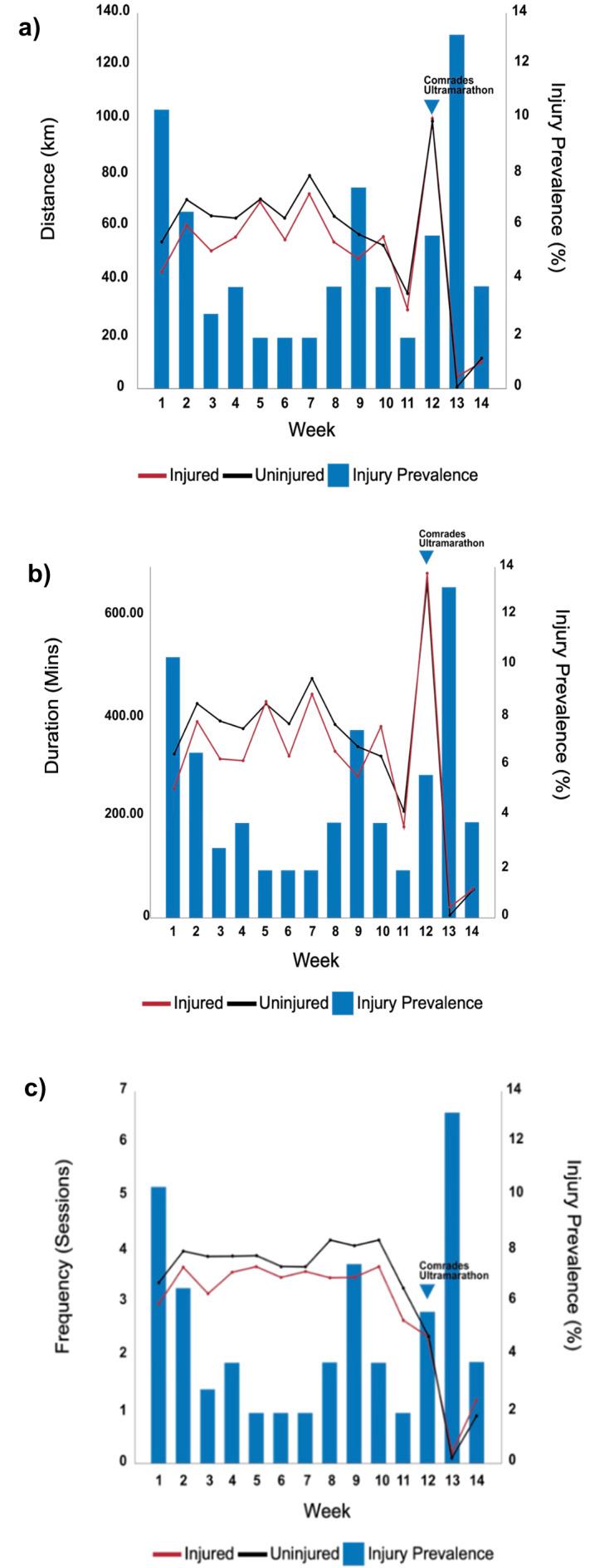
The running-related injury incidence was 8/1000 hours. The overall injury proportion was 40%. The commonly injured structures were muscles (47%) followed by tendons (24%). Commonly reported anatomical areas of injury were the knee (26%) and hip (19%). Lower training load distance in the 12 weeks leading up to the race was linked to a higher risk of injury (p=0.02), primarily occurring during or after the race. Weekly training frequency and injury risk showed a significant heterogeneous relationship (p=0.02). The effect of the acute to chronic workload ratio on injury risk was minimal (p=0.3).
CONCLUSION
Lower training loads were associated with a higher risk for injury, and the frequency of running training per week influenced injury risk. Insufficient training may not prepare the runners for the demands of the ultradistance race. Sudden changes in training load (evident in the acute training load measurements) appeared to have a minimal effect on injury risk. The non-linear relationship between several training load variables and injury risk can successfully be modelled using Generalised Additive Models, which may improve the accuracy of injury prediction modelling in ultramarathon runners.
背景
超级马拉松跑步存在重大受伤风险,监测训练负荷可能会识别出受伤的风险因素。需要进行受伤监测研究,以更好地评估受伤发生率及其与训练负荷的关系。
目的
确定2018年战友超级马拉松赛前12周和赛后两周跑步者与跑步相关的受伤发生率、性质及相关训练负荷。
方法
招募了106名参与者。回顾性收集他们在14周内的每周受伤和训练负荷数据(距离、时长、频率和急性-慢性工作量比值)。使用广义相加模型对训练负荷变量与受伤风险之间的关系进行建模。
结果
与跑步相关的受伤发生率为每1000小时8次。总体受伤比例为40%。常见的受伤结构是肌肉(47%),其次是肌腱(24%)。常见的受伤解剖部位是膝盖(26%)和臀部(19%)。比赛前12周较低的训练负荷距离与较高的受伤风险相关(p=0.02),主要发生在比赛期间或比赛之后。每周训练频率与受伤风险呈现显著的异质性关系(p=0.02)。急性-慢性工作量比值对受伤风险的影响最小(p=0.3)。
结论
较低的训练负荷与较高的受伤风险相关,每周的跑步训练频率会影响受伤风险。训练不足可能使跑步者无法应对超长距离比赛的需求。训练负荷的突然变化(在急性训练负荷测量中明显)似乎对受伤风险影响最小。使用广义相加模型可以成功模拟几个训练负荷变量与受伤风险之间的非线性关系,这可能会提高超级马拉松跑步者受伤预测模型的准确性。

 Zotero 插件