National Centre for Sport and Exercise Medicine, School of Sport, Exercise and Health Sciences, Loughborough University, Loughborough, LE11 3TU, UK.
National Centre for Sport and Exercise Medicine, School of Sport, Exercise and Health Sciences, Loughborough University, Loughborough, LE11 3TU, UK.
J Sport Health Sci. 2021 Sep;10(5):513-522. doi: 10.1016/j.jshs.2021.04.001. Epub 2021 Apr 20.
Running-related musculoskeletal injuries (RRMIs), especially stemming from overuse, frequently occur in runners. This study aimed to systematically review the literature and determine the incidence and prevalence proportion of RRMIs by anatomic location and specific pathology.
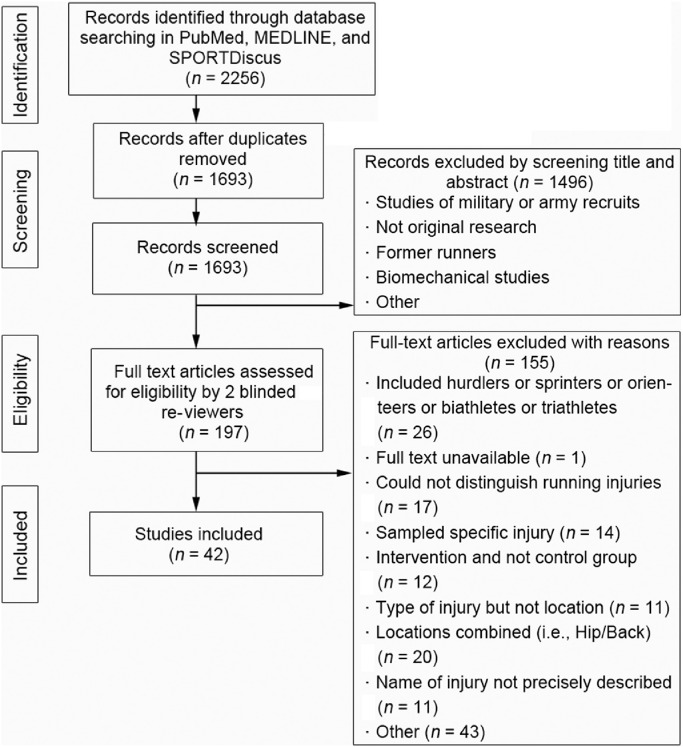
An electronic database search with no date beginning restrictions was performed in SPORTDiscus, PubMed, and MEDLINE up to June 2020. Prospective studies were used to find the anatomic location and the incidence proportion of each RRMI, whereas retrospective or cross-sectional studies were used to find the prevalence proportion of each RRMI. A separate analysis for ultramarathon runners was performed.
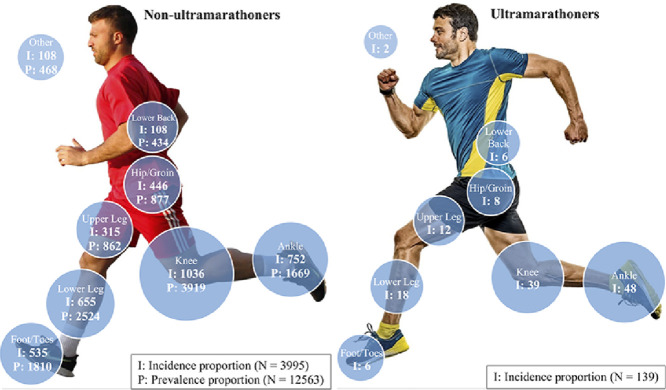
The overall injury incidence and prevalence were 40.2% ± 18.8% and 44.6% ± 18.4% (mean ± SD), respectively. The knee, ankle, and lower leg accounted for the highest proportion of injury incidence, whereas the knee, lower leg, and foot/toes had the highest proportion of injury prevalence. Achilles tendinopathy (10.3%), medial tibial stress syndrome (9.4%), patellofemoral pain syndrome (6.3%), plantar fasciitis (6.1%), and ankle sprains (5.8%) accounted for the highest proportion of injury incidence, whereas patellofemoral pain syndrome (16.7%), medial tibial stress syndrome (9.1%), plantar fasciitis (7.9%), iliotibial band syndrome (7.9%), and Achilles tendinopathy (6.6%) had the highest proportion of injury prevalence. The ankle (34.5%), knee (28.1%), and lower leg (12.9%) were the 3 most frequently injured sites among ultramarathoners.
The injury incidence proportions by anatomic location between ultramarathoners and non-ultramarathoners were not significantly different (p = 0.798). The pathologies with the highest incidence proportion of injuries were anterior compartment tendinopathy (19.4%), patellofemoral pain syndrome (15.8%), and Achilles tendinopathy (13.7%). The interpretation of epidemiological data in RRMIs is limited due to several methodological issues encountered.
与跑步相关的肌肉骨骼损伤(RRMI),尤其是过度使用引起的损伤,在跑步者中经常发生。本研究旨在系统地回顾文献,按解剖部位和特定病理确定 RRMI 的发生率和患病率比例。
对 SPORTDiscus、PubMed 和 MEDLINE 数据库进行了无日期限制的电子检索,检索时间截至 2020 年 6 月。前瞻性研究用于确定每个 RRMI 的解剖部位和发生率比例,而回顾性或横断面研究用于确定每个 RRMI 的患病率比例。还对超长距离跑步者进行了单独的分析。
总体损伤发生率和患病率分别为 40.2%±18.8%和 44.6%±18.4%(均为平均值±标准差)。膝关节、踝关节和小腿占损伤发生率的比例最高,而膝关节、小腿和足/趾占损伤患病率的比例最高。跟腱炎(10.3%)、胫骨内侧应力综合征(9.4%)、髌股疼痛综合征(6.3%)、足底筋膜炎(6.1%)和踝关节扭伤(5.8%)占损伤发生率的比例最高,而髌股疼痛综合征(16.7%)、胫骨内侧应力综合征(9.1%)、足底筋膜炎(7.9%)、髂胫束综合征(7.9%)和跟腱炎(6.6%)占损伤患病率的比例最高。在超长距离跑步者中,踝关节(34.5%)、膝关节(28.1%)和小腿(12.9%)是最常受伤的部位。
超长距离跑步者和非超长距离跑步者的解剖部位损伤发生率比例无显著差异(p=0.798)。发病率比例最高的病理类型为前间隔肌腱病(19.4%)、髌股疼痛综合征(15.8%)和跟腱炎(13.7%)。由于遇到了几个方法学问题,RRMI 中的流行病学数据的解释受到了限制。