Janas Piotr P, T'Jonck Wouter, Burgess Matthew O, Reck Maximilian, Chauché Caroline, Vermeren Matthieu, Lucas Christopher D, Bain Calum, Illingworth Robert, Roberts Edward W, McSorley Henry J, Schwarze Jürgen
Centre for Inflammation Research, Institute for Regeneration and Repair, the University of Edinburgh, Edinburgh, Scotland.
Centre for Cardiovascular Science, The University of Edinburgh, Edinburgh, Scotland.
Allergy. 2025 Sep;80(9):2501-2518. doi: 10.1111/all.16683. Epub 2025 Aug 7.
Viral lower respiratory tract infections (LRTIs) can reduce the severity of subsequent LRTIs but have also been linked to respiratory allergy development and exacerbation. Here, we show that viral LRTI can imprint lung epithelial cells (LECs), leading to prolonged phenotypic and functional changes.
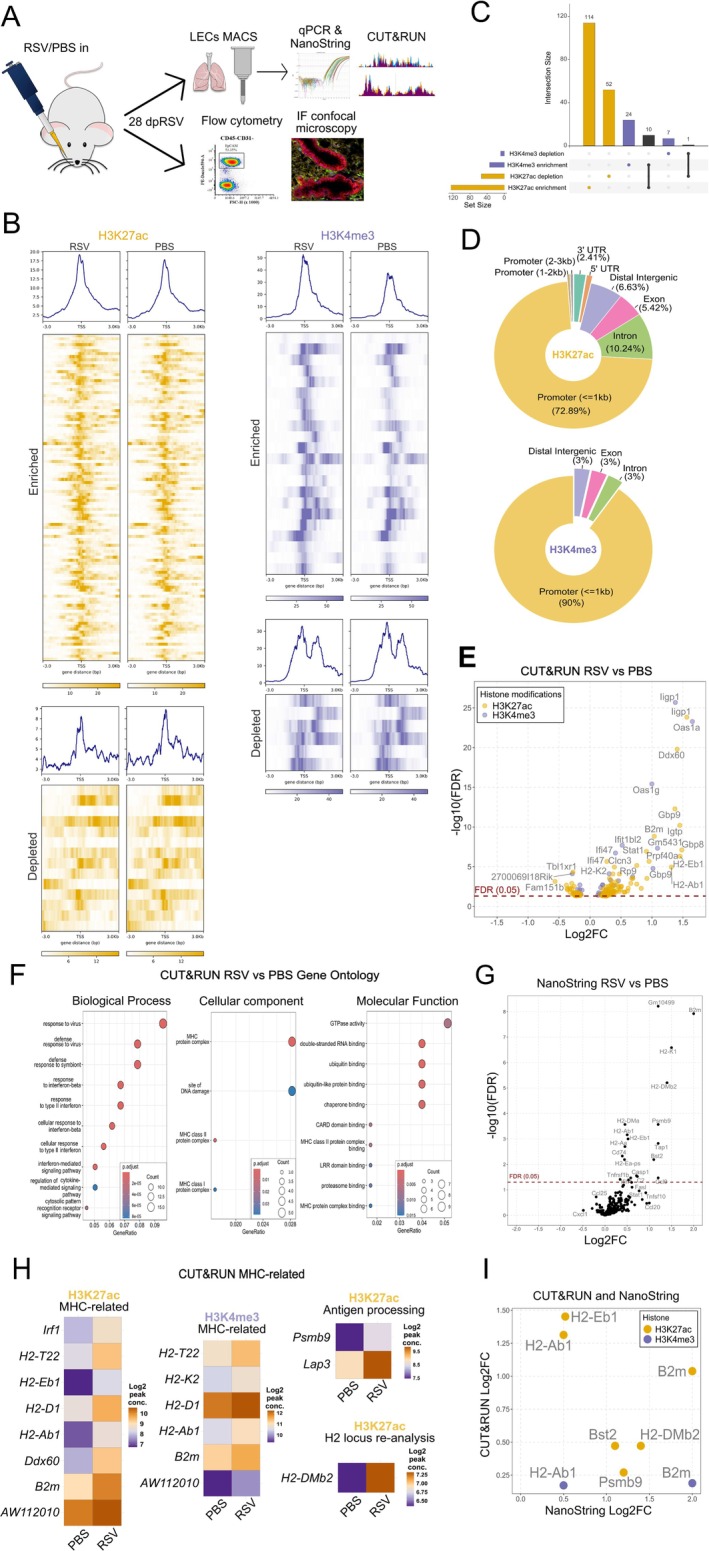
Mice were infected via intranasal administration of respiratory syncytial virus (RSV). After 28 days, LECs were isolated using cold dispase digestion followed by magnetic-activated cell sorting. Epigenetic changes were assessed using Cleavage Under Targets and Release Using Nuclease (CUT&RUN), while transcriptional changes were evaluated using NanoString and qPCR. Flow cytometry was employed to measure cell surface major histocompatibility complex (MHC) levels, antigen uptake and processing rates, and OT-I cell proliferation after antigen presentation.
We identified epigenetic and transcriptomic changes in murine LECs 28 days after RSV infection, especially impacting genes associated with MHC. Lasting upregulation of MHC-I and MHC-II was further increased following in vivo LPS stimulation. Importantly, MHC upregulation was associated with increased antigen uptake and processing, as well as increased antigen presentation to T cells.
Our data demonstrate that RSV can induce prolonged upregulation of antigen presentation by LECs, with the potential to facilitate local T cell responses to microbial antigens and allergens and to enhance immunity or in susceptible hosts respiratory allergy.
病毒性下呼吸道感染(LRTIs)可减轻后续LRTIs的严重程度,但也与呼吸道过敏的发生和加重有关。在此,我们表明病毒性LRTI可对肺上皮细胞(LECs)产生印记,导致表型和功能的长期改变。
通过鼻内接种呼吸道合胞病毒(RSV)感染小鼠。28天后,使用冷胰蛋白酶消化,随后通过磁珠激活细胞分选分离LECs。使用靶向切割及核酸酶释放法(CUT&RUN)评估表观遗传变化,同时使用NanoString和qPCR评估转录变化。采用流式细胞术测量细胞表面主要组织相容性复合体(MHC)水平、抗原摄取和加工速率,以及抗原呈递后OT-I细胞的增殖。
我们在RSV感染28天后鉴定出小鼠LECs中的表观遗传和转录组变化,尤其影响与MHC相关的基因。体内脂多糖刺激后,MHC-I和MHC-II的持续上调进一步增加。重要的是,MHC上调与抗原摄取和加工增加以及向T细胞的抗原呈递增加有关。
我们的数据表明,RSV可诱导LECs长期上调抗原呈递,有可能促进局部T细胞对微生物抗原和过敏原的反应,并增强易感宿主的免疫力或引发呼吸道过敏。