• 文献检索
  • 文档翻译
  • 深度研究
  • 学术资讯
  • Suppr Zotero 插件Zotero 插件
  • 邀请有礼
  • 套餐&价格
  • 历史记录
应用&插件
Suppr Zotero 插件Zotero 插件浏览器插件Mac 客户端Windows 客户端微信小程序
定价
高级版会员购买积分包购买API积分包
服务
文献检索文档翻译深度研究API 文档MCP 服务
关于我们
关于 Suppr公司介绍联系我们用户协议隐私条款
关注我们

Suppr 超能文献

核心技术专利:CN118964589B侵权必究
粤ICP备2023148730 号-1Suppr @ 2026

文献检索

告别复杂PubMed语法,用中文像聊天一样搜索,搜遍4000万医学文献。AI智能推荐,让科研检索更轻松。

立即免费搜索

文件翻译

保留排版,准确专业,支持PDF/Word/PPT等文件格式,支持 12+语言互译。

免费翻译文档

深度研究

AI帮你快速写综述,25分钟生成高质量综述,智能提取关键信息,辅助科研写作。

立即免费体验

钝性腹部创伤后肝脾伴血管损伤的发生率、特征及治疗

Prevalence, characteristics and treatment of concomitant injury to liver and spleen with vascular injury after blunt abdominal trauma.

作者信息

Kistner Anna, Alagic Zlatan, Enocson Anders, Koskinen Seppo K

机构信息

Department of Molecular Medicine and Surgery, Karolinska Institute, Stockholm, 171 77, Sweden.

Department of Nuclear Medicine and Medical Physics, Karolinska University Hospital, Stockholm, 171 76, Sweden.

出版信息

Sci Rep. 2025 Aug 7;15(1):28972. doi: 10.1038/s41598-025-14113-w.

DOI:10.1038/s41598-025-14113-w
PMID:40775260
原文链接:https://pmc.ncbi.nlm.nih.gov/articles/PMC12331954/
Abstract

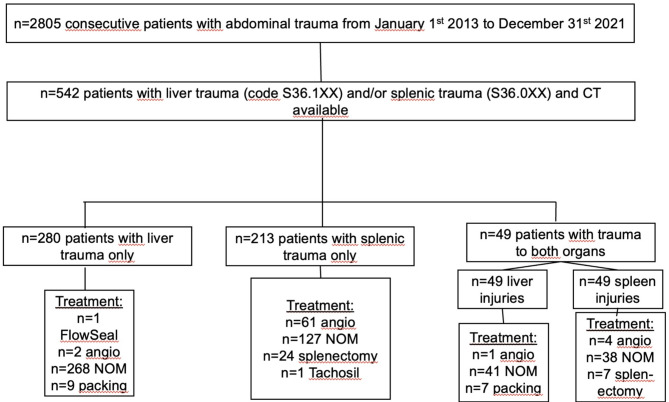
Our purpose was to assess the prevalence of liver injuries as well as concomitant injuries to the liver and spleen in patients with blunt or penetrating abdominal trauma, and to determine the prevalence, management and outcome of active bleeding and contained vascular injuries (CVI; pseudoaneurysm/AV-fistula) seen on admission CT. A retrospective, single-center, longitudinal cohort study with nine-year data (2013-2021) of all ≥ 15-year-old patients with severe blunt or penetrating abdominal trauma and an ICD code for liver and/or splenic trauma. CT examinations were identified. Radiology, medical reports and images were reviewed and only patients with an adequate admission CT were included in the final study group. Of 2805 patients with abdominal trauma (71% males), 409 patients (14.6%) had a liver injury, and 329 had a CT on admission (329/409; 80.4%). 313 patients (11.2%) had a splenic injury and 262 had a CT (262/313; 83.7%). Of these, 65 patients or 2.3% (65/2805) had injury to both organs, with 49 patients with CT (49/65; 75.4%), combined group (CG) (79% males). The median (range) ISS was 21 (4-75) for single organ injury patients and 34 (9-75) for patients with both organs injured (p < 0.0001). Active liver or splenic bleeding was seen in 5.8% and 17.9%, respectively. In CG, 11 (11/49; 22.4%) patients had active bleeding. Of these, two patients had active bleeing in both organs (4.1%). Liver patients with active bleeding had significantly higher ISS (p = 0.025) than those without. In CG, ISS did not differ significantly between patients with and without active bleeding (p = 0.073), however, it tended to be higher in those with active bleeding. Most liver injuries with active bleeding were treated non-operatively (12/19; 63.2%). An active bleeding was more common in spleen than in liver patients; odds ratio (OR) (95% CI) 3.57 (2.04-6.25), p < 0.0001. A CVI was more common in splenic compared with liver injuries, OR 6.71 (95% CI; 2.27-19.9, p < 0.0001). Active bleeding was more common in CG than in single organ injury patients; OR 3.67 (1.73-7.79), p < 0.0016. 30-day survival rate did not differ between patients with or without active bleeding, but was slightly lower in CG compared with only liver injury (89.8% vs. 93.7%, p = 0.36). In conclusion the prevalence of liver injury in abdominal trauma seen on admission CT was 11.7% of all patients with blunt or penetrating abdominal trauma, and concomitant splenic and liver injury was seen in 1.7%. Non-operative management was applied in almost two thirds of patients with liver injuries. Active bleeding was seen in 5.8% of liver, 17.9% of splenic and 22.4% of CG patients. ISS was doubled in CG compared with single organ injury patients. Active bleeding was more common in CG, and CG had slightly increased mortality rate compared with single organ injury patients.
https://cdn.ncbi.nlm.nih.gov/pmc/blobs/7df7/12331954/6a0385383828/41598_2025_14113_Fig3_HTML.jpg
https://cdn.ncbi.nlm.nih.gov/pmc/blobs/7df7/12331954/099516c6b982/41598_2025_14113_Fig1_HTML.jpg
https://cdn.ncbi.nlm.nih.gov/pmc/blobs/7df7/12331954/cd92f8403821/41598_2025_14113_Fig2_HTML.jpg
https://cdn.ncbi.nlm.nih.gov/pmc/blobs/7df7/12331954/6a0385383828/41598_2025_14113_Fig3_HTML.jpg
https://cdn.ncbi.nlm.nih.gov/pmc/blobs/7df7/12331954/099516c6b982/41598_2025_14113_Fig1_HTML.jpg
https://cdn.ncbi.nlm.nih.gov/pmc/blobs/7df7/12331954/cd92f8403821/41598_2025_14113_Fig2_HTML.jpg
https://cdn.ncbi.nlm.nih.gov/pmc/blobs/7df7/12331954/6a0385383828/41598_2025_14113_Fig3_HTML.jpg
摘要

我们的目的是评估钝性或穿透性腹部创伤患者肝脏损伤以及肝脏和脾脏合并损伤的发生率,并确定入院时CT所见活动性出血和局限性血管损伤(CVI;假性动脉瘤/动静脉瘘)的发生率、处理方法及预后。这是一项回顾性、单中心、纵向队列研究,纳入了2013年至2021年期间所有年龄≥15岁、患有严重钝性或穿透性腹部创伤且有肝脏和/或脾脏创伤ICD编码的患者。通过检索CT检查资料进行研究。回顾了放射学、医学报告及影像资料,最终研究组仅纳入入院时CT检查合格的患者。在2805例腹部创伤患者中(男性占71%),409例(14.6%)有肝脏损伤,其中329例入院时进行了CT检查(329/409;80.4%)。313例(11.2%)有脾脏损伤,262例进行了CT检查(262/313;83.7%)。其中,65例患者(2.3%,65/2805)两个器官均有损伤,49例进行了CT检查(49/65;75.4%),为联合损伤组(CG)(男性占79%)。单器官损伤患者的损伤严重度评分(ISS)中位数(范围)为21(4 - 75),两个器官均损伤患者的ISS中位数(范围)为34(9 - 75)(p < 0.0001)。肝脏或脾脏活动性出血的发生率分别为5.8%和17.9%。在联合损伤组中,11例(11/49;22.4%)患者有活动性出血。其中,2例患者两个器官均有活动性出血(4.1%)。有活动性出血的肝脏损伤患者的ISS显著高于无活动性出血者(p = 0.025)。在联合损伤组中,有活动性出血和无活动性出血患者的ISS差异无统计学意义(p = 0.073),但有活动性出血者的ISS有升高趋势。大多数有活动性出血的肝脏损伤采用非手术治疗(12/19;63.2%)。脾脏损伤患者中活动性出血比肝脏损伤患者更常见;优势比(OR)(95%置信区间)为3.57(2.04 - 6.25),p < 0.0001。与肝脏损伤相比,CVI在脾脏损伤中更常见,OR为6.71(95%置信区间;2.27 - 19.9,p < 0.0001)。联合损伤组中活动性出血比单器官损伤患者更常见;OR为3.67(1.73 - 7.79),p < 0.0016。有或无活动性出血患者的30天生存率无差异,但联合损伤组与仅肝脏损伤患者相比略低(89.8%对93.7%,p = 0.36)。总之,入院时CT所见腹部创伤患者中肝脏损伤的发生率为所有钝性或穿透性腹部创伤患者的11.7%;肝脏和脾脏合并损伤的发生率为1.7%。近三分之二的肝脏损伤患者采用非手术治疗。肝脏损伤患者中活动性出血的发生率为5.8%,脾脏损伤患者中为17.9%,联合损伤组中为22.4%。与单器官损伤患者相比,联合损伤组患者的ISS翻倍。联合损伤组中活动性出血更常见,且与单器官损伤患者相比,联合损伤组死亡率略有升高。

相似文献

1
Prevalence, characteristics and treatment of concomitant injury to liver and spleen with vascular injury after blunt abdominal trauma.钝性腹部创伤后肝脾伴血管损伤的发生率、特征及治疗
Sci Rep. 2025 Aug 7;15(1):28972. doi: 10.1038/s41598-025-14113-w.
2
Relevance of intra-abdominal pressure monitoring in non-operative management of patients with blunt liver and splenic injuries.腹内压监测在钝性肝脾损伤患者非手术治疗中的相关性
Chin J Traumatol. 2025 Jul;28(4):307-312. doi: 10.1016/j.cjtee.2024.02.006. Epub 2024 Oct 30.
3
The use and timing of angioembolization in pediatric blunt liver and spleen injury.小儿钝性肝脾损伤中血管栓塞术的应用及时机
J Trauma Acute Care Surg. 2024 Jun 1;96(6):915-920. doi: 10.1097/TA.0000000000004228. Epub 2024 Jan 9.
4
Emergency ultrasound-based algorithms for diagnosing blunt abdominal trauma.基于急诊超声的钝性腹部创伤诊断算法
Cochrane Database Syst Rev. 2015 Sep 14;2015(9):CD004446. doi: 10.1002/14651858.CD004446.pub4.
5
Clinical outcomes of non-operative management and clinical observation in non-angioembolised hepatic trauma: A systematic review of the literature.非血管栓塞性肝外伤非手术治疗和临床观察的临床结果:文献系统评价。
Chin J Traumatol. 2022 Sep;25(5):257-263. doi: 10.1016/j.cjtee.2022.04.004. Epub 2022 Apr 13.
6
Isolated free fluid on computed tomographic scan in blunt abdominal trauma: a systematic review of incidence and management.钝性腹部创伤计算机断层扫描中孤立的游离液体:发病率及处理的系统评价
J Trauma. 2002 Jul;53(1):79-85. doi: 10.1097/00005373-200207000-00016.
7
Interventional radiology in pediatric blunt liver and spleen injuries: A multicenter retrospective observational study.小儿钝性肝脾损伤的介入放射学:一项多中心回顾性观察研究。
J Trauma Acute Care Surg. 2025 Aug 1;99(2):233-242. doi: 10.1097/TA.0000000000004640. Epub 2025 May 1.
8
PECARN prediction rule for cervical spine imaging of children presenting to the emergency department with blunt trauma: a multicentre prospective observational study.PECARN 预测规则在儿童因钝器伤就诊于急诊时的颈椎成像:一项多中心前瞻性观察研究。
Lancet Child Adolesc Health. 2024 Jul;8(7):482-490. doi: 10.1016/S2352-4642(24)00104-4. Epub 2024 Jun 4.
9
Sertindole for schizophrenia.用于治疗精神分裂症的舍吲哚。
Cochrane Database Syst Rev. 2005 Jul 20;2005(3):CD001715. doi: 10.1002/14651858.CD001715.pub2.
10
Comparison of Two Modern Survival Prediction Tools, SORG-MLA and METSSS, in Patients With Symptomatic Long-bone Metastases Who Underwent Local Treatment With Surgery Followed by Radiotherapy and With Radiotherapy Alone.两种现代生存预测工具 SORG-MLA 和 METSSS 在接受手术联合放疗和单纯放疗治疗有症状长骨转移患者中的比较。
Clin Orthop Relat Res. 2024 Dec 1;482(12):2193-2208. doi: 10.1097/CORR.0000000000003185. Epub 2024 Jul 23.

本文引用的文献

1
Observation-first versus angioembolization-first approach in stable patients with blunt liver trauma: A WTA multicenter study.观察优先与血管栓塞优先策略在稳定型钝性肝外伤患者中的应用:一项 WTA 多中心研究。
J Trauma Acute Care Surg. 2024 Nov 1;97(5):764-769. doi: 10.1097/TA.0000000000004372. Epub 2024 May 27.
2
The prevalence of early contained vascular injury of spleen.脾脏早期被包裹性血管损伤的发生率。
Sci Rep. 2024 Apr 4;14(1):7917. doi: 10.1038/s41598-024-58626-2.
3
Evaluation of management of CT scan proved solid organ injury in blunt injury abdomen-a prospective study.
腹部钝性损伤中CT扫描证实的实性器官损伤的管理评估——一项前瞻性研究。
Eur J Trauma Emerg Surg. 2024 Dec;50(6):2753-2763. doi: 10.1007/s00068-024-02501-2. Epub 2024 Mar 21.
4
Predictive factors of mortality in damage control surgery for abdominal trauma.腹部创伤损伤控制外科中死亡率的预测因素。
Rev Col Bras Cir. 2022 Sep 2;49:e20223390. doi: 10.1590/0100-6991e-20223390-en. eCollection 2022.
5
Impact of AIS 2015 versus 1998 on injury severity scoring and mortality prediction - single centre retrospective comparison study.2015 年与 1998 年版 AIS 对创伤严重程度评分和死亡率预测的影响-单中心回顾性比较研究。
Am J Emerg Med. 2022 Oct;60:73-77. doi: 10.1016/j.ajem.2022.07.050. Epub 2022 Jul 25.
6
Changing from a two-tiered to a one-tiered trauma team activation protocol: a before-after observational cohort study investigating the clinical impact of undertriage.从双层创伤小组激活模式转变为单层创伤小组激活模式:一项观察性队列研究,调查分诊不足对临床的影响
Eur J Trauma Emerg Surg. 2022 Oct;48(5):3803-3811. doi: 10.1007/s00068-021-01696-y. Epub 2021 May 22.
7
Validation of the revised 2018 AAST-OIS classification and the CT severity index for prediction of operative management and survival in patients with blunt spleen and liver injuries.验证修订后的 2018AAST-OIS 分类和 CT 严重指数在预测钝性脾和肝损伤患者手术治疗和生存中的作用。
Eur Radiol. 2020 Dec;30(12):6570-6581. doi: 10.1007/s00330-020-07061-8. Epub 2020 Jul 21.
8
Liver trauma: WSES 2020 guidelines.肝脏创伤:WSES 2020 指南。
World J Emerg Surg. 2020 Mar 30;15(1):24. doi: 10.1186/s13017-020-00302-7.
9
Analysis of risk factors of mortality in abdominal trauma.腹部创伤死亡率的危险因素分析。
Ulus Travma Acil Cerrahi Derg. 2020 Jan;26(1):43-49. doi: 10.14744/tjtes.2019.12147.
10
The role of grade of injury in non-operative management of blunt hepatic and splenic trauma: Case series from a multicenter experience.损伤分级在钝性肝脾创伤非手术治疗中的作用:多中心经验的病例系列
Medicine (Baltimore). 2019 Aug;98(35):e16746. doi: 10.1097/MD.0000000000016746.