
生态相似性决定非本地鱼类的建立,而人类压力和本地生物多样性则塑造入侵丰富度。
Ecological similarity governs non-native fish establishment while human pressure and native diversity shape invasion richness.
作者信息
Xu Meng, Fang Miao, Usoof Anas M, Mandrak Nicholas E, Chu Cindy, Qian Hong, Cao Yong, Liu Chunlong, Cuthbert Ross N, Li Shao-Peng, Su Guohuan, Tedesco Pablo A, Dick Jaimie T A, Wei Hui, Yu Fandong, Shu Lu, Wang Xuejie, Mu Xidong, Gu Dangen
机构信息
Pearl River Fisheries Research Institute, Chinese Academy of Fishery Sciences, Guangzhou, China.
Key Laboratory of Prevention and Control for Aquatic Invasive Alien Species, Ministry of Agriculture and Rural Affairs, Guangzhou, China.
出版信息
Sci Adv. 2025 Aug 8;11(32):eadw4347. doi: 10.1126/sciadv.adw4347.
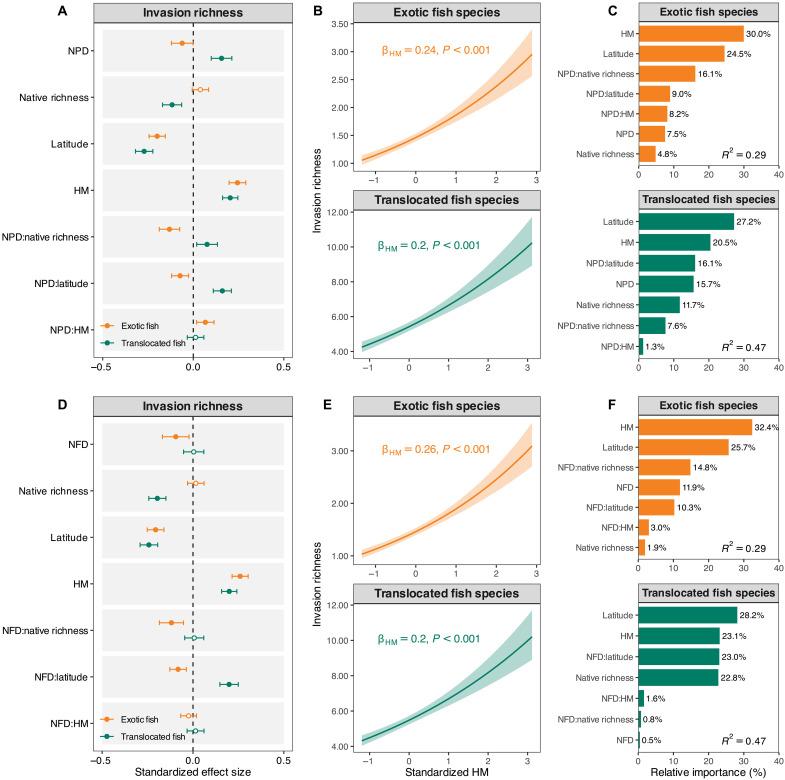
Biological invasions by non-native fish species pose a major threat to global freshwater ecosystems. However, our understanding of why invaders establish in some communities but not others (i.e., occurrence probability) and why some communities harbor more invaders than others (i.e., invasion richness) remains limited. Here, we combine species- and community-level analyses across taxonomic, phylogenetic, and functional dimensions to investigate both the occurrence probability and invasion richness of exotic and translocated fish species across nearly 3000 North American freshwater fish communities. We found that ecological similarity between non-native and native species primarily governed non-native fish establishment, with invaders more likely to succeed when closely related to native species. In contrast, invasion richness was largely promoted by human pressure, while native diversity reduced richness specifically for translocated species. Additionally, both the occurrence and richness of invaders increased toward lower latitudes. Together, these findings highlight the distinct yet complementary roles of environmental filtering, human activities, and biotic interactions in shaping freshwater fish invasions.
非本地鱼类物种的生物入侵对全球淡水生态系统构成了重大威胁。然而,我们对于为何入侵者能在某些群落中立足而在其他群落中不能(即出现概率),以及为何有些群落容纳的入侵者比其他群落更多(即入侵丰富度)的理解仍然有限。在此,我们结合分类学、系统发育学和功能维度上的物种及群落水平分析,以调查近3000个北美淡水鱼群落中外来和移植鱼类物种的出现概率及入侵丰富度。我们发现,非本地物种与本地物种之间的生态相似性主要决定了非本地鱼类的立足情况,当入侵者与本地物种亲缘关系相近时更有可能成功。相比之下,入侵丰富度在很大程度上受到人类压力的促进,而本地多样性则特别降低了移植物种的丰富度。此外,入侵者的出现和丰富度都朝着低纬度地区增加。这些发现共同凸显了环境过滤、人类活动和生物相互作用在塑造淡水鱼入侵过程中独特而互补的作用。


 Zotero 插件