Zhu Chuanhua, Li Hongwei, Zhang Lina, Liu Yonglu, Zhang Yangyang, Huang Binbin, Li Wei
Department of Rehabilitation, Binzhou Medical University Hospital, Binzhou, China.
School of Special Education and Rehabilitation, Department of Rehabilitation Medicine, Binzhou Medical University, Yantai, China.
Front Neurol. 2025 Jul 25;16:1590185. doi: 10.3389/fneur.2025.1590185. eCollection 2025.
To investigate the impact of animated video modeling (AVM) on the brain function of children with autism spectrum disorder (ASD) using functional near-infrared spectroscopy (fNIRS).
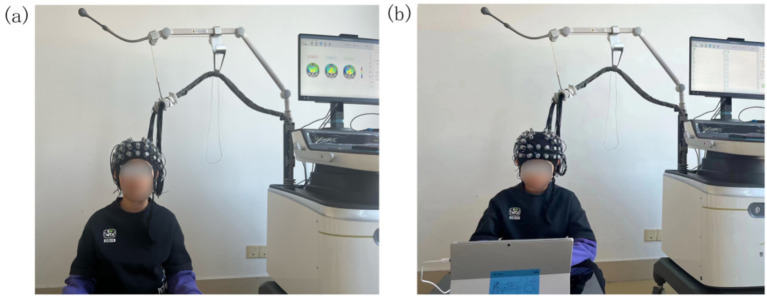
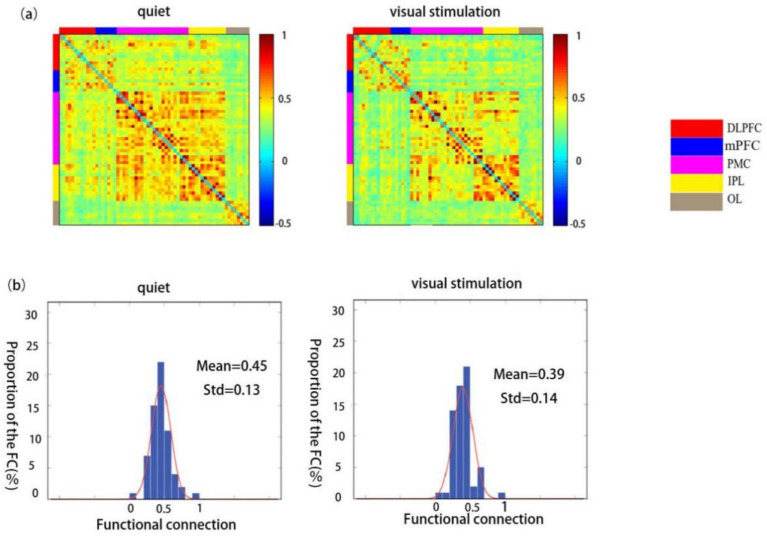
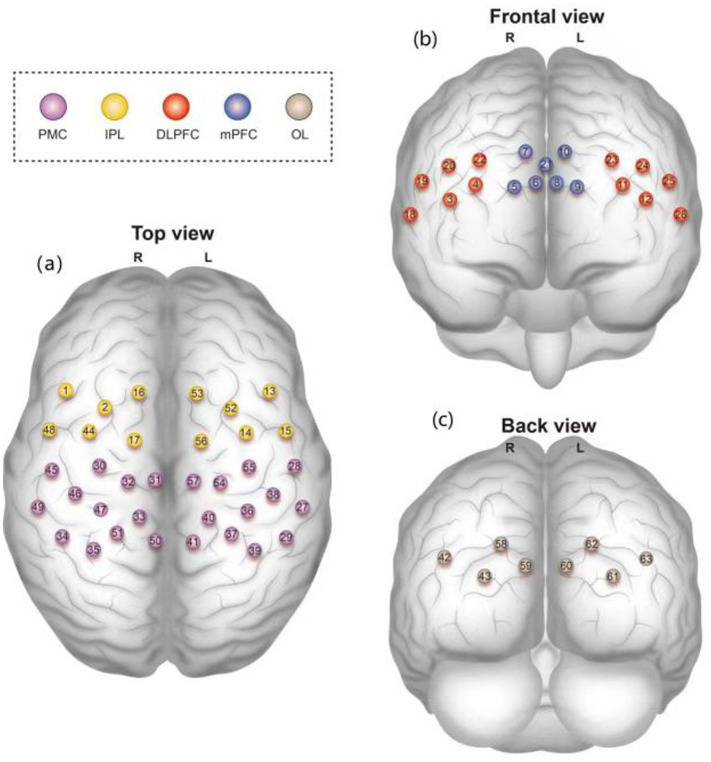
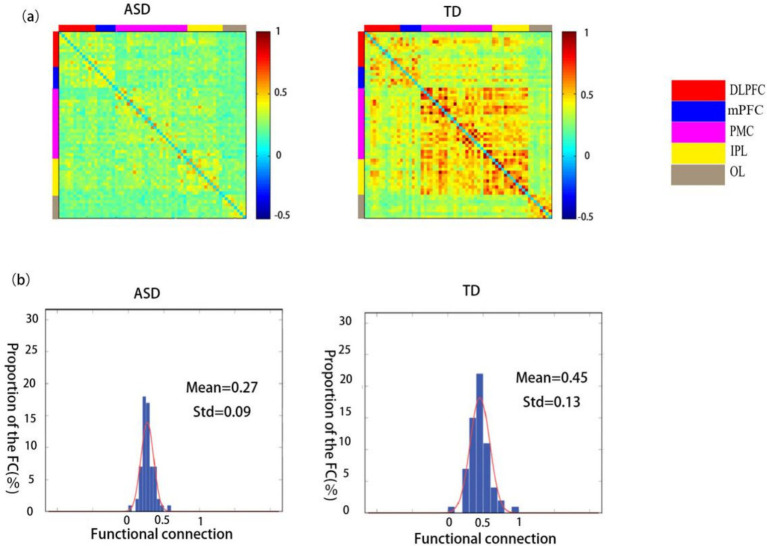
Fifteen children with ASD and 15 matched typically developing (TD) controls were enrolled. fNIRS was used to obtain 8-min data in quiet and visually stimulated states, with the dorsolateral prefrontal cortex, medial prefrontal cortex (mPFC), and bilateral occipital lobe as regions of interest (ROIs). Based on the concentration of oxygenated hemoglobin (HbO) over time, correlation coefficient analysis was performed to calculate functional connection strength, and the intergroup disparity was compared.
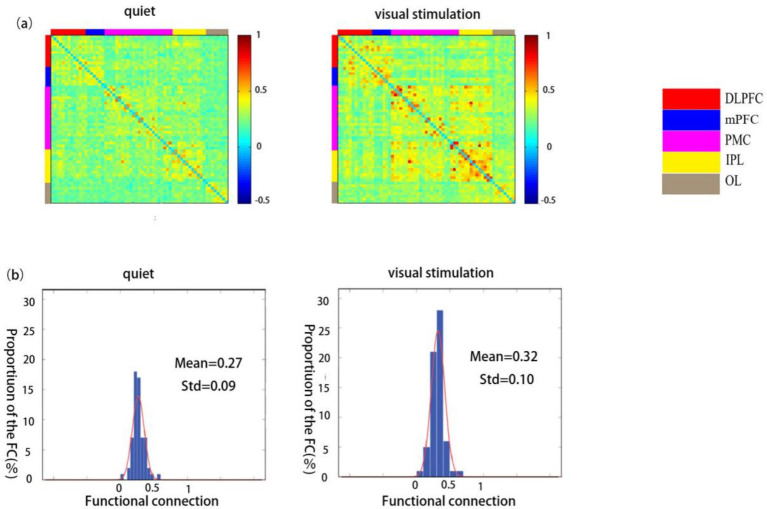
The ASD group showed significantly lower functional connection strength. Comparison of the ROI-ROI functional connectivity strength revealed significant differences in connectivity patterns of the right dorsolateral prefrontal lobe (RDLPFC), left dorsolateral prefrontal lobe (LDLPFC), mPFC, right occipital lobe (ROL), and left occipital lobe (LOL) with other brain regions. Extremely significant differences were found between the RDLPFC/RPMC, ROL/RPMC, LOL/RPMC, and LOL/LIPL. The functional connectivity strength of children with ASD was significantly higher during visual stimulation than during the quiet test. Comparison between the ROI-ROI functional connectivity strengths revealed significant differences in the connectivity strength of the RDLPFC/LOL, LDLPFC/LIPL, mPFC/RPMC, mPFC/LPMC, mPFC/LIPL, ROL/RPM, ROL. RIPL, ROL/LIPL, and LOL/LIPL. Extremely significant differences were observed between the ROL/RPMC and ROL/RIPL.
Animated video modeling can improve visual perception and information processing in children with ASD, by strengthening the functional connectivity between the occipital and inferior parietal cortices.
使用功能近红外光谱技术(fNIRS)研究动画视频建模(AVM)对自闭症谱系障碍(ASD)儿童脑功能的影响。
招募了15名患有ASD的儿童和15名匹配的发育正常(TD)对照儿童。使用fNIRS在安静和视觉刺激状态下获取8分钟的数据,将背外侧前额叶皮层、内侧前额叶皮层(mPFC)和双侧枕叶作为感兴趣区域(ROI)。基于随时间变化的氧合血红蛋白(HbO)浓度,进行相关系数分析以计算功能连接强度,并比较组间差异。
ASD组的功能连接强度明显较低。ROI-ROI功能连接强度的比较显示,右侧背外侧前额叶(RDLPFC)、左侧背外侧前额叶(LDLPFC)、mPFC、右侧枕叶(ROL)和左侧枕叶(LOL)与其他脑区的连接模式存在显著差异。在RDLPFC/RPMC、ROL/RPMC、LOL/RPMC和LOL/LIPL之间发现了极其显著的差异。ASD儿童在视觉刺激期间的功能连接强度明显高于安静测试期间。ROI-ROI功能连接强度的比较显示,RDLPFC/LOL、LDLPFC/LIPL、mPFC/RPMC、mPFC/LPMC、mPFC/LIPL、ROL/RPM、ROL.RIPL、ROL/LIPL和LOL/LIPL的连接强度存在显著差异。在ROL/RPMC和ROL/RIPL之间观察到极其显著的差异。
动画视频建模可以通过加强枕叶和顶下小叶皮层之间的功能连接,改善ASD儿童的视觉感知和信息处理能力。